
Archaeological Museum of Olympia
When excavators began digging in the sacred precinct of Altis in the nineteenth century, they quickly realized they had a problem of abundance. The earth around Olympia was yielding bronze and marble faster than anyone could catalog it. The solution came in 1888: a neoclassical building on the hill of Drouva, funded by the Athenian banker Andreas Syggros and designed by two German architect-archaeologists who were already working the site, Wilhelm Dorpfeld and Friedrich Adler. It was the first museum built in Greece outside of Athens. More than a century later, what it houses still stops visitors cold.
The Hermes Room
The most debated object in the museum stands in its own space: the Hermes and the Infant Dionysus, a marble statue attributed — with some scholarly dispute — to Praxiteles, the fourth-century BC Athenian sculptor considered one of the greatest of antiquity. The figure of Hermes leans against a tree trunk, his weight shifted onto one hip in the S-curve pose called contrapposto, the infant Dionysus cradled in his left arm. The right arm, now missing, was extended, and scholars believe it once dangled a bunch of grapes to distract the infant god. The surface of the marble retains traces of the original finish, giving the skin an almost organic quality that has fascinated viewers since the statue was unearthed in 1877 in the Temple of Hera. Whether it is an original Praxiteles or a later copy remains genuinely uncertain — the debate has continued for over a century. Standing before it, the argument feels academic.
Victory in Stone and Bronze
The Nike of Paionios occupies another iconic place in the collection. Carved by the sculptor Paionios of Mende and originally mounted on a tall triangular pillar before the Temple of Zeus, the figure of the goddess of victory descends as if landing — her drapery swept back as though still in motion, her wings spread behind her. The dynamic energy of the sculpture is remarkable for its date, around 421 BC. Bronze is equally well represented here. The museum's bronze collection is among the most significant in the world: griffin heads, tripods, armor, figurines, votive offerings accumulated over centuries of athletic and religious ceremony. The Helmet of Miltiades, the Athenian general who commanded at the Battle of Marathon in 490 BC, is here — a real helmet from a real battle, dedicated at Olympia with an inscription naming its donor. It is a direct physical connection to one of the most consequential days in Greek history.
The Gods Above the Temple
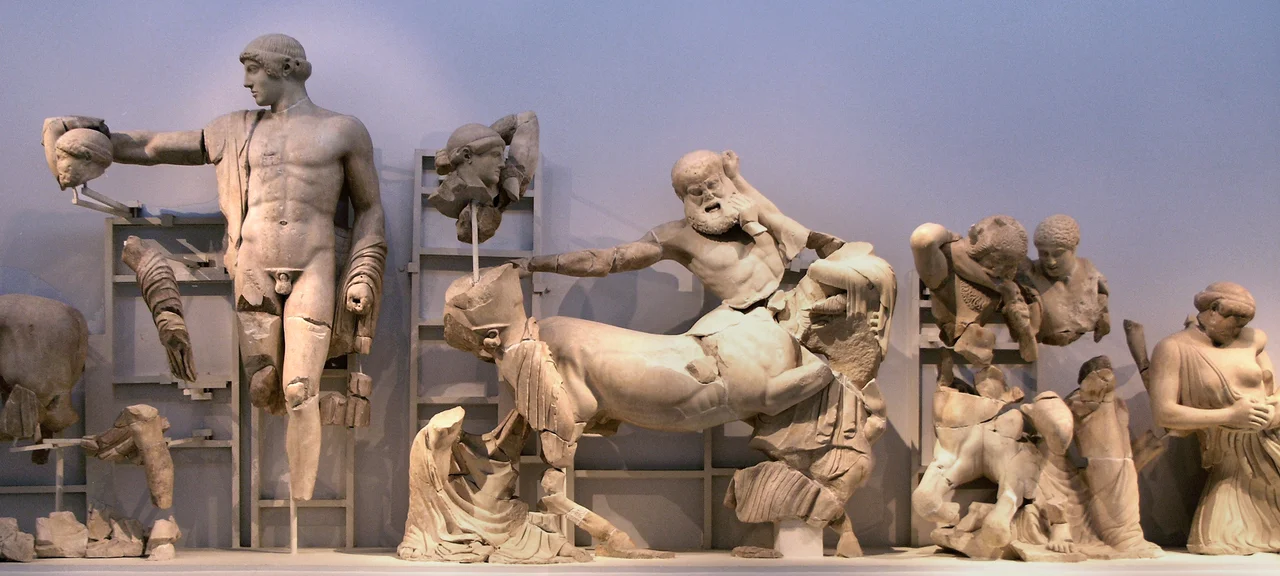
The pediment sculptures from the Temple of Zeus fill an entire gallery and form one of the great achievements of fifth-century BC Greek art. The east pediment depicted the moment before the chariot race between Pelops and Oinomaus — Zeus standing at the center, flanked by the two competitors with their horses and chariots, the figures arranged in a tense, waiting stillness that perfectly captures the instant before catastrophe and transformation. The west pediment showed the battle between the Lapiths and the centaurs at the wedding of Pirithoos — chaos, struggle, and the commanding figure of Apollo at the center, one arm extended, imposing order. The twelve metopes above the temple's porches depicted the Labors of Heracles. Seeing these sculptures in the museum, having been rescued from the ruins of the temple and reconstructed, is to understand what the sanctuary of Olympia was trying to say about divine authority and human striving.
A Building With Its Own History
The original 1888 museum building had a complicated afterlife. An earthquake damaged it in 1954, and it eventually proved too small for the growing collection. Plans for a new museum were developed in the 1970s, and the current building — larger, purpose-built — opened to house the permanent collection. The original Syggros building, after a period of disuse, was repurposed in 2004 as a museum dedicated to the history of the ancient Olympic Games. Between 1930 and 1936, a cast bronze griffin's head disappeared from the collection; it was eventually repatriated to Greece by the Metropolitan Museum of Art in 2025. The museum also played an unexpected role in recent Olympic history: the lighting ceremony for the 2026 Winter Olympics torch relay took place inside the museum on 26 November 2025, after poor weather forecasts prevented the traditional outdoor ceremony at the ancient stadium. The flame, lit by the sun's rays during rehearsals and transferred in a safety lamp, burned within the museum until the public ceremony began.
From the Air
The Archaeological Museum of Olympia is located at approximately 37.64°N, 21.63°E, immediately north of the ancient sanctuary of Olympia in the valley of the Alpheus River. From the air at 3,000–5,000 feet, the Alpheus River valley is clearly visible, with the ancient precinct and the museum buildings clustered together just north of the river. The Kronos Hill rises to the north of the sanctuary and provides a useful visual landmark. The nearest major airport is LGRX (Araxos), approximately 55 kilometers to the northwest. Approach from the northwest following the Alpheus River valley eastward; the site of ancient Olympia, with its distinctive wooded sacred precinct, appears on the south bank. Good visibility is generally available in this inland valley location.
Nearby Stories
- Santameri Castle 4.6 km away
- Aristarchos 2.3 m Telescope 4.8 km away
- Lepreum 9.1 km away
- Arcadia (region) 13 km away
- Peloponnese 14 km away
- St. Mark's Roman Catholic Church 20 km away
- Strofades 22 km away
- County Palatine of Cephalonia and Zakynthos 39 km away