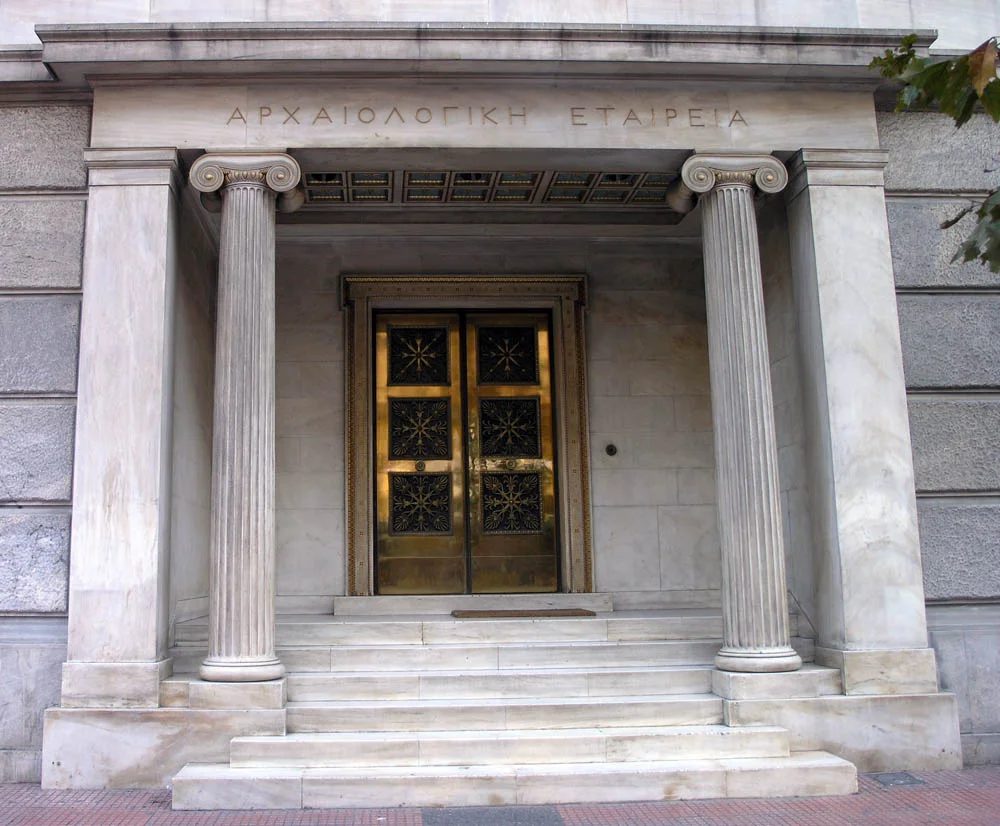

Archaeological Society of Athens
Greece was barely a country when a wealthy merchant decided someone had to save its past. The modern Greek state was only a few years old, its monuments scarred by war and centuries of neglect, when Konstantinos Bellios put his fortune behind an idea: a private society devoted to digging up, protecting, and displaying the antiquities of the new nation. In 1837, working with Kyriakos Pittakis, the head of the country's fledgling archaeological service, he founded the Archaeological Society of Athens. It still exists today, and the trail of its excavations runs through nearly every famous site in Greece.
A Patron and a Purpose
Bellios was an unlikely guardian of Greek heritage. An Aromanian from the Kastoria region, he made his name in commerce and finance before the founding of the Kingdom of Greece turned him toward philanthropy. A scholar and a nationalist, he poured money into the reconstruction of a country rebuilding itself from the ground up, and the Archaeological Society was among his lasting gifts. The society's mission was practical and urgent: encourage excavations, care for what was found, and put the antiquities on public display. In a young state with little money and enormous archaeological wealth lying half-buried, an independent body that could accept donations and organize digging filled a gap the government could not yet cover on its own.
The Diggers
The society's history is really the history of the people who served it. From 1859 to 1894, the scholar and epigraphist Stefanos Koumanoudis ran it as secretary and launched excavations across the Athenian landscape, the Kerameikos cemetery, the Acropolis, the Theatre of Dionysus, and reaching out into Attica at Eleusis and Marathon, into Boeotia, the Peloponnese, and the Cyclades. Christos Tsountas, an ephor of antiquities for the society, became one of the great names of prehistoric archaeology. The roster reads like a directory of Greek scholarship: Panagiotis Kavvadias, general inspector of antiquities and professor at the university; Valerios Stais, who in the 1890s explored the prehistoric settlement of Thorikos with the society's funding, mapping tholos tombs and the layered occupation of Velatouri Hill. Their fieldwork laid foundations that scholars are still building on more than a century later.
A Woman in the Field
Among the society's notable members was Semni Karouzou, born in Tripoli and educated at the University of Athens, a classical archaeologist who specialized in ancient Greek ceramics. She served as a vice president of the society in the mid-1970s, but her significance reaches further: she was the first woman to join the Greek Archaeological Service, breaking into a field that had been closed to women, and went on to excavate in Crete, Euboea, and Thessaly. She also helped curate the National Archaeological Museum of Athens, the great repository of Greek antiquity that the society itself had helped bring into being. Her career marks the moment the discipline she loved began, slowly, to make room for the people it had long excluded.
Knowledge That Compounds
The society never stopped at lifting objects from the ground. It published, and it published systematically, in journals like the Praktika and the Archaiologike Ephemeris, building an archive that turned isolated finds into a connected record. That patient documentation is its quiet legacy. At Eleusis, the society's 19th and early 20th century excavations gave later scholars the raw material to reconstruct the sanctuary of Demeter and the secretive Eleusinian Mysteries; the historian Kevin Clinton spent decades from 1966 onward transcribing the site's inscriptions, and Michael Cosmopoulos drew on the society's old work to reassess the Bronze Age settlement beneath. At Thorikos, Stais's reports let a later generation trace the site's trade connections across the Aegean. Funded today by foundations and the Greek state alike, the society proves a simple truth about archaeology: a careful excavation is a gift not only to its own age but to every scholar who comes after.
From the Air
The Archaeological Society of Athens is headquartered in central Athens near 37.9787 N, 23.7347 E, a short walk from the National Archaeological Museum it helped found. This is an institution rather than a single visible landmark; from the air the dense neoclassical core of central Athens surrounds it, with the Acropolis to the southwest and Lycabettus Hill to the northeast as the clearest visual references. Nearest airport is Athens International (LGAV), roughly 32 km east-southeast. Expect busy controlled airspace and summer haze over the capital.
Nearby Stories
- Great Sand Beach 5 km away
- Battle of Delium 7.7 km away
- Tower of Aliartos 9 km away
- HMHS Britannic 10 km away
- Saronic Gulf 15 km away
- Sousaki Volcano 17 km away
- Sanctuary of Apollo Maleatas 24 km away
- Skyros 66 km away