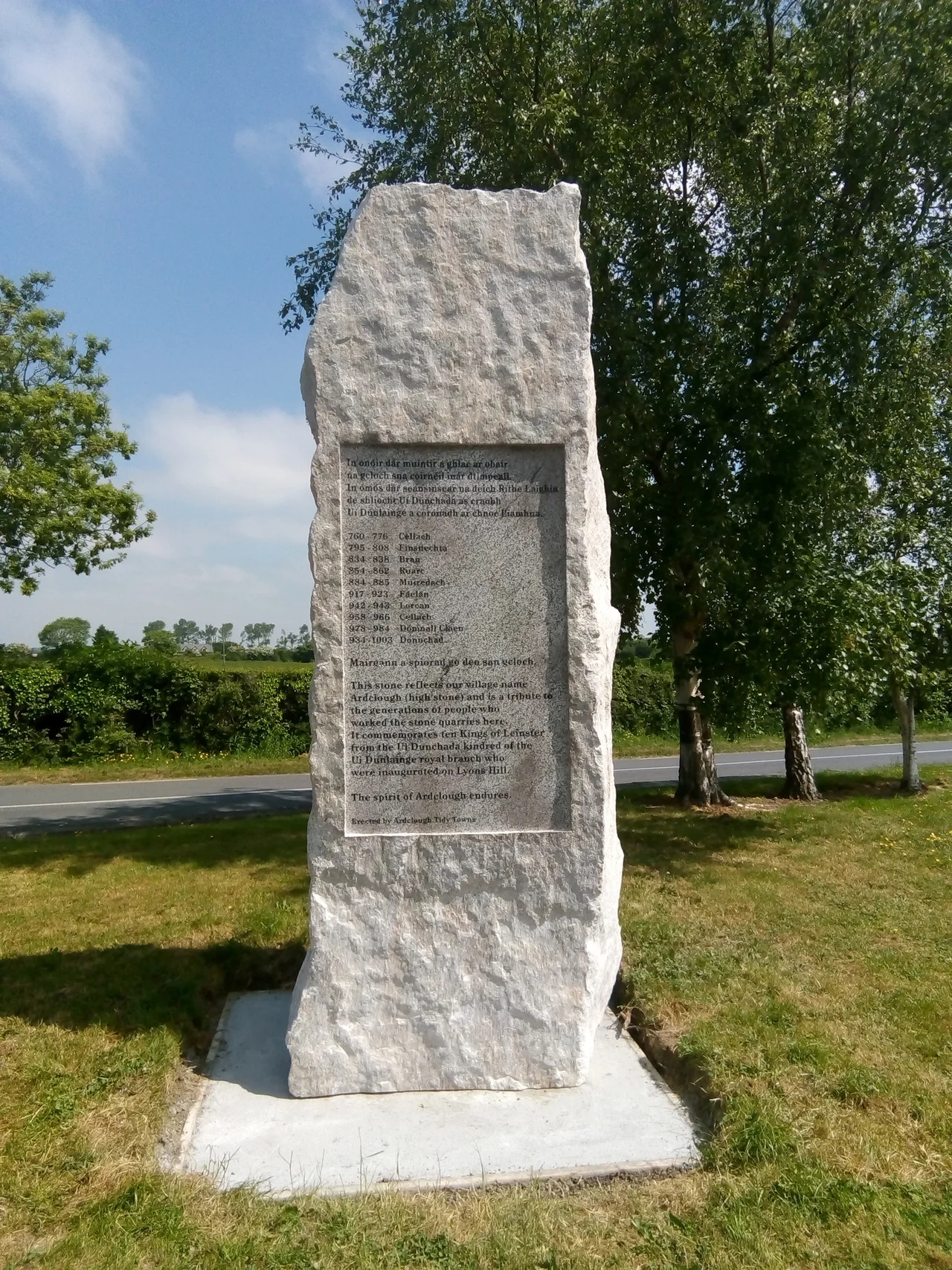

Ardclough
Arthur Guinness, the founder of the famous brewery, is buried in Oughterard cemetery just outside the village. The graveyard sits on a low hill that was the inauguration site for ten kings of Leinster of the Ui Dunchada dynasty, and the seventh-century monastery that once crowned the hill was associated with two female Irish saints, Briga and Derchairthinn. Ardclough is the kind of small Kildare village where you keep finding much bigger histories tucked into the hedgerows. Tradition holds that Guinness's mother returned to the Read family homestead at Bishopscourt to give birth - a custom of the time - which would make Ardclough his birthplace as well as his burial place.
The Brewer's Country
Ardclough is officially Ardclogh, in the parish of Kill in County Kildare, two miles off the N7 national primary road. The River Liffey passes within a kilometre. The village lies below two detached foothills of the Wicklow Mountains - Lyons Hill and Oughterard - on some of the most fertile soils in Ireland. Arthur Guinness was born in 1725 to Richard Guinness and Elizabeth Read, who came from Bishopscourt townland just up the road. Elizabeth's family - the Reads - were the agents and receivers for Dr Arthur Price, the Archbishop of Cashel, and lived in Celbridge at the time of Arthur's birth. The brewer's connection to Ardclough has produced a quiet cottage industry of pilgrim visits to Oughterard cemetery, where his grave sits among others from a community that has been burying its people on this hill for over a thousand years.
Granite for Nelson's Pillar
When the Grand Canal began construction in 1756, Ardclough was one of the first sections to be dug. The canal reached the village in 1763 with the opening of the 13th lock - a 137-foot double lock built with Pozzolana mortar to the ambitious design of the canal's original engineer Thomas Omer. The width of the canal through the 13th lock is twenty feet, four feet wider than the rest of the system - a fossil of Omer's plans, before a successor engineer, John Trail, reduced the design to handle smaller barges. Local limestone from Patrick Sullivan's quarries powered the village's 19th-century economy. Stone from the freestone quarry on Golden Hill above the village was used to build Nelson's Pillar in Dublin, the General Post Office on O'Connell Street, the Custom House, and the Four Courts. Stone from Ballyknockan quarry to the south built the Bank of Ireland and the Liverpool Cathedral. When Patrick Sullivan died in 1879, the Ardclough quarries fell quiet. The village population, which had been seventy-five in the 1850s, collapsed to twenty-one by 1891 and just six by 1901. Industries vanish the way they came.
The Fog of October 1853
On 5 October 1853, a heavy fog hung over the Great Southern and Western Railway line near Straffan station. A goods train ran into the back of a stalled passenger train at a point 974 yards south of the station. The collision was so violent that the goods train smashed through the first-class carriage and drove it a quarter of a mile down the track. Eighteen people died, including four children. It was the third-worst rail accident in Irish history at the time. The Donegal poet William Allingham wrote a poem about it. The tragedy is one of those nineteenth-century railway accidents that read now like a warning about how fragile the new technologies were - fog, mass, momentum, and no signalling beyond the human eye. On 22 June 1975, more than a hundred years later, a Whitechurch resident named Christy Phelan was killed near Baronrath when he engaged a group of men planting a bomb on the railway line. The bomb was intended to derail a train carrying participants to a Republican commemoration at Bodenstown. Phelan's intervention prevented greater loss of life.
Boyzone, Ryanair, and the Civil War
Ronan Keating - the lead singer of Boyzone - grew up in Ardclough. So did Charlie McCreevy, who served as Ireland's Minister for Finance from 1997 to 2004 and then as European Commissioner for the Internal Market until 2010; he was raised in the lock house at the 14th lock and played underage hurling for Ardclough. Tony Ryan, the aviator who founded Ryanair and Guinness Peat Aviation, bought a home at Lyons before his death in 2007. The Barnewell homestead at Lyons was the headquarters of anti-treaty forces in north Kildare during the Irish Civil War. In October 1917, the headmistress of Ardclough National School, Nora J Murray, was accused by a local Irish Unionist of 'sedition in time of war' under the Defence of the Realm Act for teaching Irish history. The local community mounted a defence fund. The charges were dropped, but Murray was forced out, and the house where she lodged was later burned by the British Army. Lydia Shackleton - botanical artist, second cousin of Antarctic explorer Ernest Shackleton - lived here between 1853 and 1860 when she was housekeeper for her brother at the family's newly acquired mill at Lyons. Ardclough GAA hurling club has won thirteen Kildare County Senior Hurling Championships, most recently in 2017. Smaller villages remember bigger battles.
From the Air
Ardclough sits at 53.17N, 6.34W, two miles off the N7 between Naas and Dublin. Cruise 2,000-3,000 ft to take in the Grand Canal running northwest-southeast, Lyons Hill and Oughterard immediately to the east, and the Wicklow Mountains rising beyond. The Liffey valley lies just to the south. Nearest international airport is Dublin (EIDW), about 25 km northeast. Casement Aerodrome (EIME) is closer to the northeast.
Nearby Stories
- Monasterevin 4.4 km away
- Edward Pakenham 11 km away
- Templemore 13 km away
- Dunsany Castle and Demesne 13 km away
- Wicklow Gold Rush 18 km away
- German submarine U-1051 46 km away
- HMS Tyler 48 km away
- HMS Manners (K568) 66 km away