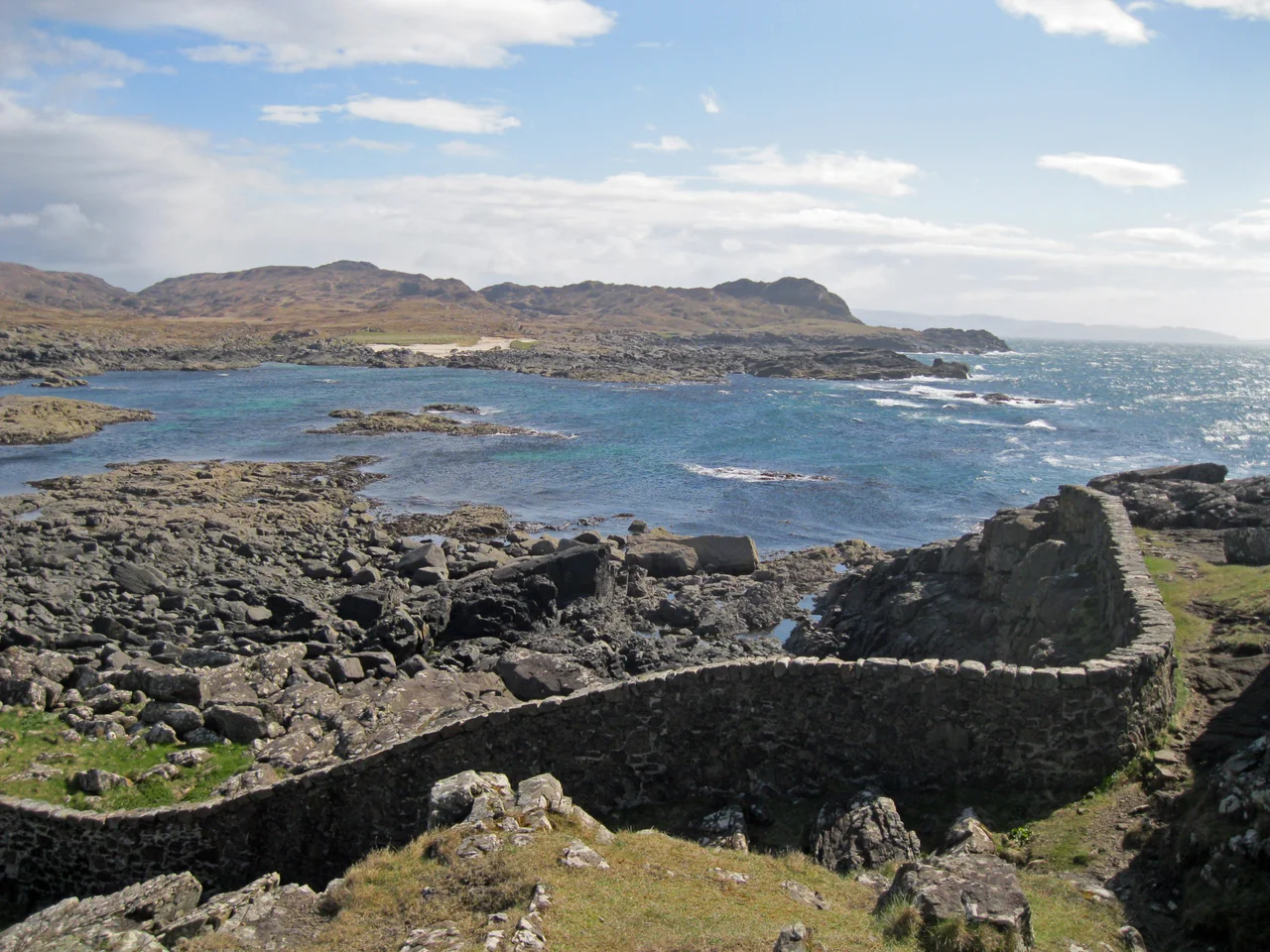

Ardnamurchan Lighthouse
Alan Stevenson, asked to build a lighthouse on the most westerly point of mainland Britain, decided to make it look Egyptian. Not Egyptian-revival like a country house folly, but seriously Egyptian: an oversized tapering shaft of pink granite, with detailing inspired by pylon temples on the Nile. It was 1849, the year Britain was sending exploratory missions up the Nile and bringing back drawings of monuments. Stevenson, the eldest son of Robert Stevenson and the uncle of Robert Louis Stevenson, took the influence literally. The result, completed that same year, remains the only Egyptian-style lighthouse in the United Kingdom.
Pink Granite from the Sea
The tower stands 36 metres tall, made entirely of pink granite shipped to the site by sea - because in 1849 there was no other practical way to bring building stone to a point this remote. The peninsula's only road approach was, and remains, a single-track ribbon of tarmac that winds for hours through Sunart and the western reaches of Lochaber. Stevenson's design choice has been debated for nearly two centuries. Some historians attribute the Egyptian motifs to the fashion of the day, when Egyptomania still rippled through British design half a century after Napoleon's Egyptian campaign and the publication of the Description de l'Égypte. Others point to a more practical motive: the tapering Egyptian form gave the tower exceptional structural stability against the Atlantic gales that hit Ardnamurchan Point with nothing to slow them between here and Newfoundland.
The Kingdom of Light
Mains electricity reached the lighthouse in 1976, and the light was fully automated in 1988. From then on, the keepers were gone. The Northern Lighthouse Board now monitors the light remotely from Edinburgh, and the keepers' cottages have been converted into a visitor centre. The exhibition is called Rioghachd na Sorcha - the Kingdom of Light - and it occupies the restored engine room and workshop. Visitors can see the original fog horn (a brass-and-iron contraption that once roared warnings across the Sound), explore the geology and natural history of the surrounding cliffs, and climb the tower itself for the view: due west across nothing but ocean to the Outer Hebrides, the Small Isles ranged across the northwest, and the long blue ridge of Mull's mountains to the south.
Sherlock Holmes and Top Gear
The lighthouse has had two strange brushes with popular culture. The final chapter of the computer game Sherlock Holmes: The Awakened, released in 2007, takes place inside the tower - a remote, fog-bound setting chosen by the Ukrainian studio Frogwares precisely because Ardnamurchan looks like the edge of the world. In 2021 the BBC motoring programme Top Gear arrived for an episode in which three presenters raced three off-road vehicles - a Land Rover Defender, an Ariel Nomad, and a Mercedes-AMG G63 - to deliver a new light bulb to the lighthouse and then fit it themselves. The sequence captured something true about the building: it remains genuinely difficult to reach, despite being on the British mainland. To get a light bulb here, you really do need a Land Rover, several hours, and the patience to drive single-track roads that have not changed much since Stevenson's masons arrived by boat.
From the Air
Located at 56.73N, 6.23W at Ardnamurchan Point on the western tip of the Ardnamurchan peninsula - the most westerly point of mainland Great Britain. Nearest airport: Oban (EGEO), about 32 nm south-southeast. Tobermory on Mull lies about 7 nm south across the entrance to the Sound of Mull. Recommended viewing altitude 1,500-3,000 ft for the dramatic cliff approach. The 36 m pink granite tower is unmistakable from the air, especially against the dark basalt of the surrounding headland.
Nearby Stories
- Strontian 3.6 km away
- Gylen Castle 6.7 km away
- Kinloch Castle 10 km away
- Carsaig Arches 16 km away
- Tiree 24 km away
- German submarine U-722 26 km away
- Dun Telve 27 km away
- Skerryvore 29 km away