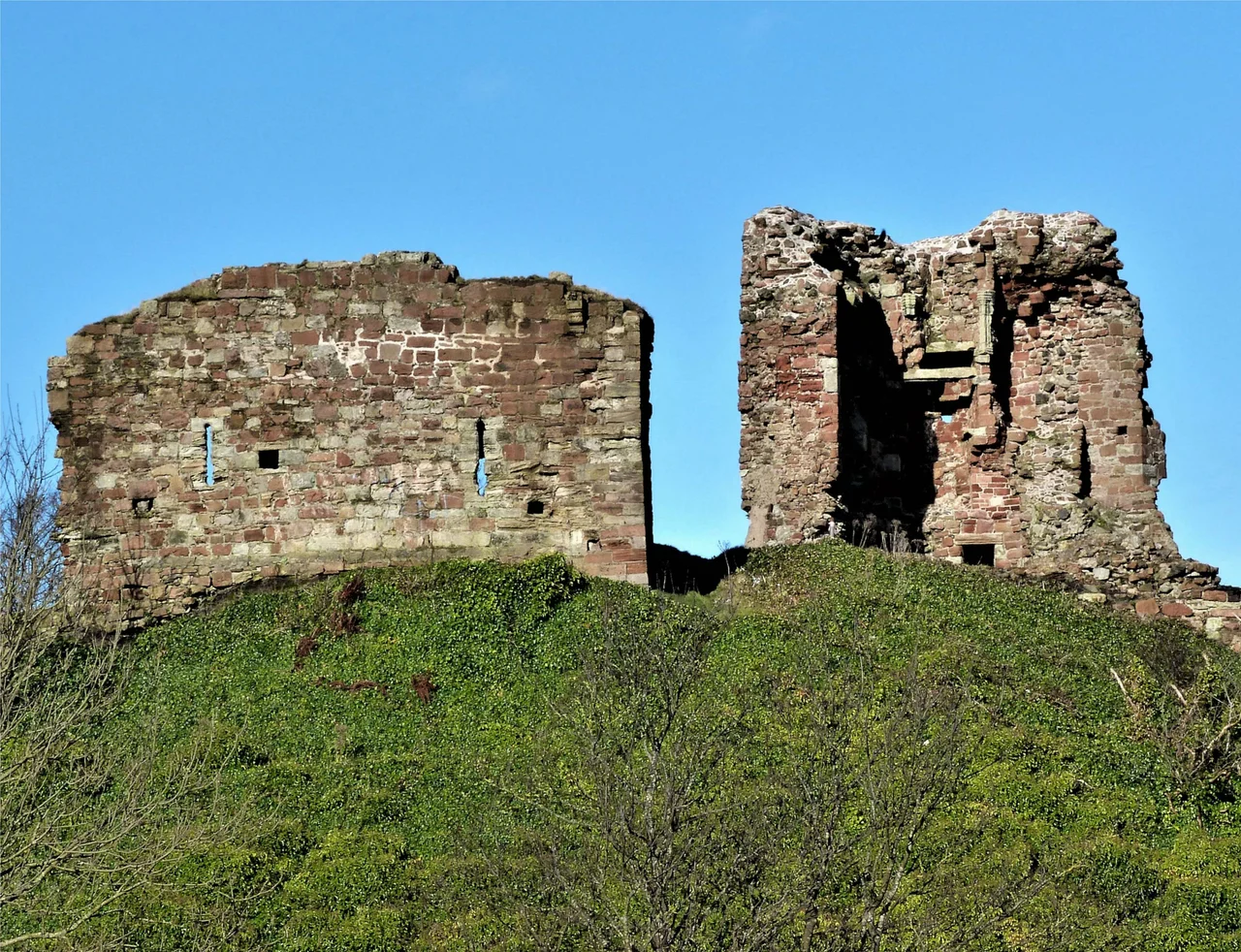

Ardrossan Castle
They still call the vaults Wallace's Larder. The name comes from a brutal night during the Wars of Scottish Independence, when the English garrison holding Ardrossan Castle was slaughtered and their bodies stacked, by tradition, in the cellars below. Whether William Wallace himself was there, history is reluctant to say outright - but the name stuck for seven centuries, and on stormy nights, the villagers will tell you, the great Scottish patriot's ghost is said to wander the ruins above the Firth of Clyde. The castle stands on a ridge above the modern town of Ardrossan, defended once by a moat, its keep now broken to the corbels of its parapet and silent against the Ayrshire sky.
The Hill That Gave the Town Its Name
Ardrossan sits on a rocky hill, and the hill gave the place its name - *ard*, meaning height, and *rossan*, a rocky promontory. The present ruins stand on the footprint of an earlier castle owned by the Barclay family, but by the thirteenth century the property had passed to the Ardrossan family themselves. The site has long been a marker of regional identity: an 1847 tour book called *Sylvan's Pictorial Handbook to the Clyde and its Watering-Places* describes the castle as already ruined, set above an old churchyard, offering beautiful views of the ocean. According to the Gilks brothers who wrote it, the town was originally called Castle Crags before taking the Ardrossan name from the family who held it. By then the castle belonged to the Earls of Eglinton, and would remain a curiosity rather than a stronghold.
Cromwell Takes the Stones
The end came in 1648, when Oliver Cromwell's troops destroyed the castle and carried much of its stone south to Ayr. There they used it to help build the Ayr Citadel - a Burgh of Regality known as Montgomerieston, a fortification meant to anchor Cromwellian control over the western Lowlands. Records from 1617 had shown that the Earls of Eglinton were still patching the castle then, with accounts noting "seventeen feet of rigging-stone" worked by a stonemason for repairs. Three decades later, those careful repairs were rendered pointless. What survives today is a fragment - part of the fifteenth-century keep that the Montgomeries built after the earlier structure was damaged in the Wars of Independence, a vaulted range containing a kitchen and cellars, and a deep passageway with a well at the bottom. The whole site is a Scheduled Monument now, the ruins fenced off because they are in hazardous condition.
Sir Fergus and the Devil
The castle has another legend, older and stranger than the patriot's ghost. Sir Fergus Barclay, the "De'il of Ardrossan," was famous around Ayrshire for his horsemanship. The secret of his skill, the story goes, was a magical bridle given to him by the Devil himself - in exchange, of course, for Sir Fergus's soul. But Barclay was a sly man. He tricked the Devil into giving the soul back, and the Devil, furious at having been outwitted by a Scottish knight, attacked the castle in his rage. He is said to have left his hoof prints in one of the rocks below the keep, a petrosomatoglyph marker still pointed out to those who care to look. Sir Fergus, having retained both his bridle and his soul, was buried in the castle chapel a few hundred yards inland, further down the hill. Like most stories worth telling, this one cannot be verified - but the rock with the hoof prints is real, and the chapel foundations are still there.
What Remains, and What Endures
Standing on the hill today, the visitor sees fragments: a corner of the keep, the broken vaults of Wallace's Larder, the rough stone passageway leading down to the well. The town has grown up around the foot of the hill, the ferry to Brodick on Arran leaves from the harbour below, and trains run on the Ayrshire Coast Line through the streets where the medieval burgh once stood. The castle itself is not maintained as a visitor attraction - the structure is too fragile, the dangers too real. But the ridge is still climbable, the views are still beautiful, and the place still keeps its names. Wallace's Larder. The De'il's hoof prints. The ghost on stormy nights. In a country full of ruined castles, Ardrossan holds its share of stories - and refuses to forget any of them.
From the Air
Coordinates 55.6419°N, 4.8101°W. Ardrossan Castle sits on a low ridge above the harbour town of Ardrossan on the North Ayrshire coast, with the Firth of Clyde and the Isle of Arran prominent to the west. Recommended viewing altitude 1,500 to 2,500 feet AGL to make out the castle hill, the harbour, and the regular CalMac ferry route to Brodick. Nearest ICAO airports: Glasgow Prestwick (EGPK) about 13 nm to the south-east, Glasgow International (EGPF) about 25 nm north-east. Expect Atlantic weather - low cloud and showers can blow in fast off the Clyde estuary, particularly on a westerly wind.
Nearby Stories
- Battle of Drumclog 2.2 km away
- Culzean Castle 3.3 km away
- Greenock 5.9 km away
- Lochranza 7.9 km away
- Battle of Kilsyth 16 km away
- Loch Fyne 19 km away
- Dunaverty Castle 25 km away
- Moniaive 27 km away