.png)
Argentine Confederation
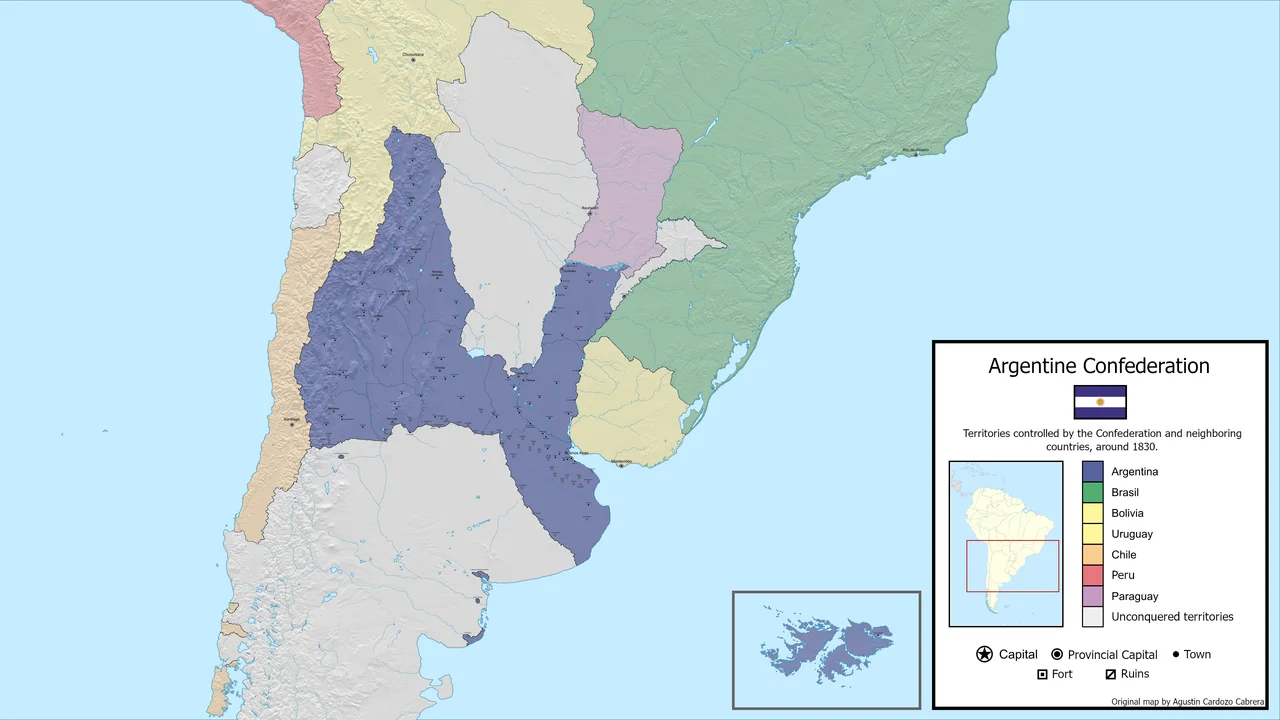
Open the Constitution of Argentina to Article 35 and you will find a list of the country's official names. One of them is the Argentine Confederation, the title under which much of nineteenth-century Argentina conducted its affairs. It is not a museum piece; it is a legal name the republic still answers to. Between 1831 and 1861 this was simply what the country was called, a loose league of provinces with no president, governed in foreign matters by whoever held Buenos Aires. The story of how that confederation rose, split, and finally fused into modern Argentina is the story of how a nation argued itself into existence, and for a crucial stretch of it the seat of power sat not in Buenos Aires at all, but on the high bank of the Paraná River in the city of Paraná.
Federalists and Unitarians
After winning independence from Spain, the provinces of the old Viceroyalty of the Río de la Plata fell into a long quarrel over a single question: who should govern, and from where. Unitarians wanted a strong central state run from Buenos Aires; federalists wanted the provinces to keep their autonomy. In 1828 the Unitarian Juan Lavalle overthrew and executed the federalist governor Manuel Dorrego, igniting civil war. The rancher Juan Manuel de Rosas organized the federalist resistance, allied with the Santa Fe caudillo Estanislao López, and defeated Lavalle. In 1831 the provinces of Buenos Aires, Entre Ríos, and Santa Fe signed the Federal Pact; defeated provinces joined one by one, and together they became the Argentine Confederation.
The Chains Across the River
Rosas governed without the title of head of state, yet for two decades he dominated the confederation, handling its wars with Bolivia, Brazil, Uruguay, France, and Britain. The most storied of these came in 1845, when an Anglo-French fleet tried to force its way up the Paraná to trade directly with the upriver provinces, bypassing Buenos Aires entirely. At a sharp bend called Vuelta de Obligado, General Lucio Mansilla strung three massive iron chains across the river on twenty-four boats and lined the bank with cannon. The Argentines lost the battle on November 20, but the European fleet was so battered, and the campaign so costly, that the powers eventually withdrew and recognized Argentina's sovereignty over its own rivers. Argentina still marks that day as the Day of National Sovereignty.
A Capital on the Paraná
Rosas fell in 1852, defeated at the Battle of Caseros by Justo José de Urquiza, the federalist governor of Entre Ríos. Urquiza convened a constituent assembly and gathered the provinces at San Nicolás to agree on a path forward, but Buenos Aires balked. In September 1852 the city seceded, declaring itself the independent State of Buenos Aires and keeping the lucrative customs revenue of its port for itself. The rest of the provinces carried on as the Argentine Confederation, and they needed a capital that was not Buenos Aires. They chose Paraná. From 1854 to 1861 this river city was the seat of the federal government, home to the president, the congress, and the institutions of a nation that pointedly did not include its largest city.
Two Argentinas, Then One
For most of a decade two rival Argentinas faced each other across the question of the port. The Confederation, governed from Paraná under Urquiza and later Santiago Derqui, drafted and adopted the 1853 constitution that still anchors the country. Buenos Aires wrote its own. They fought, negotiated, and fought again. Urquiza beat the porteño general Bartolomé Mitre at Cepeda in 1859 but declined to crush the city; Mitre beat Urquiza at Pavón in 1861 and did not destroy the Confederation. Out of that exhausted stalemate came reunification: Buenos Aires rejoined on the condition that it would not automatically be the capital, and the two halves merged into the modern Republic of Argentina. The Confederation had ended, but the constitution it wrote, and one of its names, endured.
From the Air
The Argentine Confederation was a historical state, but its capital from 1854 to 1861 was the city of Paraná, located at approximately 31.73°S, 60.53°W on the high eastern bank of the Paraná River in Entre Ríos Province. From the air, Paraná appears as a substantial city on bluffs above a wide, island-studded stretch of the river, directly across the water from the city of Santa Fe; the Hernandarias Subfluvial Tunnel connects the two beneath the riverbed. The river itself, broad and braided with green islands, is the dominant landmark of the whole region. The nearest airport is Paraná's General Justo José de Urquiza Airport (ICAO SAAP), named for the Confederation's first president, just outside the city; Rosario's Islas Malvinas International Airport (ICAO SAAR) lies downriver to the south. A viewing altitude of 4,000 to 6,000 feet over Paraná gives a clear sense of why this site mattered: a defensible bluff commanding a great river highway. The flat surrounding terrain offers broad visibility in clear weather.
Nearby Stories
- Predelta National Park 18 km away
- Sa Pereira Rail Disaster 26 km away
- Esperanza, Santa Fe 27 km away
- Rafaela 37 km away
- San José Palace 158 km away
- El Palmar National Park 170 km away
- San Carlos Castle 201 km away
- The Pampas 343 km away