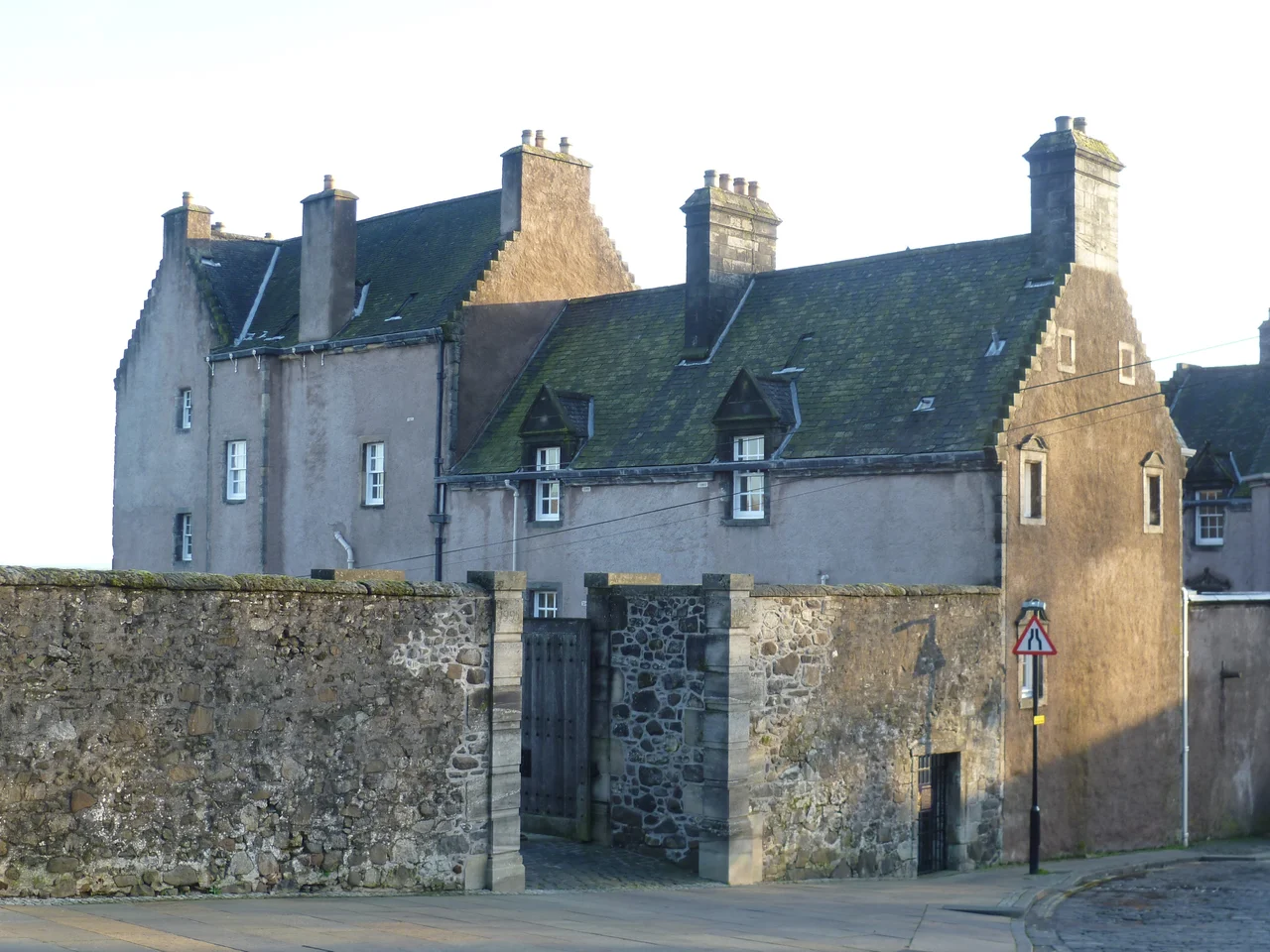

Argyll's Lodging
Above the main entrance, an armorial tablet shows a shield supported by a Native American and a mermaid. The motto below reads per mare per terras — 'by sea and by land' — the motto of Nova Scotia, which exists because Sir William Alexander persuaded King James VI to give him a charter for a chunk of North America in 1621 and then named it for his own ancestral country. The crest above is believed to be the first armorial representation of a beaver in heraldry. The house behind that doorway is, in the careful judgement of the Royal Commission on the Ancient and Historical Monuments of Scotland, 'the most important surviving town-house of its period in Scotland' — a Renaissance palace in miniature, perched on Castle Wynd just below the rock of Stirling Castle, decorated to receive a king who came north only once.
The Merchant, the Abbey, and Sir William
The first house on the site was probably built by John Traill, a wealthy Stirling merchant, sometime in the early sixteenth century — two storeys, a hall above and a kitchen below. In 1559 Traill sold it to Adam Erskine, the Commendator (lay administrator) of nearby Cambuskenneth Abbey, who turned the dwelling into an L-shaped tower house with four floors, a small south wing, and a kitchen in the west. In 1604 it passed to another Erskine, and then in 1629 to Sir William Alexander, whose wife Janet was an Erskine — which explains how he was able to buy it. Sir William had been born in 1577 in Menstrie, a village a few miles to the northeast of Stirling, and had risen through court service. He tutored Prince Henry, the heir who died young. He followed King James VI south to London in 1603 when the crowns of Scotland and England were united, was knighted in 1609, and in 1626 was appointed principal Secretary for Scotland for life. The Nova Scotia colony was his project — and Charles I made him 1st Earl of Stirling and Viscount Canada in 1633.
Decorated for a King Who Barely Came
In 1633 Charles I planned to come to Scotland for his Scottish coronation. Sir William, anticipating that the King might lodge with him, had the house remodelled into a small Renaissance palace. He built suites of public and private rooms. He commissioned exterior decoration on a scale that announced who he was and what he had done for the Crown — the armorial tablet, the carved heraldry, the motto. The High Dining Room, the Drawing Room, the bed chambers — everything was prepared. Charles came to Scotland once, was crowned, returned to England, and never came back. Sir William died insolvent in 1640, leaving the house to his son Charles. But the town of Stirling claimed the property in lieu of his unpaid debts. The town council wanted to turn it into a guest-house. That plan was never carried out, and in the 1660s the Lodging was sold to Archibald Campbell, 9th Earl of Argyll — the man whose name would attach to it ever after.
Argyll's Escape
Archibald Campbell, born in 1629, was a complicated figure — a staunch supporter of the monarchy who nevertheless ended his life as a rebel against it. He bought the house in 1666 and extended it outward to the north and south, enclosing the courtyard behind a screen wall with an elaborate entrance gate. Some of the painted interior decoration he commissioned has survived. In 1680 the Test Act required holders of public office to swear conformity with the King's ideas on church government. Argyll refused to take the oath. He was declared a traitor in 1681 and imprisoned in Edinburgh Castle. He escaped — disguised as a page boy, with his stepdaughter Sophia Lindsay having brought a page's clothes for the exchange — and fled from Leith to the Netherlands, where he waited. His estates were confiscated, but with characteristic foresight he had had an inventory drawn up of all his belongings at the Lodging and assigned them to his wife, Lady Anna Mackenzie. Because her first husband, the Earl of Balcarres, had remained loyal to the Crown, the king allowed Anna to keep her property. In June 1685 Argyll returned to Scotland to lead a rebellion against James VII, coinciding with the Duke of Monmouth's revolt in England. He was captured at Renfrew within weeks, taken to Edinburgh, and beheaded in the Grassmarket.
Hospital and Museum
The Campbells held the house for most of the next century. In 1746, during the Jacobite rebellion, Prince William, Duke of Cumberland — soon to be 'the Butcher' for his actions at Culloden — stayed here on his way north. In 1764 the fourth Duke of Argyll sold it. Around 1800 the British Army bought it for use as a military hospital, because the small infirmary inside Stirling Castle had become hopelessly inadequate. During the Napoleonic Wars the army had expanded from 40,000 to 225,000 men, and even the wounded coming back from the Peninsula needed beds. The Lodging served as a hospital until 1964, then as a youth hostel. In 1996 Historic Scotland opened it as a museum, and — using the inventory the 9th Earl had drawn up before his exile — refurnished the rooms as they would have looked in his time. The High Dining Room, the Drawing Room, My Lord and Lady's Bed Chamber, and My Lady's Closet (the lady's private salon) can be walked through today, much as their original occupants would have known them.
From the Air
Argyll's Lodging stands at 56.12°N, 3.94°W in Castle Wynd, the final uphill approach to Stirling Castle. From altitude the castle on its volcanic dolerite plug is the dominant feature — a 250-foot crag rising abruptly from the carse of the Forth, with the medieval Old Town climbing the spine toward it and the Lodging tucked into the upper end of that approach. The Forth winds northeast through the carse below toward the Firth. Edinburgh Airport (EGPH) is 25 nm east-southeast; Glasgow Airport (EGPF) is 22 nm southwest. The Wallace Monument crowns the Abbey Craig to the northeast — another distinctive crag visible for many miles — and the Ochil Hills rise immediately to the north. Stirling is one of the most navigationally legible cities in Scotland from the air; the Lodging itself is a small Renaissance building, but it sits directly below the castle's southern approach, easy to locate from the much larger landmark above it.
Nearby Stories
- Murder of Alesha MacPhail 3.1 km away
- Ben Lomond 5 km away
- Lochleven Castle 8.8 km away
- Battle of Dunsinane 15 km away
- Pentland Hills 16 km away
- Breadalbane Hydro-Electric Scheme 17 km away
- Beith 17 km away
- Rannoch Moor 24 km away