.jpg)
Arlington Cinema 'N' Drafthouse
On June 17, 1963, Arlington's movie theaters officially desegregated. Among the first to walk into the Arlington Theater on Columbia Pike and buy a ticket was Dorothy Hamm, a Black civil rights activist, and her son Edward Leslie Jr. It was an ordinary act with a long history behind it. The theater had opened in August 1940 as a whites-only establishment, and it had remained whites-only for 23 years. Hamm had spent the late 1950s and early 1960s leading school desegregation efforts in Arlington, and the previous year leading picketing campaigns outside Virginia movie houses. Two Black women had been arrested at Arlington's Glebe Theater and Fairfax's Jefferson Theater in 1962 for the crime of trying to buy a ticket. Their civil suit had forced Neighborhood Theaters Inc. to capitulate. As of June 17, 1963, the whole chain - including the Arlington - was officially desegregated. Dorothy and Edward were among the first through the door. The theater is still there.
Bowling Alleys Upstairs
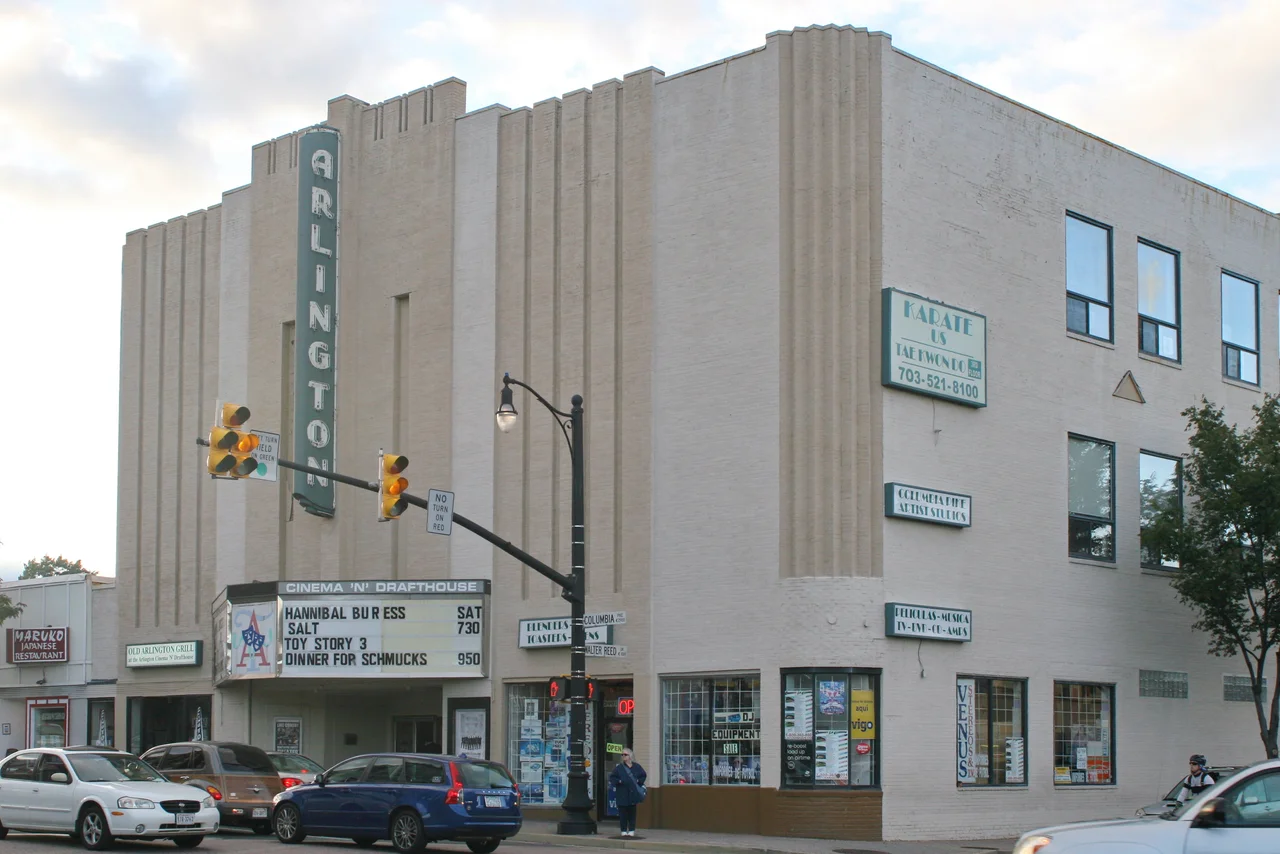
The Arlington Theater opened on August 15, 1940, as the centerpiece of what its developer called the Arlington Recreational Center. Dr. Charles P. Munson - a retired dentist who had chaired the Arlington school board - had bought the corner of Columbia Pike and Walter Reed Drive and demolished a general store called M. Sher and Sons to build a three-story complex that combined a 616-seat movie theater, a 24-lane bowling alley on the second and third floors, several department stores, and a corner drugstore called the Arlington Pharmacy. The whole package opened together. Architect Fred Bishop designed the Art Deco facade in white-and-mauve painted brick, with a rounded corner and a vertical neon ARLINGTON sign above the marquee. Bishop designed seven theaters in Virginia and one in North Carolina between the 1920s and 1940s. Only three of them survive today - the Arlington, the Byrd Theatre in Richmond, and the Beacon Theatre in Hopewell. Opening night featured Cary Grant and Irene Dunne in My Favorite Wife. Tickets were 25 cents. Popcorn was a dime.
Dorothy Hamm and the Glebe Theater
Throughout the 1940s and 1950s the Arlington Theater operated as a whites-only segregated facility, like nearly every movie house in northern Virginia. By the late 1950s Dorothy Hamm, a civil rights leader and one of the first parents to file school desegregation suits in Arlington under Brown v. Board of Education, was leading picket lines outside the theaters that refused to admit Black patrons. The legal turning point came in November 1962 when two Black women - having attempted to buy tickets at the Glebe Theater in Arlington and the Jefferson Theater in Fairfax - were arrested and then filed a civil suit against the chain's owner, Neighborhood Theaters Inc. Dorothy Hamm joined the suit. In June 1963 a settlement was reached: the chain would admit non-white patrons at all locations, and two sections of Virginia code that had let theater owners use the police to enforce segregation were struck down. The Arlington Theater therefore became one of the first desegregated theaters in Virginia. The Glebe Theater is gone. The Jefferson Theater is gone. The Arlington is still serving popcorn.
From Single Screen to Drafthouse
The Arlington spent the 1960s and early 1970s as a conventional single-screen neighborhood theater. By the mid-1970s the multiplex era had begun, and single-screen houses everywhere were closing. Owner Tom Sarris kept it open through 1985 mainly on second-run fare. That year Tony Fischer, who already owned the Bethesda Cinema and Drafthouse across the river in Maryland, bought the building and converted it into a dine-in venue. He pulled out most of the original 616 fixed seats, installed bar tables and office chairs, built a kitchen, and reopened as the Arlington Cinema 'N' Drafthouse with a capacity of about 275. The audience could order beer, pizza, and bar food while watching second-run features. The setup was deliberately low-rent and worked. In 2005, entrepreneur Greg Godbout bought the theater with Tim Clark and applied to the county for a permit to host live entertainment. The first comedy lineup at what they called the Drafthouse Comedy Lounge included Jessica Paquin and Erin Jackson. The first touring comics booked into the main theater were Andy Kindler and Todd Barry.
A Stage on Columbia Pike
Within a decade the Arlington Cinema 'N' Drafthouse had become one of the most consistently booked comedy venues on the East Coast. The list of comedians who have headlined the main stage reads like a roster of working American comedy: John Mulaney, Patton Oswalt, Maria Bamford, Marc Maron, Tracy Morgan, Trevor Noah, Amy Schumer, Nate Bargatze, Ronny Chieng, Ali Wong, Doug Stanhope, Janeane Garofalo, Dan Harmon, T.J. Miller. The theater has continued to alternate stand-up nights with screenings of mainstream features. In 2016 the owners opened a second comedy-only venue in downtown D.C. at 13th and L Streets NW called Drafthouse Comedy, modeled on a New York off-Broadway black box theater. The D.C. location closed in December 2020 during the COVID-19 pandemic and did not reopen. The Arlington itself, listed on Arlington County's roster of 23 Essential historic properties - the highest preservation tier - keeps showing movies and booking comedians on Columbia Pike. The mauve and white facade Fred Bishop designed in 1939 still stands. The neon ARLINGTON sign still glows. The bowling alleys on the upper floors are gone - they were converted into artist studios and a Taekwondo studio decades ago - but the building still hosts the same essential transaction it did on opening night in 1940. People come in. People sit in the dark. Something funny happens on the screen, or on the stage, or both.
From the Air
The Arlington Cinema 'N' Drafthouse sits at 38.86 degrees N, 77.09 degrees W on Columbia Pike at Walter Reed Drive in Arlington County, Virginia. The Pentagon is 2 miles northeast. This is inside Class B airspace and the Washington Special Flight Rules Area. Reagan National (KDCA) is 3 miles east. Coordinate with Potomac TRACON. Watch for the DCA arrival corridors along the river - this site lies under one of them.
Nearby Stories
- Gunston Hall 1.1 km away
- 2023 Baltimore Shooting 4.9 km away
- Battle of Middleburg 6.6 km away
- Crownsville Hospital Center 10 km away
- Battle of Loudoun Heights 13 km away
- First Battle of Rappahannock Station 20 km away
- Howard County, Maryland 21 km away
- Harriet Tubman Underground Railroad 50 km away