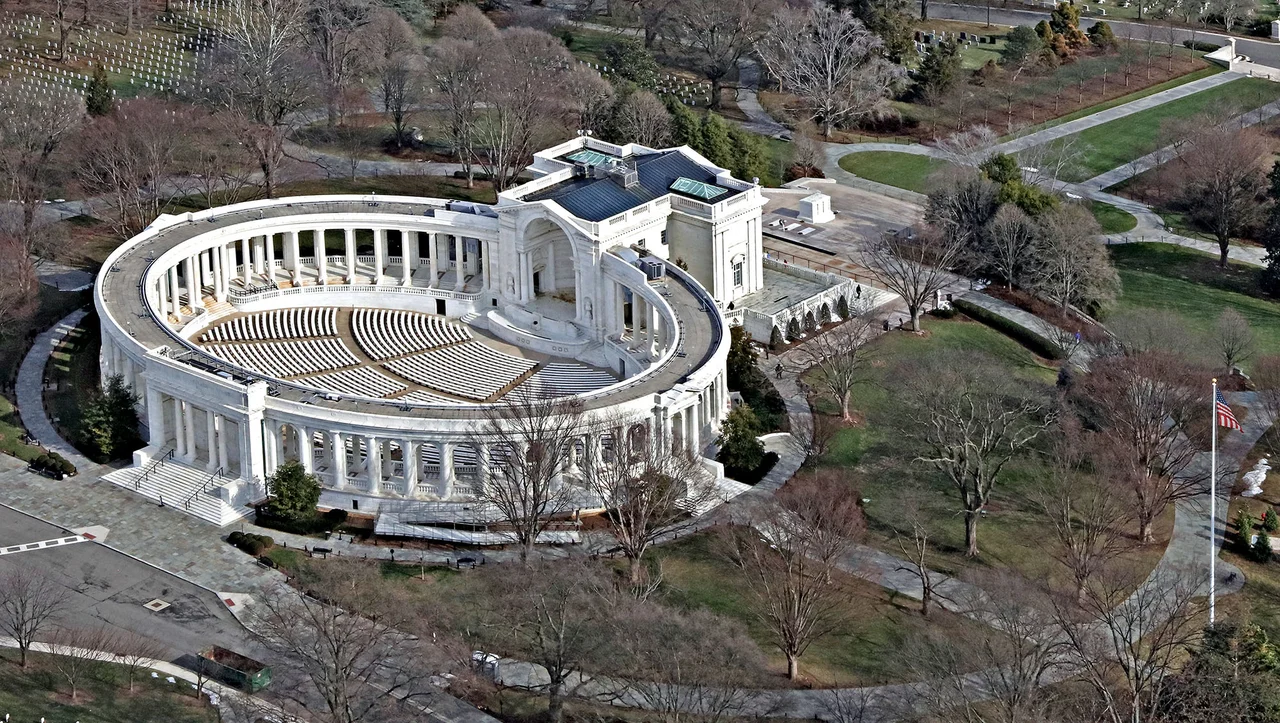

Arlington Memorial Amphitheater
Walk into the marble amphitheater on the hill at Arlington National Cemetery on any clear morning, and the white Vermont and Massachusetts stone seems to catch and hold the light without giving any of it back. Five thousand seats curve around the open central stage, with a colonnaded Doric peristyle behind them and a small chapel and apse on the east side. The structure was designed in 1913 and dedicated on May 15, 1920, in the immediate aftermath of the war that had transformed every previous American definition of military sacrifice. It anchors the eastern steps of what is now the Tomb of the Unknown Soldier. On Memorial Day, on Veterans Day, and on the days when an unknown serviceman is brought home from a foreign battlefield to lie in honor in this country, this is the room where it happens. Three Presidents have laid wreaths here in the same year. The building itself remembers that it was Ivory Kimball's idea.
Judge Kimball's Project
Arlington National Cemetery was established in 1864, and by 1873 the crowds attending Memorial Day services there had become too large for any temporary gathering place. Quartermaster General Montgomery C. Meigs - the man who had ordered the cemetery created in Mary Lee's flower garden - authorized construction of a small wooden amphitheater southwest of Arlington House. The structure became known as the Tanner Amphitheater. By the early twentieth century even it was too small. Judge Ivory Kimball, commander of the Department of the Potomac chapter of the Grand Army of the Republic - the Union veterans' organization - began lobbying Congress in 1903 for a permanent stone amphitheater that would honor not only the Civil War dead but all American war dead. Legislation failed in 1905, 1907, and 1908. A 1908 bill authorized the establishment of a commission but provided only $5,000 to support it. Senator George Sutherland of Utah finally introduced successful legislation in 1912. President William Howard Taft signed it into law on March 4, 1913 - one of the last acts of his presidency.
Carrere and Hastings
The Arlington Memorial Amphitheater Commission contracted on October 12, 1914, with the New York architectural firm of Carrère and Hastings to design the building. Thomas Hastings, of the firm that had designed the New York Public Library, led the architectural team. The civilian Army Corps of Engineers engineer Frederick D. Owen had drawn earlier conceptual sketches starting in 1904 and remained involved as a designer of the cornerstone trowel that President Wilson would use, and as chair of the dedication reception committee. The completed design called for a 5,000-seat open-air amphitheater on a Greek model, with a Doric peristyle ringing the seating area, a small nonsectarian chapel and apse at the east end, a reception hall at the west, and exterior decoration in Vermont Imperial Danby marble and Massachusetts Beebe River granite. The firm of George A. Fuller Company - the general contractor for the Lincoln Memorial and many other federal projects of the era - began construction in March 1915. President Wilson laid the cornerstone on October 13, 1915. The Great War interrupted the original construction schedule. By June 1918 the exterior was nearly complete. Final dedication came on May 15, 1920.
The Tomb on the Steps
The Tomb of the Unknown Soldier was placed in the center of the amphitheater's east steps. Congress had authorized in 1921 the burial of an unidentified American soldier from the First World War on the plaza outside the amphitheater, to symbolize all American war dead. The first Unknown was selected from four caskets in France, escorted home aboard the USS Olympia, and interred at Arlington on November 11, 1921 - Armistice Day. The original tomb was a simple marble slab. Congress authorized a permanent monumental treatment in 1926. The design by architect Lorimer Rich and sculptor Thomas Hudson Jones - a marble sarcophagus carved with three Greek figures representing Peace, Victory, and Valor on the front, and the wreaths of six major World War I battles on the sides - was selected on December 10, 1928. The new tomb was completed in 1932. Unknown servicemen from World War II and Korea were added in 1958, and from Vietnam in 1984 (later disinterred after DNA identified him as Air Force Lt. Michael Blassie). The tomb has been guarded continuously by the 3rd U.S. Infantry Regiment - the Old Guard - since 1937, in all weather, by day and by night. The transfer of the guard on the half-hour during summer and the hour during winter is one of the most attended ceremonies in Washington.
What the Marble Holds
The amphitheater has hosted state funerals and memorial services for many decades. Confederate veteran and sculptor Sir Moses Ezekiel was buried at his Confederate Memorial in front of the amphitheater in 1921. Pulitzer Prize-winning soldier and poet Joyce Kilmer was honored here. Tuskegee Airmen, Buffalo Soldiers, Medal of Honor recipients, and unknown American service members have lain in honor in the apse. Frank Buckles, the last American veteran of the First World War, lay here on March 15, 2011, before burial - 92 years after the war he had served in ended. The building has needed repeated repair. The marble cladding cracked from seasonal expansion and contraction. In 1954 a study uncovered design deficiencies that would cost over half a million dollars to address. Major renovations were done in 1956, 1995-1996, and again in 2012-2014. The 1995 renovation produced a brief controversy when it was discovered that the planned marble replacement was Italian rather than the original Vermont Imperial Danby - the procurement was changed. The amphitheater is still in active use. Three Presidents have laid wreaths in the same year here on Memorial Day. The marble outside is still white. The list of names inscribed inside on the chapel walls - of the World War I dead remembered here - still serves the purpose Judge Ivory Kimball gave it in 1903.
From the Air
The Memorial Amphitheater stands at 38.88 degrees N, 77.07 degrees W on the hilltop at Arlington National Cemetery, immediately west of the Tomb of the Unknown Soldier. The cemetery itself sits on the bluffs above the Potomac River across from the Lincoln Memorial. This is inside Class B airspace and the Washington Special Flight Rules Area. P-56B over the Pentagon is half a mile southeast. Reagan National (KDCA) is 2 miles east. Coordinate with Potomac TRACON. Watch for the DCA approach corridors along the river. Aerial photography over the cemetery is restricted - check current NOTAMs.
Nearby Stories
- Gunston Hall 1.1 km away
- 2023 Baltimore Shooting 4.9 km away
- Battle of Middleburg 6.6 km away
- Crownsville Hospital Center 10 km away
- Battle of Loudoun Heights 13 km away
- First Battle of Rappahannock Station 20 km away
- Howard County, Maryland 21 km away
- Harriet Tubman Underground Railroad 50 km away