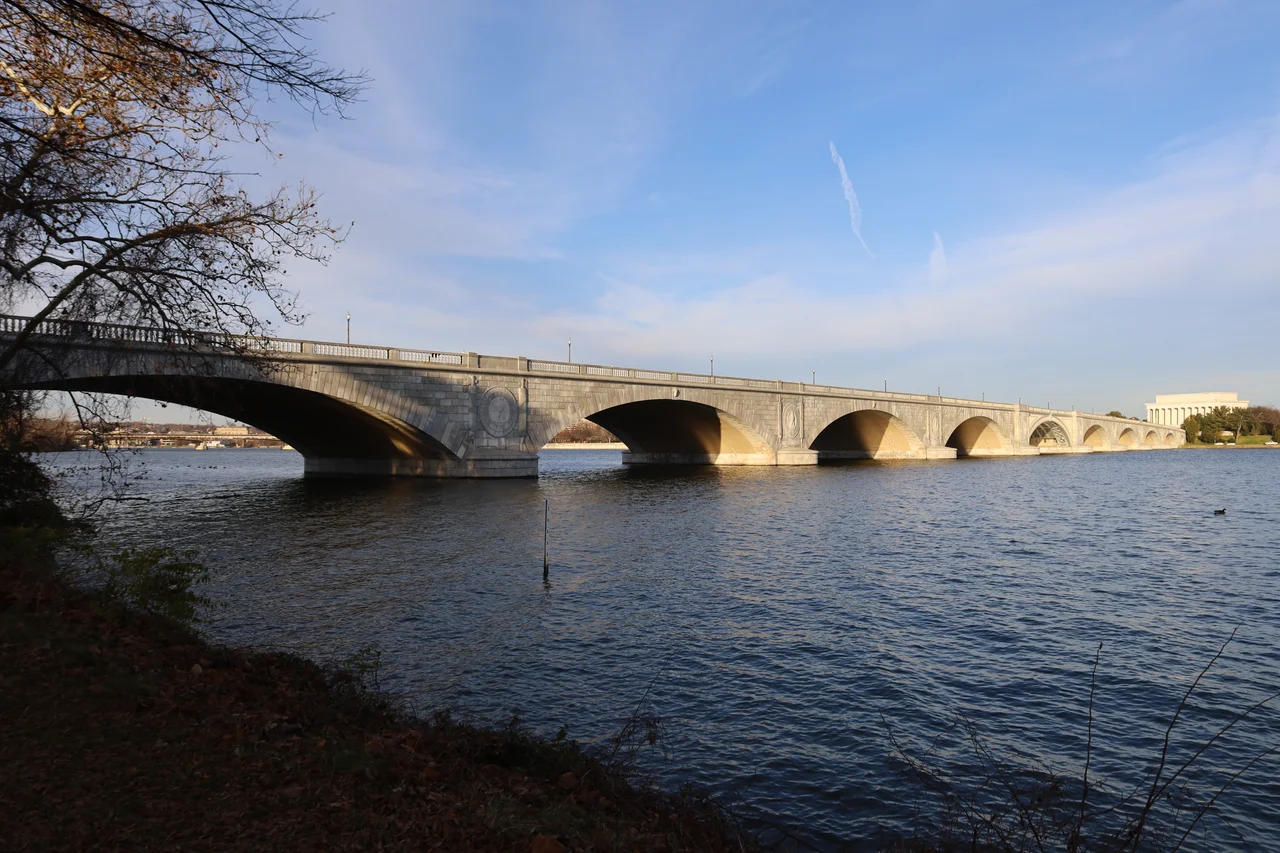

Arlington Memorial Bridge
Warren Harding sat in a Cadillac on Highway Bridge for three hours on November 11, 1921. The presidential motorcade was trying to cross from Washington to Arlington National Cemetery for the dedication of the Tomb of the Unknown Soldier. Tens of thousands of mourners were trying to do the same thing on the same single river crossing, and the bridge could not handle the load. Harding, by all accounts furious by the time he reached the ceremony, decided that this would not happen again. By June 1922 he had pushed an appropriation through Congress to fund the long-dormant Arlington Memorial Bridge Commission. By 1932 the bridge was open. Today it carries the formal axis of the National Mall west across the Potomac to the foot of Arlington National Cemetery and the columns of Arlington House - the prewar home of Robert E. Lee. The siting was deliberate. The reconciliation symbolism was intentional. The bridge took 46 years to get built.
Forty-Six Years of Argument
Congress first proposed a Potomac bridge at this site on May 24, 1886. The War Department reported back the next year recommending a Lincoln-Grant Memorial Bridge. The Washington Post lobbied for adding Robert E. Lee to the dedication. The 1887 proposal evolved into a Grant Memorial Bridge - a 105-foot suspension span - and then, when Southern senators blocked Grant-related funding, evolved again into competing designs that included a bare steel truss, a low masonry arch, and an extravagant Romanesque Revival concept by Paul J. Pelz with paired central towers and ornamental barbicans. The Army Corps of Engineers ran soundings of the river bed in 1898. A National Memorial Bridge Association was formed to lobby Congress. Four prominent New York bridge engineers submitted competing designs. None of it produced a bridge. The 1900 McMillan Commission, formed by Senator James McMillan of Michigan to make sense of the development of Washington and the National Mall, finally provided the framework. The McMillan Plan, issued January 15, 1902, located the bridge on the line of sight between a future Lincoln Memorial and Arlington House. That siting decision, accepted by the Commission of Fine Arts in 1910, fixed the design problem for the next thirty years.
Harding's Traffic Jam
After Harding's frustrated experience on November 11, 1921, the bridge commission finally got funded. A joint meeting of the Arlington Memorial Bridge Commission, the Commission of Fine Arts, and Vice President Coolidge on December 18, 1922, unanimously confirmed the McMillan Plan siting - on the axis between the new Lincoln Memorial and Arlington House. The architectural firm of McKim, Mead, and White - the same firm that had designed Pennsylvania Station in New York, the Boston Public Library, and the Morgan Library - was selected by direct invitation on April 4, 1923. Architect William Mitchell Kendall led the design. He proposed a low Neoclassical masonry arch bridge with nine spans, a central bascule drawbridge to permit larger ships to reach the Georgetown waterfront, and elaborately planned approaches on both sides. The Georgetown merchants insisted on the drawbridge. The Commission of Fine Arts asked Kendall to widen the bridge to 100 feet, and he did. Construction began in 1926. The bridge opened January 16, 1932, in time for the bicentennial of George Washington's birth. The four monumental gilded bronze sculpture groups that flank the approaches were commissioned separately: Leo Friedlander's Arts of War (Valor and Sacrifice) on the east and James Earle Fraser's Arts of Peace (Music and Harvest, Aspiration and Literature) on the west. All four were cast by Ferdinando Marinelli Artistic Foundry of Florence and dedicated on September 26, 1951, as a gift from the Italian people in gratitude for American postwar reconstruction assistance.
The Bascule That Stopped Opening
The central drawbridge was designed to lift on demand for ship traffic. In practice the demand declined steadily as the Georgetown waterfront industrial activity faded. The bascule was last opened for an actual ship in 1961. After that it was operationally closed. Its mechanical components, however, deteriorated even when idle, and by the 2010s a federal inspection found the steel structure of the drawbridge in such advanced corrosion that the entire bridge faced weight restrictions. Tour buses were banned. School buses were rerouted. A federal study estimated the bridge had only five to ten years of useful life remaining. Congress appropriated emergency funding. The Federal Highway Administration and the National Park Service undertook a $227 million rehabilitation between 2018 and 2020. The corroded bascule was removed and replaced with a fixed-span steel girder section that does not open. The marble facing was refurbished. The lighting was replaced. The eight sculptures - Leo Friedlander's Arts of War (Sacrifice and Valor) on the east end and James Earle Fraser's Arts of Peace (Music and Harvest, Aspiration and Literature) on the west - were cleaned and regilded. The bridge reopened to full load capacity in late 2020.
Symbolism on the Axis
The bridge functions as much as a symbol as a road. The eastern approach in Washington faces the Lincoln Memorial directly. The western approach in Arlington runs straight to Arlington House at the top of the hill above the cemetery. Arlington House had been the prewar home of Robert E. Lee. When Congress, the McMillan Commission, and the Commission of Fine Arts insisted on this specific axis, they were committing the federal government to a particular reading of the Civil War - one in which the Union and the Confederacy could be visually linked through the dignified architecture of memory. Lee's portrait was carved into a roundel above the western entrance. The Confederate Memorial sits a short walk away inside the cemetery. The bridge does not say where Lee was wrong. It says simply that the dead on both sides of his war are now buried on the same hill, looked at by the same Lincoln, crossed to by the same river bridge. People still walk it - across the Memorial Bridge, up the slope through the cemetery, past the eternal flame at Kennedy's grave, to the colonnade of the amphitheater and the Unknown Soldier's tomb. The Memorial Bridge connects them. It has done so since 1932.
From the Air
The Arlington Memorial Bridge crosses the Potomac River at 38.89 degrees N, 77.06 degrees W, between the Lincoln Memorial and Columbia Island, on the formal axis of the National Mall. The bridge is 2,163 feet long. This is inside Prohibited Area P-56A on the D.C. side and within the Washington Special Flight Rules Area throughout. Reagan National (KDCA) is 3 miles southeast. Coordinate with Potomac TRACON. The Potomac River visual approach to DCA passes immediately overhead - watch for descending traffic from the north and northwest.
Nearby Stories
- Gunston Hall 1.1 km away
- 2023 Baltimore Shooting 4.9 km away
- Battle of Middleburg 6.6 km away
- Crownsville Hospital Center 10 km away
- Battle of Loudoun Heights 13 km away
- First Battle of Rappahannock Station 20 km away
- Howard County, Maryland 21 km away
- Harriet Tubman Underground Railroad 50 km away