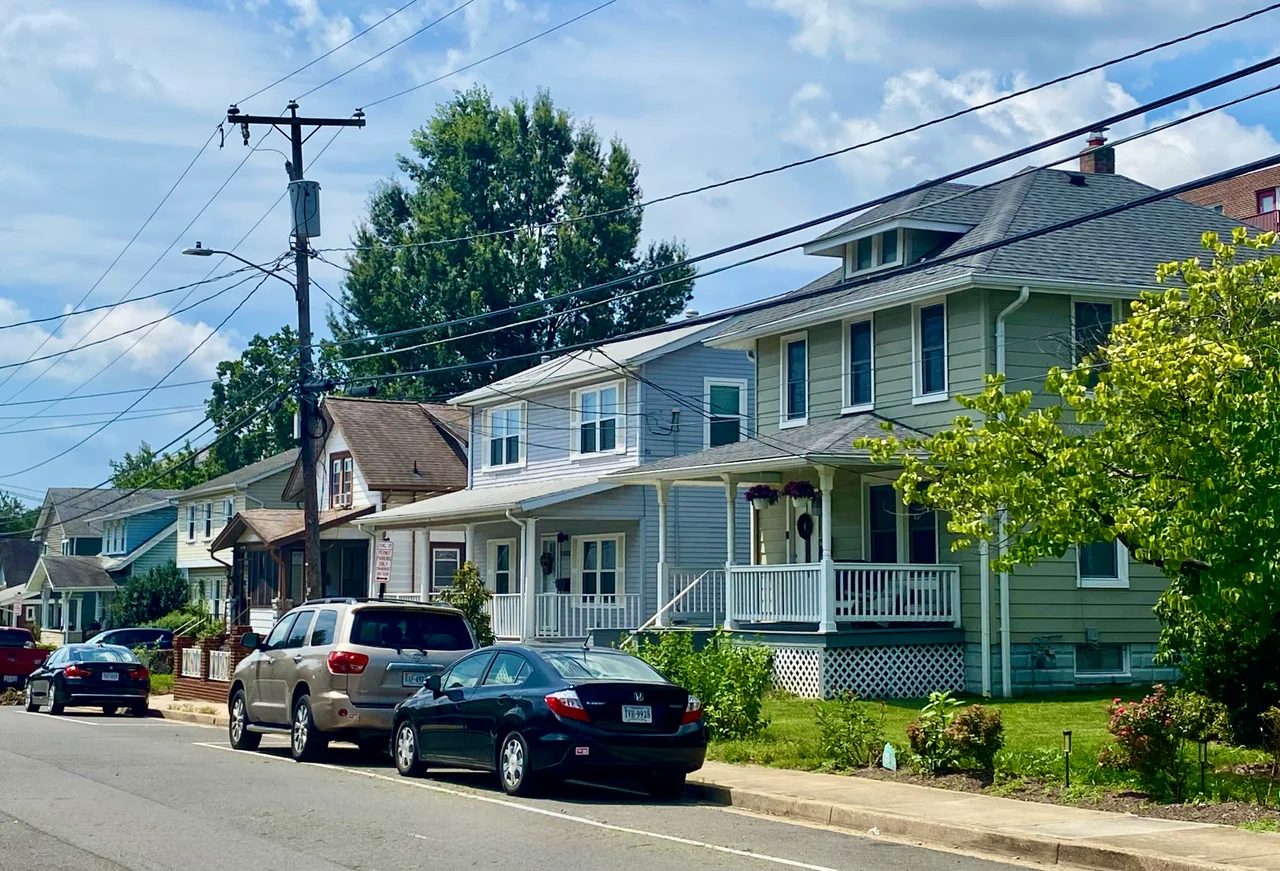

Arlington View, Virginia
In 1947, a Black student named Constance Carter and her classmates at Hoffman-Boston High School filed suit against the Arlington County school board. They had photographs of their school's science room as exhibits - a few sinks, a few microscopes on dilapidated tables, a roof that leaked. They also had photographs from the all-white Washington-Lee High School a few miles north, with its laboratories, its full library, its gymnasium. The case, Carter v. School Board of Arlington County, went to the Fourth Circuit Court of Appeals and Carter's side won. The ruling did not integrate Arlington's schools immediately. It did force the county to upgrade the Black school. By 1953 Hoffman-Boston had a separate elementary building, a gymnasium, and a cafeteria. By 1959 the schools were integrated. The neighborhood that surrounded Hoffman-Boston was called Johnson's Hill then. In 1965 the county renamed it Arlington View as part of an urban renewal plan. The lawsuit is mostly forgotten outside the neighborhood. The people who filed it are not.
From Plantation to Subdivision
Before the Civil War, the rolling land south of present-day Columbia Pike was a 100-acre plantation owned by John Robert Johnston. Johnston farmed the property with 15 enslaved people, growing a variety of crops. After emancipation in 1865, he employed some of his formerly enslaved farmhands as sharecroppers and - unusually for a former slave owner - publicly supported civil rights and political participation for the recently emancipated Black community. When he died in 1881, his sons Richard and William chose to do something even more unusual. They began selling subdivided plots to Black buyers - many of them families who had been living in nearby Freedman's Village, a federal contraband-camp-turned-community established on the Arlington estate in 1863 and now being closed by the federal government and by white developers who wanted the land for whites-only suburban subdivisions. Richard platted the Johnston subdivision in 1888. The new African American neighborhood became known as Johnson's Hill. The same year, Harry Gray and his wife Martha - both employees of the Department of the Interior - built an Italianate-style brick home modeled on Foggy Bottom row houses. The Harry W. Gray House still stands at 716 South 23rd Street and is the oldest building in the neighborhood. It was listed on the National Register of Historic Places in 2004.
The Jim Crow Squeeze
By 1900 Johnson's Hill had developed a middle-class Black community institutionally anchored by the Jefferson School - a wood-frame schoolhouse for Black children - the Mount Zion Baptist Church relocated from Freedman's Village, and an Odd Fellows lodge. The community was governed under Jim Crow law. The 1896 Supreme Court ruling in Plessy v. Ferguson legalized separate but equal segregation. Arlington's Good Citizens League - led by developers Crandal Mackey and Frank Lyon - pushed for restrictive housing covenants, supported the 1901-02 Virginia constitutional convention that disenfranchised Black voters through poll taxes, and worked to confine Black residence to a shrinking set of permitted neighborhoods. Arlington passed a 1930 zoning ordinance that effectively banned new multifamily housing in Black areas. Lots in Gray's subdivision were subdivided again and again - the original four-lot block became seventy lots after Harry Gray's death in 1913. Roads in Johnson's Hill stayed unpaved into the 1960s while white subdivisions a mile away got curb and gutter. The Jefferson School expanded in 1915, added an eight-room wing with Rosenwald Fund support in 1931, and was renamed Hoffman-Boston Junior Colored High School in 1932. In 1939 it added a K-12 curriculum because Black Arlington students were being refused enrollment in segregated D.C. high schools.
The Pentagon Squeezed Harder
When the federal government broke ground for the Pentagon in 1941 and the Navy Annex shortly after, it used eminent domain to demolish the Black neighborhoods of East Arlington and Queen City, displacing over 900 residents and razing Mount Olive Baptist Church. Some of the displaced residents relocated to Johnson's Hill. The federal government also dumped construction debris from the Pentagon project into Johnson's Hill's ravines, degrading the neighborhood's appearance and condition without consulting anyone who lived there. The Arlington Trailer Camp - temporary housing for displaced workers designed by Howard University architect Albert Cassell, the most prominent Black architect in the region - was built nearby in 1941 and partially abandoned by 1943 due to poor living conditions. By 1950, Johnson's Hill, Green Valley, and Hall's Hill were the only three areas in Arlington County where African Americans could live. The Carter lawsuit and the broader civil rights organizing by the Arlington NAACP - which had been founded in 1940 - set the stage for the eventual integration of the schools in February 1959. The local press, surprised at how little overt violence the integration produced, called it the day nothing happened. George Lincoln Rockwell's American Nazi Party, headquartered nearby, would call it something else.
Conservation, Highway, Gentrification
In 1965 the county designated Johnson's Hill as a Conservation Area under federal urban renewal funding. The roads were finally paved. Sidewalks and gutters were installed. Cul-de-sacs were constructed at dead-end streets. The county renamed the neighborhood Arlington View - a name borrowed from an earlier nearby subdivision - because Johnson's Hill had developed too many associations with the conditions the conservation plan was supposed to remedy. The Shirley Memorial Highway expansion of the late 1960s demolished part of the neighborhood, including Mount Zion Baptist Church, which moved to Green Valley. Hoffman-Boston's senior high school closed in 1964 to facilitate integration; the building hosted integrated junior high classes until 1971 and now functions as an integrated elementary school. The Carver Homes - public housing built after the war and named for the African American agricultural scientist George Washington Carver - were sold off and largely demolished by 2016. Arlington View today is more racially integrated than at any time in its history: the Black share of the population fell from 99 percent in 1970 to about 62 percent in 2010. Property values have climbed sharply with proximity to the Pentagon and Pentagon City. The Harry W. Gray House is preserved. Markers commemorate the Jefferson School, the Odd Fellows lodge, and the original Mount Zion congregation. The neighborhood is still here. The neighborhood it used to be is harder to find.
From the Air
Arlington View sits at 38.86 degrees N, 77.07 degrees W in central Arlington, bounded by Columbia Pike to the north, Washington Boulevard to the east, Interstate 395 to the south, and South Rolfe Street to the west. The Pentagon is one mile northeast. This is inside Class B airspace and the Washington Special Flight Rules Area. P-56B over the Pentagon is just north. Reagan National (KDCA) is 2 miles east. Coordinate with Potomac TRACON before any low operations.
Nearby Stories
- Gunston Hall 1.1 km away
- 2023 Baltimore Shooting 4.9 km away
- Battle of Middleburg 6.6 km away
- Crownsville Hospital Center 10 km away
- Battle of Loudoun Heights 13 km away
- First Battle of Rappahannock Station 20 km away
- Howard County, Maryland 21 km away
- Harriet Tubman Underground Railroad 50 km away