
Artemision Bronze
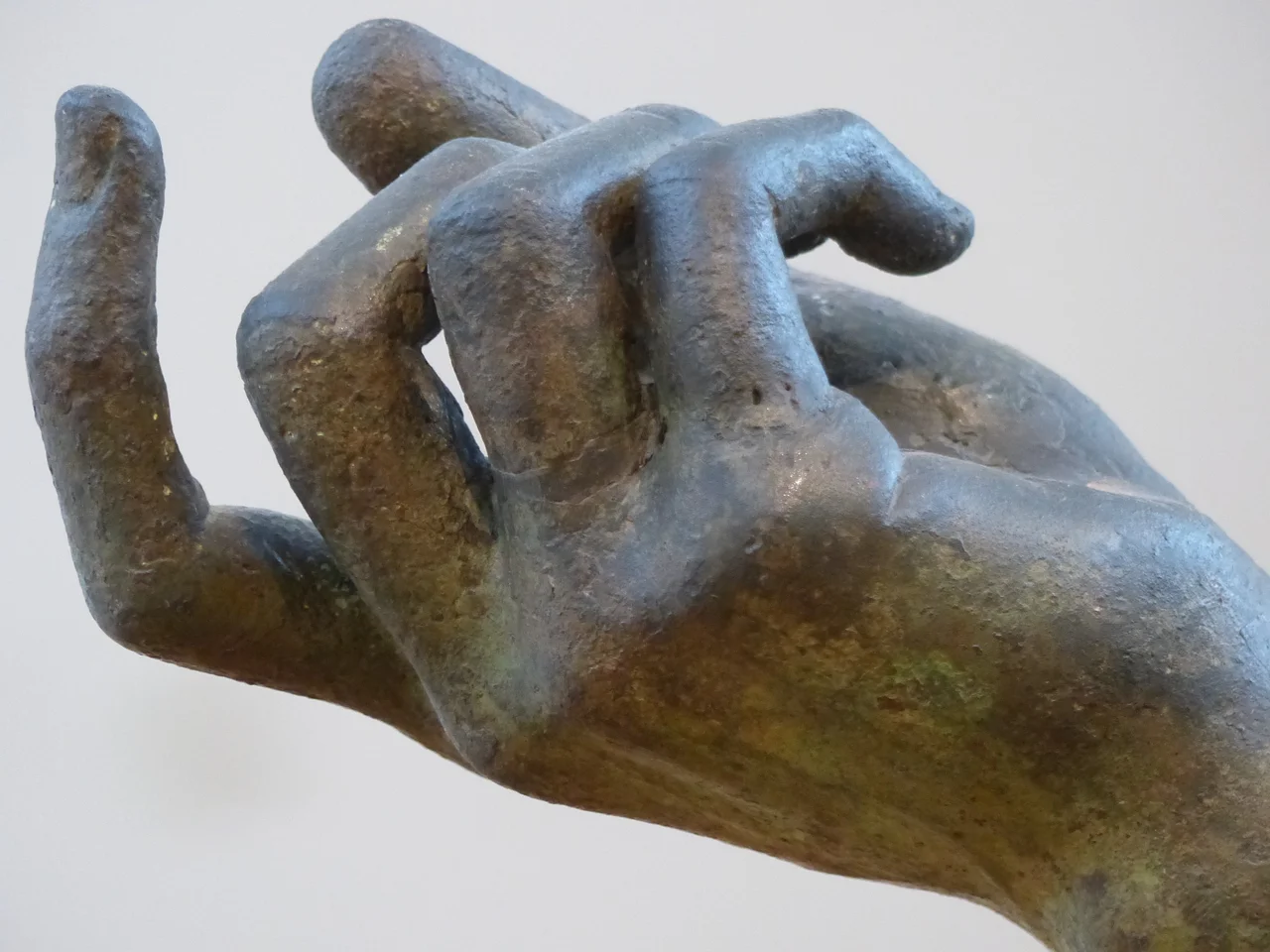
He is poised to throw, and we will never know at what. The right arm is drawn back, the left extended for aim, the whole body balanced on the edge of a strike that froze about 2,460 years ago. But the weapon is gone. If the lost object in that grasping hand was a thunderbolt, this is Zeus, king of the gods. If it was a trident, this is Poseidon, lord of the sea. The missing attribute has kept scholars arguing for nearly a century, and standing before the figure in the National Archaeological Museum in Athens, you feel the weight of the unanswered question in the empty fist.
Risen from the Sea
The bronze did not come from a temple or a tomb. It came up out of the Aegean. In 1926, off Cape Artemision at the northern tip of Euboea, the first pieces surfaced, and in 1928 divers worked the site of an ancient shipwreck to recover the rest. The wreck sank no earlier than the middle of the 2nd century BC, likely a vessel hauling looted Greek masterpieces, and it gave up more than one treasure. From the same ship came the Jockey of Artemision, a spirited bronze of a galloping horse and its young rider. One scholar, Sean Hemingway, has suggested the horse and jockey may have been plundered from Corinth in 146 BC and were bound for Pergamon when the sea took them. The excavation ended abruptly and was never resumed: in 1928 a diver died at the site, and no one returned to learn what else lay below.
Zeus or Poseidon
The case turns on the hand. Those who call him Poseidon note that he came from the sea, but as the scholar Caroline Houser dryly observed, the statue went into the water only because the ship carrying it sank. A stronger clue is the pose. Greek vase painters and coin makers showed Poseidon stabbing with his trident in a tight, fencing-like lunge, while Zeus hurled his lightning with the arm raised high overhead, exactly the attitude of the Artemision figure. There is a practical objection too: a full trident raised in this stance would have crossed the face, ruining the profile that ancient viewers prized above all other angles. The bronze is also simply a giant version of a long line of small Zeus figurines, going back to the late 7th century, all caught in this same lightning-throwing pose. Most scholars now read him as Zeus. But opinion remains divided, and the god keeps his secret.
A Body Made to Live
What survives is barely over life size, 2.09 meters of bronze in the Severe style, the restrained, gathering manner that came just before the full bloom of Classical art around 460 BC. The sculptor is unknown; provenance has been claimed for Attica, Boeotia, Aegina, Sicyon, and Argos, and names from Kalamis to Myron have been floated without proof. The figure was never meant to look like cold metal. The eye sockets, empty now, were once inset, probably with bone or ivory, and the eyebrows were inlaid with silver, the lips and nipples with copper, so the god would have gazed back with something like a living face. The archaeologist Carol Mattusch described the effect precisely: the figure has the potential for violence, is concentrating, poised to throw, but the action is just beginning, and we are left to contemplate the coming demonstration of strength. It is that suspended threat, the breath held before the blow, that makes the bronze unforgettable.
The Face of a Nation
Few ancient sculptures have traveled as far into modern life as this one. The serene, bearded head became an emblem of Greece itself: it appeared on a 500-drachma postage stamp in use from 1954 to 1977, and on a 1,000-drachma banknote first issued in 1970. Generations of Greeks carried the god in their pockets and on their letters without always knowing whether they were carrying Zeus or Poseidon. The original now commands a gallery in the National Archaeological Museum in Athens, where visitors circle it the way the ancients would have wanted, seeking that crucial profile. Across Greece, the Charioteer of Delphi, a near-contemporary bronze now at the Delphi Archaeological Museum, stands as another of the vanishingly few survivors from an age when most great Greek bronzes were melted down for their metal. The Artemision god lived because he was lost. A shipwreck that drowned a sculptor's masterpiece also sealed it away from the furnaces, and the sea returned it whole.
From the Air
The Artemision Bronze is displayed indoors at the National Archaeological Museum, 28is Oktovriou (Patission) Street in central Athens, near 37.9889 N, 23.7322 E. From the air the dense neoclassical grid of central Athens surrounds the site; the Acropolis to the south and Lycabettus Hill to the east are the best visual anchors. The statue itself was recovered far to the north, off Cape Artemision at the tip of Euboea, roughly 37.99 N, 23.73 E reflecting the museum location rather than the find spot. Nearest airport is Athens International (LGAV), about 32 km east-southeast. Expect busy controlled airspace over the capital.
Nearby Stories
- Great Sand Beach 5 km away
- Battle of Delium 7.7 km away
- Tower of Aliartos 9 km away
- HMHS Britannic 10 km away
- Saronic Gulf 15 km away
- Sousaki Volcano 17 km away
- Sanctuary of Apollo Maleatas 24 km away
- Skyros 66 km away