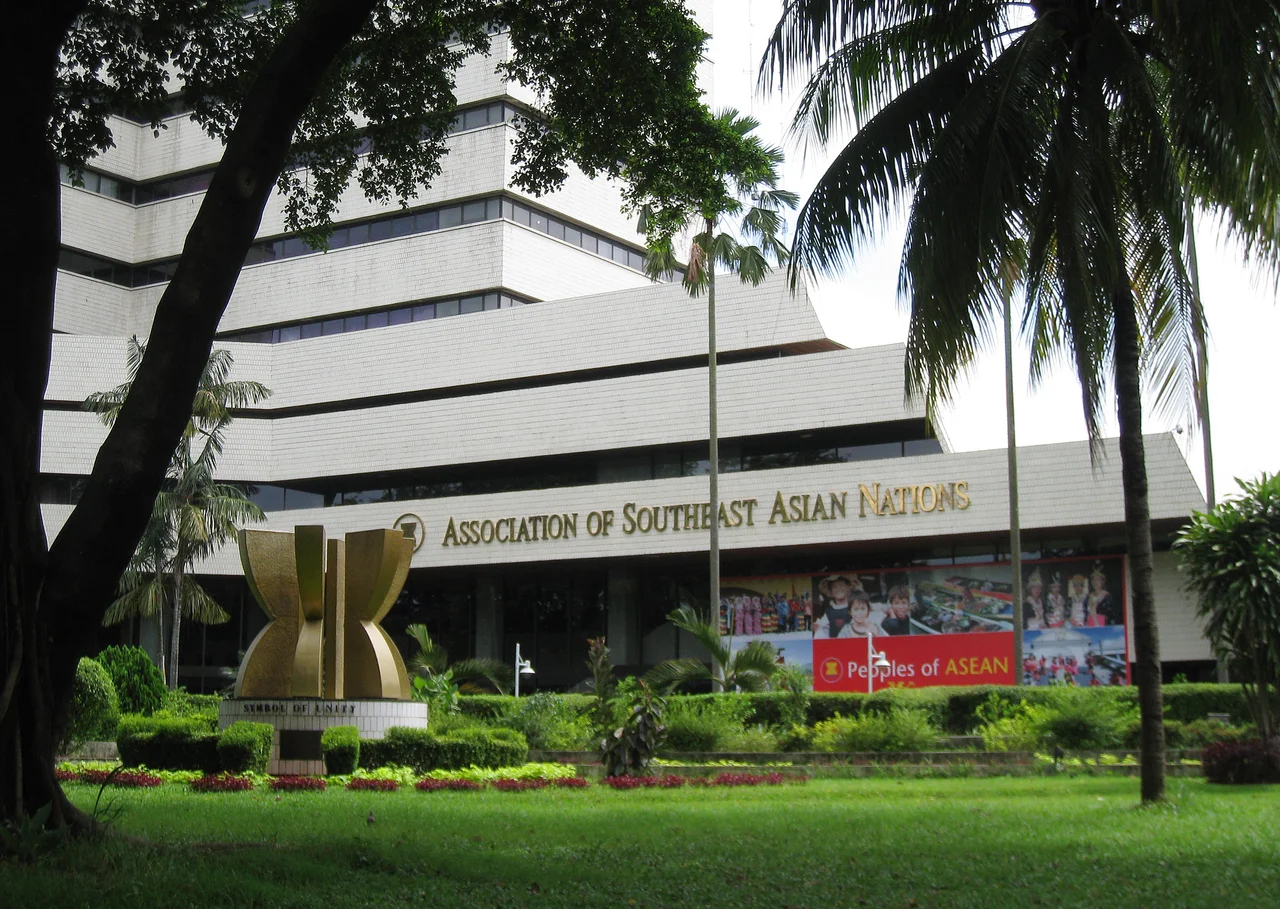

A Bridge Between Ten Nations
The skybridge connecting the twin towers of the ASEAN Headquarters in South Jakarta has no central support pillars. At 41 meters, it is the longest column-free bridge in Indonesia, and its architects intended it as a metaphor: dialogue bridging differences, unsupported by anything but mutual commitment. Whether or not visitors think about symbolism as they cross it, the physical fact is striking — a suspended walkway linking two towers that house the permanent missions and administrative offices of eleven Southeast Asian nations, hovering above a five-story podium in the Kebayoran Baru district of Jakarta.
The Argument for Jakarta
Placing ASEAN's permanent home in Jakarta was not inevitable. When the idea of a dedicated secretariat emerged in the early 1970s, Indonesia's Foreign Minister Adam Malik identified a plot of land in Kebayoran Baru — an area historically known as CSW, short for Centrale Stichting Wederopbouw (Central Foundation for Reconstruction), a Dutch agency that developed the Kebayoran Baru satellite city. But the Philippines pushed back. President Ferdinand Marcos proposed Manila as the site, earmarking a location on Roxas Boulevard and pledging to fund the secretariat's first two years of operation. The deadlock came to a head at a foreign ministers' meeting at the Borobudur Hotel in Jakarta in May 1974, with neither side willing to yield. Consensus arrived two years later at the First ASEAN Summit in Bali on February 23, 1976, when the foreign ministers finally chose Jakarta.
Rice Paddies in Concrete
The architect who gave ASEAN its first physical identity was Soejoedi Wiroatmodjo, whose involvement began around 1975. Soejoedi rejected overt traditional motifs. Instead, he designed an eight-story modernist building whose terraced form evoked the rice paddies that terrace hillsides across Southeast Asia — a subtle nod to shared agricultural heritage without resorting to decorative cliche. The building was inaugurated in 1981, with President Suharto declaring it a symbol of "the unwavering determination of the 250 million people of the five ASEAN member countries to unite." For decades, this modestly scaled structure served the organization's administrative needs. But ASEAN in 1981 had five member states. By the time the ASEAN Charter was adopted in 2008 and the ASEAN Community launched in 2015, membership had grown to eleven, and the original building could no longer contain what the organization had become.
Towers Rising from a Mayor's Office
The expansion story began prosaically: around 2012, officials discussed converting the unused South Jakarta mayor's office next door into additional secretariat space. Jakarta Governor Joko Widodo — later Indonesia's president — was involved in early negotiations, and his successor Basuki Tjahaja Purnama, known as Ahok, pushed for a bolder approach. Rather than renovating the old mayoral building, Ahok advocated tearing it down and building something new. A 2015 design competition drew 80 entries. Bentara Indonesia Arsitek won with a twin-tower concept. Groundbreaking came on January 5, 2018, with a construction cost of approximately 448.77 billion rupiah funded by the state budget. The result: two 16-story towers rising above a shared podium, earthquake-resistant to modern Indonesian standards, with the signature skybridge hovering at the upper levels. The complex earned a Platinum green building certification from the Green Building Council Indonesia.
Where Art Meets Diplomacy
Inside the complex, the ASEAN Gallery occupies a permanent space inaugurated on August 8, 2001 — timed to coincide with ASEAN Day and the organization's 34th anniversary. The gallery displays Southeast Asian sculptures, paintings, and monuments donated by member states, dialogue partners, private foundations, and individual artists. It also hosts the ASEAN Artists Residency Programme, which brings artists from across the region to Jakarta to develop their work. Participants must produce at least one substantial piece during their stay, and the resulting works enter the gallery's permanent collection. For a building designed to house bureaucracy, the gallery introduces an unexpected texture — evidence that the diplomats who work here decided their headquarters needed beauty as well as conference rooms.
Named on the Map
The ASEAN Headquarters has made its mark on Jakarta's transit infrastructure. The nearest MRT station on the North-South Line was originally called Sisingamangaraja, after the street it sits on. It has since been renamed ASEAN Headquarters station, joining the CSW-ASEAN transit-oriented development that links the station with TransJakarta bus rapid transit via an elevated pedestrian bridge. The station's design embraces the theme of Unity in Diversity, with accessibility features including tactile paving, wheelchair-width gates, and elevator access. For a diplomatic complex that spent its first decades as a modest terraced building on a former Dutch industrial lot, having a metro station bear its name is a particular kind of arrival — the sort that says an institution has become permanent enough to be woven into a city's daily geography.
From the Air
The ASEAN Headquarters is located at approximately 6.24°S, 106.80°E in Kebayoran Baru, South Jakarta. From the air, the twin-tower complex with its distinctive skybridge is identifiable in the dense urban fabric south of central Jakarta. Nearest major airport: Soekarno-Hatta International Airport (WIII/CGK), about 25 km northwest. Halim Perdanakusuma Airport (WIHH) is approximately 15 km east. The complex sits near the junction of Jalan Sisingamangaraja and Jalan Trunojoyo.
Nearby Stories
- The King's Footprints in the River 2.8 km away
- Rawagede Massacre 6.4 km away
- The Cruiser That Wouldn't Stop Fighting 14 km away
- Four Minutes Over the Java Sea 14 km away
- The Scholar's Mosque 21 km away
- Through the Cidepong Hills 37 km away
- Ujung Kulon National Park 97 km away
- The Islands That Vanished from Sight 352 km away