
Asia Art Archive
Contemporary art in Asia was disappearing before anyone had properly written it down. The artists who drove the experimental movements of the 1970s and 1980s — in China, the Philippines, India, Vietnam, Malaysia — were often working in conditions that left few traces: self-published zines, hand-distributed invitations, borrowed spaces, films that no institution acquired. By 2000, some of that material was already gone. Claire Hsu, Johnson Chang Tsong-zung, and Ronald Arculli founded Asia Art Archive in Hong Kong that year to interrupt the disappearance — to collect, preserve, and make accessible the documentary evidence of a regional art history that museums had largely not thought to keep.
An Archive Built for What Almost Didn't Survive
The collection at Asia Art Archive has grown to more than 120,000 records since its founding. About seventy percent of acquisitions are donations — some unsolicited, many gathered directly by researchers who seek out artists, estates, and organisations before materials disperse. The archive holds primary source documents: artists' writings, sketches, visual documentation, personal correspondence, rare periodicals. It also keeps files on individuals, events, and organisations, and produces its own images and audio-visual records. One of its most significant research projects, "Materials of the Future: Documenting Contemporary Chinese Art 1980–1990," ran for four years and assembled what AAA describes as the world's largest systematically organised archive of documentary material about Chinese art of the 1980s — a decade of extraordinary creative ferment that might otherwise exist only in the memories of those who were there. The project concluded with the launch of a dedicated website in September 2010.
Hollywood Road, Open to Anyone
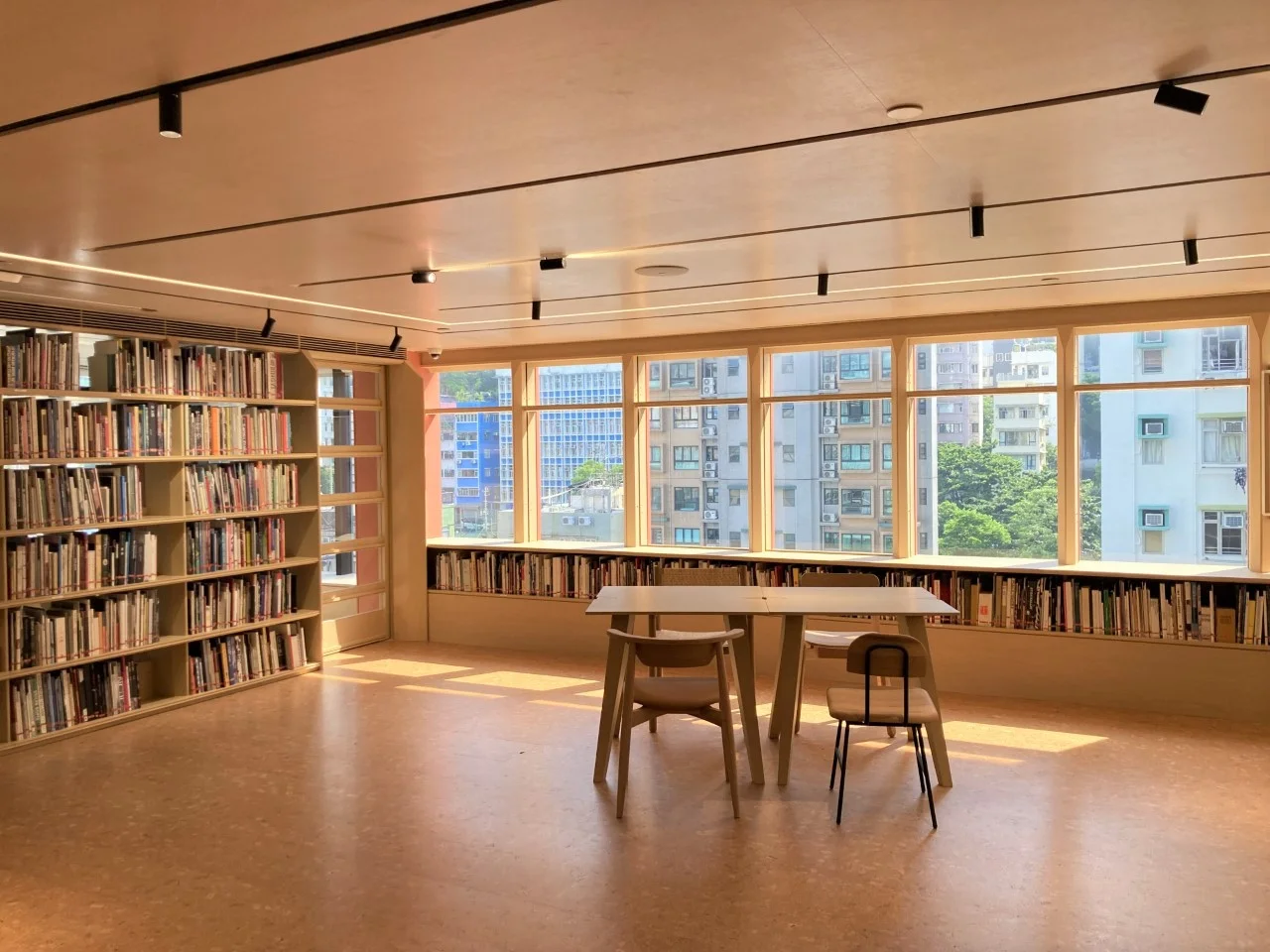
The physical archive sits at 233 Hollywood Road in Hong Kong's Sheung Wan district — a neighbourhood of antique dealers, temples, and colonial-era streets climbing the slope between the harbour and the Mid-Levels. Access is free. The library was renovated in 2022, increasing shelving capacity by fifty percent to accommodate a collection that keeps growing. Walking in, you can browse the catalogue and request materials without institutional affiliation or credentials. That openness is deliberate: AAA's mandate from its founding has been to make its holdings accessible to researchers, artists, students, and the public, not to function as a closed institutional repository. The collection is also searchable online. International branches operate in New York and New Delhi, extending the archive's reach beyond Hong Kong.
A Platform, Not Just a Storage Room
Asia Art Archive has organised more than 500 programmes and projects beyond its library functions. Speakers at its public talks and symposia have included Ai Weiwei, Xu Bing, the Guerrilla Girls, Mariko Mori, and Huang Yongping. The archive launched a residency programme in 2007, inviting artists and researchers to engage directly with its physical holdings in ways that might lead to new work — to read the materials not just as historical documents but as sources for practice. International residents have included Raqs Media Collective and Young-hae Chang Heavy Industries; local residents have included artists Pak Sheung Chuen and Wong Wai Yin. AAA also publishes art and cultural criticism on its online platform Like a Fever, whose tagline — "obsessive, moody, and oriented towards cure" — signals something about how the organisation thinks about archives: not as static warehouses, but as places where engagement with the past can generate something that acts on the present.
Preserving What Institutions Overlooked
The archive has digitised personal collections from artists and critics who would otherwise remain invisible to the art-historical record. The personal archive of Ha Bik Chuen (1925–2009), a Hong Kong-based artist whose decades of documentation became the basis of a major 2021 exhibition called Portals, Stories, and Other Journeys. The archives of Geeta Kapur and Vivan Sundaram from Delhi. The records of Ray Langenbach from Malaysia, Salon Natasha in Hanoi, Ellen Pau in Hong Kong, and Blue Space in Ho Chi Minh City. Each of these represents a different node in a regional network that was active, interconnected, and producing serious work without the institutional backing that Western art history had long taken for granted. The AAA's founding insight — that these histories needed to be secured before they were lost — has turned out to be correct. Some of what it collected in its early years would have been gone within a decade.
From the Air
Asia Art Archive is located at 22.286°N, 114.148°E on Hollywood Road in Hong Kong's Sheung Wan district, on the north side of Hong Kong Island above the central harbour waterfront. The building is not visible as a landmark from the air, but the neighbourhood sits on the hillside above the harbour, identifiable from altitude by the dense low-rise streets between the glass towers of Central to the east and the Western District to the west. Hong Kong International Airport (VHHH) is approximately 18 nautical miles to the northwest. The surrounding area at 3,000 to 5,000 feet shows the characteristic layering of Hong Kong's urban geography: waterfront reclamation, colonial-era streets, and residential towers climbing the Peak above.
Nearby Stories
- Lok Ma Chau Loop 2.3 km away
- Portas do Cerco 2.3 km away
- Kweilin Incident 17 km away
- Wanshan Archipelago Campaign 34 km away
- Nanxiong Formation 115 km away
- Battle of Nanpeng Island 148 km away
- Heyuan 169 km away
- Cape Maobitou 632 km away