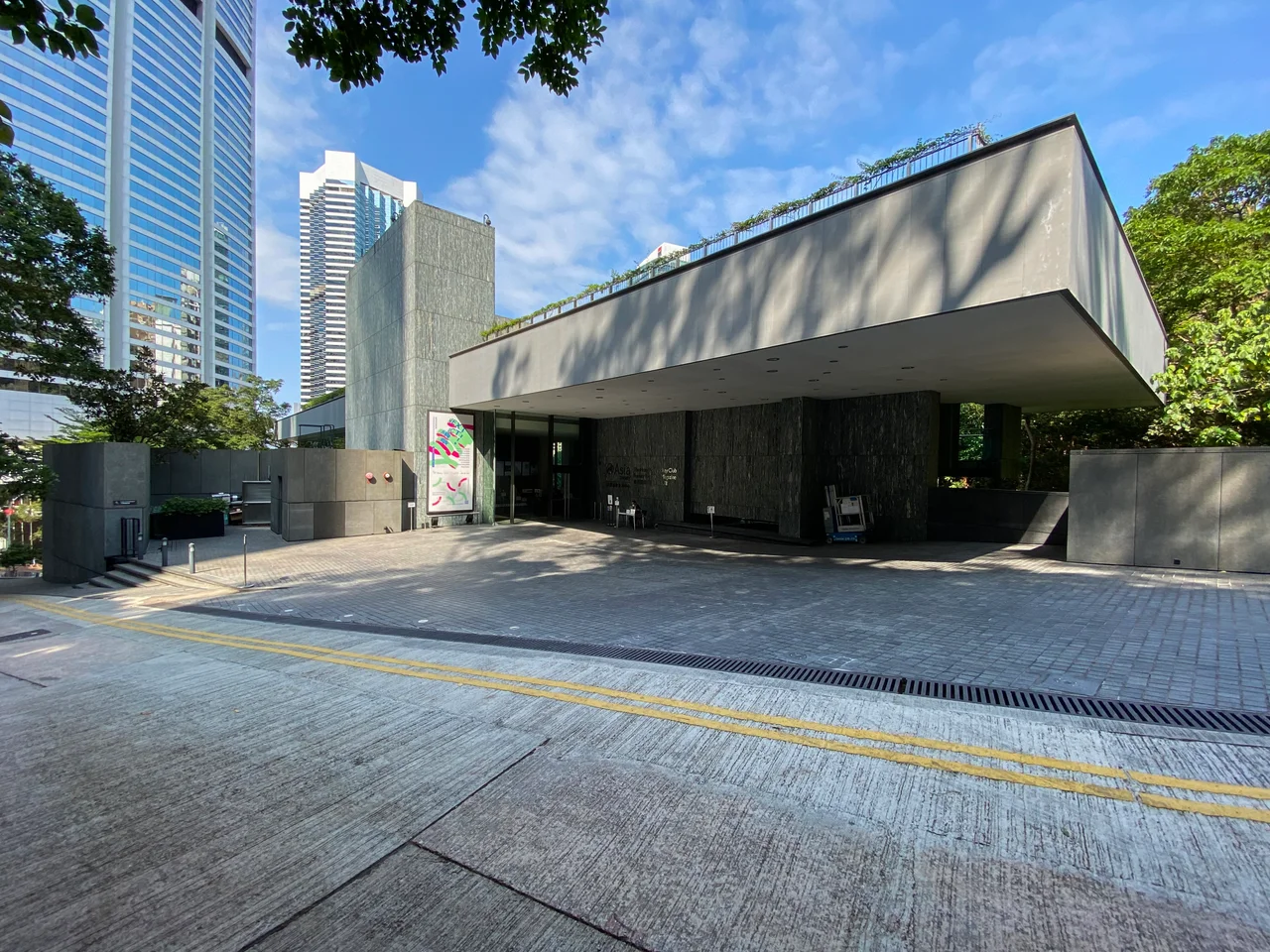

Asia Society Hong Kong Centre
The earth mounds look like gentle garden terracing until you learn what they were built to contain. Known as traverses, these grass-covered berms were engineered to limit the blast radius if the ammunition stored beside them ever detonated. For more than a century, the stone buildings they flanked sat in Victoria Barracks, handling the volatile materials that kept a colonial garrison armed. Today those same buildings house some of the most thoughtful gallery spaces in Hong Kong — and the traverses, now softened by ferns and subtropical greenery, have become the most distinctive landscaping feature on a cultural campus that nobody expected to find in the middle of the city's financial district.
Gunpowder and Stone
The Former Explosives Magazine of the Old Victoria Barracks was built in stages between 1843 and 1874, when the British Army needed somewhere secure to store the munitions supporting its garrison on Hong Kong Island. The stone construction was deliberately robust: thick walls, small apertures, buildings positioned so that a detonation in one structure would not cascade to its neighbors. The traverses — those distinctive earth banks between buildings — were an engineering solution to proximity. They absorbed pressure waves and deflected blast upward rather than outward. Magazine A, the oldest surviving military building from the colonial era in Hong Kong, was constructed between 1863 and 1868. Magazine B followed between 1905 and 1907. Both are Grade I historic buildings under Hong Kong's assessment system. The site was abandoned in the 1980s as its military purpose became obsolete, and it sat quietly while the city built around it — until the Hong Kong SAR Government granted the 1.3-hectare property to the Asia Society.
Architects Who Listened to the Ground
The commission to transform the old magazine site fell to Tod Williams and Billie Tsien, the New York-based architectural partnership known for work that responds carefully to existing materials and landscape. At a site where the history was literally embedded in the earth, they chose not to impose a bold new gesture but to weave connections. A modern footbridge — the Yasumoto Bridge — links the restored historic structures across a ravine, creating a circulation path that makes the whole 1.3-hectare campus walkable without flattening its topography. Magazine A became the Chantal Miller Gallery, an international-standard exhibition space where the thick stone walls that once contained explosive force now create a quiet, controlled environment for art. Magazine B became a 100-seat theater equipped for talks, performances, and film screenings. The restoration was funded through the Hong Kong Jockey Club Charities Trust alongside contributions from local and international donors, and the campus opened in February 2012.
A Stage for Asia's Conversations
The Asia Society itself began its Hong Kong journey in 1990, operating from a different address for more than two decades before arriving at the magazine site. Its mission — navigating shared futures for Asia and the world across arts, culture, business, and policy — shapes a program of roughly 200 events each year. The Chantal Miller Gallery, free to the public, hosts three to four major exhibitions annually. Past shows have drawn from across Asia: Xu Bing's conceptual retrospective *It Begins with Metamorphosis*, the Contemporary Chinese Woman Artist Series, Yoshitomo Nara's warmly received *Life is Only One* in 2015. Between the exhibitions, workshops, guided tours, and policy dialogues run through the calendar. The setting makes a particular kind of seriousness possible. Somewhere between the old stone walls, the restored timber, and the harbor views that open from the upper terraces, the campus asks visitors to hold historical weight and present-day ambition at the same time — which turns out to be a very Hong Kong kind of ask.
The View the Soldiers Never Paused to Take
The site sits on a hillside above Admiralty, and the views it commands over Victoria Harbour were presumably less appreciated by the soldiers and engineers who worked there under military discipline. From the upper terraces today, the harbor stretches north toward Kowloon, the skyline of Central rises to the west, and the green slopes of the Peak form a backdrop to the south. The juxtaposition is vertiginous in a cultural sense: one of the oldest colonial-era military structures in Hong Kong, restored and repurposed, surrounded by some of the most expensive office towers on earth. The Asia Society campus is open to the public for self-guided tours, and the combination of layered history, serious architecture, and commanding hilltop position makes it one of the city's least-hyped and most rewarding places to spend a morning.
From the Air
The Asia Society Hong Kong Centre sits at approximately 22.276°N, 114.165°E on the northern slope of Hong Kong Island above Admiralty, at roughly 50 meters elevation. Flying east along Victoria Harbour at 1,500 feet, the green hilltop compound is visible just east of the dense Central skyscraper cluster — look for the grass-covered traverses and stone buildings set back from the waterfront, contrasting with the glass towers immediately below. Hong Kong International Airport (VHHH) lies about 30 km to the west-northwest on Lantau Island. The neighboring Central district landmarks — including the Bank of China Tower's triangular glass form and the HSBC headquarters — provide easy visual orientation.
Nearby Stories
- Lok Ma Chau Loop 2.3 km away
- Portas do Cerco 2.3 km away
- Kweilin Incident 17 km away
- Wanshan Archipelago Campaign 34 km away
- Nanxiong Formation 115 km away
- Battle of Nanpeng Island 148 km away
- Heyuan 169 km away
- Cape Maobitou 632 km away