
Assassination of Abraham Lincoln
Lincoln did not want to go that night. He told Speaker of the House Schuyler Colfax, "I suppose it's time to go though I would rather stay," before helping Mary into the carriage. The play was Our American Cousin, the date was April 14, 1865, and the war had ended five days earlier at Appomattox. The president was tired. He had survived a kidnapping plot, a hole shot through his hat, and four years of impossible decisions. Two blocks from the White House, in a converted Baptist church on Tenth Street, an actor he had once admired from the stage was already waiting.
An Actor's Grievance
John Wilkes Booth was twenty-six, famous, and bitter. His older brother Edwin, the more celebrated Booth, had remained loyal to the Union, and the rivalry between them had curdled into something darker. Three days before the assassination, Booth stood in the crowd outside the White House and listened to Lincoln's last public speech. The president spoke of extending the vote to emancipated Black men. Booth turned to his accomplice Lewis Powell and told him to shoot Lincoln on the spot. When Powell refused, Booth muttered the words that would become his epitaph: "That is the last speech he will ever give." Booth had performed at Ford's Theatre many times. He knew its corridors, its staff, its sight lines. When he learned by chance that morning that the Lincolns would attend that evening, he had the rest of the day to prepare.
The Conspiracy
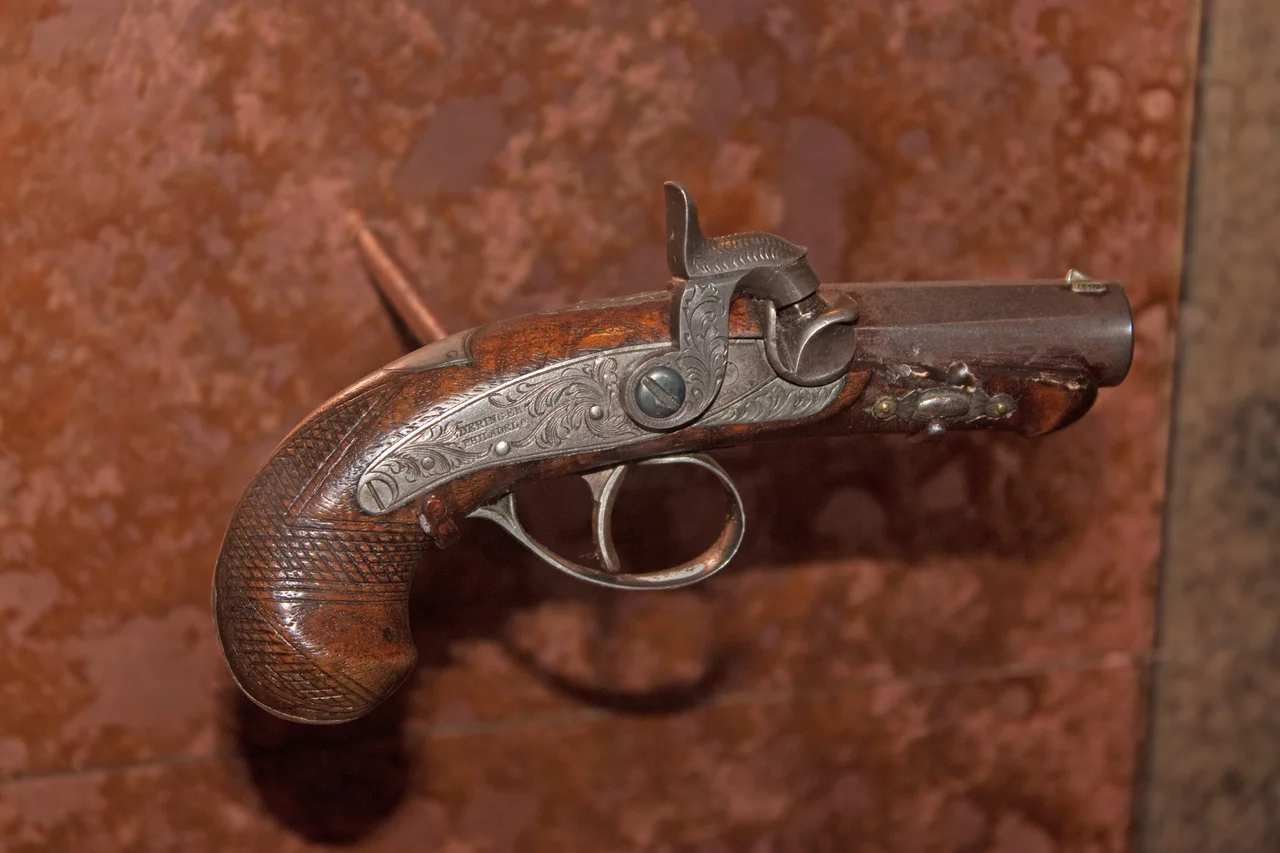
Booth's plan was not a lone gunman's impulse. At 8:45 that evening, in a Washington boarding house, he met with co-conspirators and divided the night into assignments. Lewis Powell would kill Secretary of State William H. Seward at his home. George Atzerodt would kill Vice President Andrew Johnson at the Kirkwood Hotel. David Herold would guide Powell through unfamiliar streets. The goal was decapitation, the simultaneous removal of the Union's top three officers. Atzerodt tried to back out; the plot had originally been a kidnapping, not a slaughter. Booth pressured him to continue. Only Booth himself had the celebrity to walk into the presidential box without challenge, and only he carried the small single-shot Deringer pistol that would do the work.
The Box at Ford's
The protections that should have surrounded the president were not in place. Lincoln's personal bodyguard Ward Hill Lamon was in Richmond on assignment. Officer John Frederick Parker, assigned to guard the door of the box, slipped away to a tavern at intermission and may never have returned to his post. Inside the box, Lincoln sat in a rocking chair drawn from the Ford family's own furnishings, holding Mary's hand. The audience of about seventeen hundred had risen to applaud when the family arrived; the orchestra had played "Hail to the Chief." The cast altered a line in his honor, declaring that the draft had been stopped by order of the President. Around ten o'clock, Mary leaned in and whispered, worried what Miss Harris would think of her clinging to him so. Lincoln replied that she would not think anything about it. These are the words traditionally remembered as his last.
The Shot
Booth had spent the day preparing. He had bored a small peephole in the door of the box. He had cut a notch in the wall so that a wooden brace could bar the corridor behind him. At about 10:10 he climbed the stairs to the dress circle, showed his calling card to Lincoln's valet, and stepped through the door no one was guarding. He wedged the brace into place. He looked through his peephole. Then he opened the inner door and fired a single shot into the back of Lincoln's head. The bullet passed through the president's brain and lodged behind his right eye. Major Henry Rathbone, seated in the box with his fiancee Clara Harris, lunged at Booth and was slashed across the arm with a hunting knife. Booth vaulted over the railing toward the stage twelve feet below. His spur caught on a Treasury flag draping the box. He landed awkwardly, breaking his leg.
What Came After
Booth crossed the stage with a bloody knife held over his head. Most witnesses remembered him shouting Sic semper tyrannis, the Virginia state motto, "Thus always to tyrants." Many in the audience first thought he was part of the play. He stabbed orchestra leader William Withers on his way to a side door, mounted his waiting horse, and rode east out of Washington. Lincoln was carried across Tenth Street to a boarding house owned by William Petersen and laid diagonally across a bed too short for his long frame. He never regained consciousness. He died at 7:22 the next morning. Twelve days after the shot, Booth was cornered in a Virginia tobacco barn and killed. The other conspirators were tried by military commission. Four were hanged. Lewis Powell had nearly succeeded in his attack on Seward. George Atzerodt lost his nerve and never approached Andrew Johnson. The decapitation Booth imagined fell short of its intent, but the country it remade is the one we still live in.
From the Air
Ford's Theatre stands at 38.8964 degrees north, 77.0256 degrees west, on Tenth Street NW in downtown Washington, D.C., about two blocks east of the White House. Best viewed at 1,500 to 2,500 feet AGL with the National Mall to the south. Reagan National (KDCA) lies about four nautical miles south across the Potomac; Washington Dulles (KIAD) sits roughly twenty-five nautical miles west. Class B airspace and the P-56 prohibited area cover the city center, so the site is observed only from authorized routes or from the riverside approaches.
Nearby Stories
- Gunston Hall 1.1 km away
- 2023 Baltimore Shooting 4.9 km away
- Battle of Middleburg 6.6 km away
- Crownsville Hospital Center 10 km away
- Battle of Loudoun Heights 13 km away
- First Battle of Rappahannock Station 20 km away
- Howard County, Maryland 21 km away
- Harriet Tubman Underground Railroad 50 km away