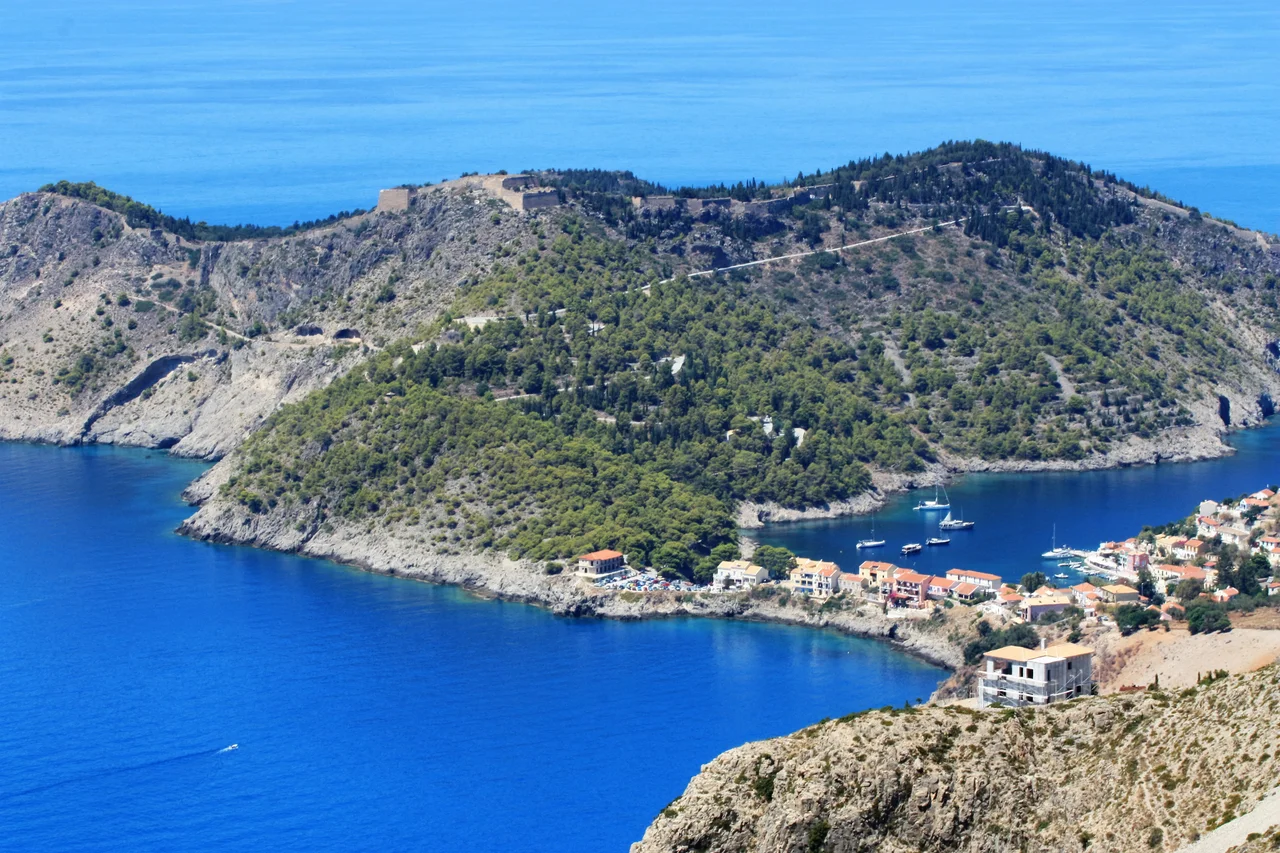

Assos Castle
The architect who built Assos Castle between 1593 and 1596 never left. Marino Gentillini had come from Venice to construct a fortress on a 170-metre rocky peninsula jutting into Cephalonia's northwest coast, and when the work was done he married a local woman, settled on the island, and had his name inscribed in the Venetian Libro d'Oro — the register of noble families. His descendants eventually turned their Cephalonian roots into something improbable: the Gentillini winery, one of the pioneering wine estates of modern Greece. A military engineer became a vintner's ancestor. The castle he built, meanwhile, outlasted empires.
A Fortress Stronger Than Gibraltar
When British general Charles James Napier visited Assos in the nineteenth century, he declared it stronger than Gibraltar. The comparison was not idle flattery. The castle walls extend for 2,000 metres, enclosing an area of 44,000 square metres — the entire peninsula of Assos, top to bottom, from the neck of the headland to its seaward tip. The hill beneath the walls rises 170 metres above the water, making a naval assault from below almost impossible. To the north lies the bay of Agia Kyriaki; to the south, the sheltered waters of the Assos anchorage. Pirates, Ottoman fleets, rival Italian powers — the castle was designed to discourage all of them simultaneously.
Why Venice Needed a Second Fortress
By 1584, the nobles of Cephalonia had concluded that the island's older stronghold, the Castle of Saint George in the south, could no longer defend the whole island. They petitioned the Venetian Senate for a new fortress to protect the northern approaches. Venice agreed, with ambitions beyond mere defense: the plan called for founding a small city within the walls and relocating the island's administrative capital from Saint George. Building began in 1593 under the supervision of Ambrosius Cornelius and was completed within three years. The result was not just a fort but a fortified town, complete with a church dedicated to Saint Mark and a residence for the Venetian High Commissioner.
Life Inside the Walls
Assos was never a comfortable place to live. The peninsula's isolation — the same feature that made it militarily strong — meant that a determined enemy could cut off its water supply and starve the settlement into surrender without a direct assault. Still, for nearly two centuries it functioned as the capital of northern Cephalonia, its small population of families known as the Kastrinoi cultivating olives and grapes on the slopes within the walls. In 1684, when Venice captured Lefkada from the Ottomans, the strategic rationale for Assos faded. By 1757, the Venetians had founded Argostoli on the southern coast, and Assos gradually emptied out.
Refuge, Prison, Ruin
The nineteenth century brought unexpected drama. In 1822, around 1,700 people from Souli — a community from the Greek mainland that had resisted Ottoman rule — arrived at Assos seeking refuge. The entire area was declared a quarantine zone, and the settlement within the walls took on the name of those who sheltered there. Later still, in the 1920s, a prison was established inside the ruins. After World War II it held political prisoners, who tended vineyards and cereal crops on the same ground where Gentillini's descendants had farmed. The 1953 Ionian earthquake damaged the surrounding region badly, and the last Kastrinoi finally left in 1963. Six people remained when the 1961 census was taken.
What Remains
Today Assos Castle is open to visitors daily with no entry fee. The walls are largely intact. Inside the ruins you can find the small church of Saint Mark and the remains of the Venetian High Commissioner's house. Near the main gate, an inscription records the castle's origins and the name of its supervising engineer. Down the slope from the walls, the village of Assos — a cluster of pastel houses around a small bay — has been carefully restored after earthquake damage and remains one of the most picturesque settlements in Cephalonia. The pine forest that covers the peninsula softens the stone, and from the ramparts, the view down to the turquoise water is the kind that makes the effort of the climb worthwhile.
From the Air
Assos Castle sits at 38.38°N, 20.53°E on the northwestern coast of Cephalonia, occupying an entire pine-covered peninsula visible from the air as a distinctive elongated headland. At 2,000–4,000 feet the fortress walls and the narrow neck connecting the peninsula to the mainland are clearly distinguishable. The village of Assos and its small bay lie at the base of the hill. The nearest airport is LGKF (Kefalonia International Airport, ICAO), approximately 50 km to the south by road. Approach from the northwest over open water gives the best aerial view of the full peninsula and its fortifications.
Nearby Stories
- Castle of Saint George, Cephalonia 1.4 km away
- Italian torpedo boat Sagittario (1936) 5.9 km away
- Oeniadae 8.9 km away
- Glarentza 23 km away
- Battle of Olpae 31 km away
- Hellenic Trench 39 km away
- Achilleion (Corfu) 100 km away
- Corfu 133 km away