_shield.JPG)
Athena Parthenos
She no longer exists. Sometime in the first millennium, the most famous statue in the ancient world simply vanished from the record, and every account we have of her comes from people who once stood in her shadow and tried to describe what they saw. The Parthenon you can climb to today is an empty shell, sun pouring through its broken roofline. But the entire building was raised for one purpose: to hold a single figure of the goddess Athena, nearly twelve meters of gold and ivory, so tall her helmet almost grazed the ceiling. The temple was the box. She was the jewel.
A Statue Built Like a Ship
The sculptor Phidias did not work alone. Under his supervision, around the mid-fifth century BCE, a team of craftsmen assembled the figure the way Athens built its navy, plank by plank. The core was a rot-proof frame of cypress wood, planted in the Parthenon floor in a hole still visible today. Onto this skeleton went the skin: ivory for the face, arms, and feet, softened and unrolled in thin sheets "like a roll of papyrus," then sheets of hammered gold for the robes. The flesh was painted, the cheeks and lips reddened so the goddess seemed alive, her lips perhaps parted to suggest breath. Athens had the carpenters who built triremes, and it set them to building a god.
The Goddess as Treasury
This was not only devotion. It was banking. The gold on the statue weighed roughly forty-four talents, more than a ton of it, deliberately made removable so the city could melt it down in an emergency and recast it later. By way of comparison, the annual tribute from Athens's imperial allies came to around twenty-eight talents a year. The whole work was reckoned at 704 talents, the price of two hundred warships. So the figure that received the city's prayers was also its emergency reserve, sheathed in wealth from the empire she presided over. Athens at the height of Pericles's power had found a way to pray to its own treasury and call it piety.
Reading the Surface
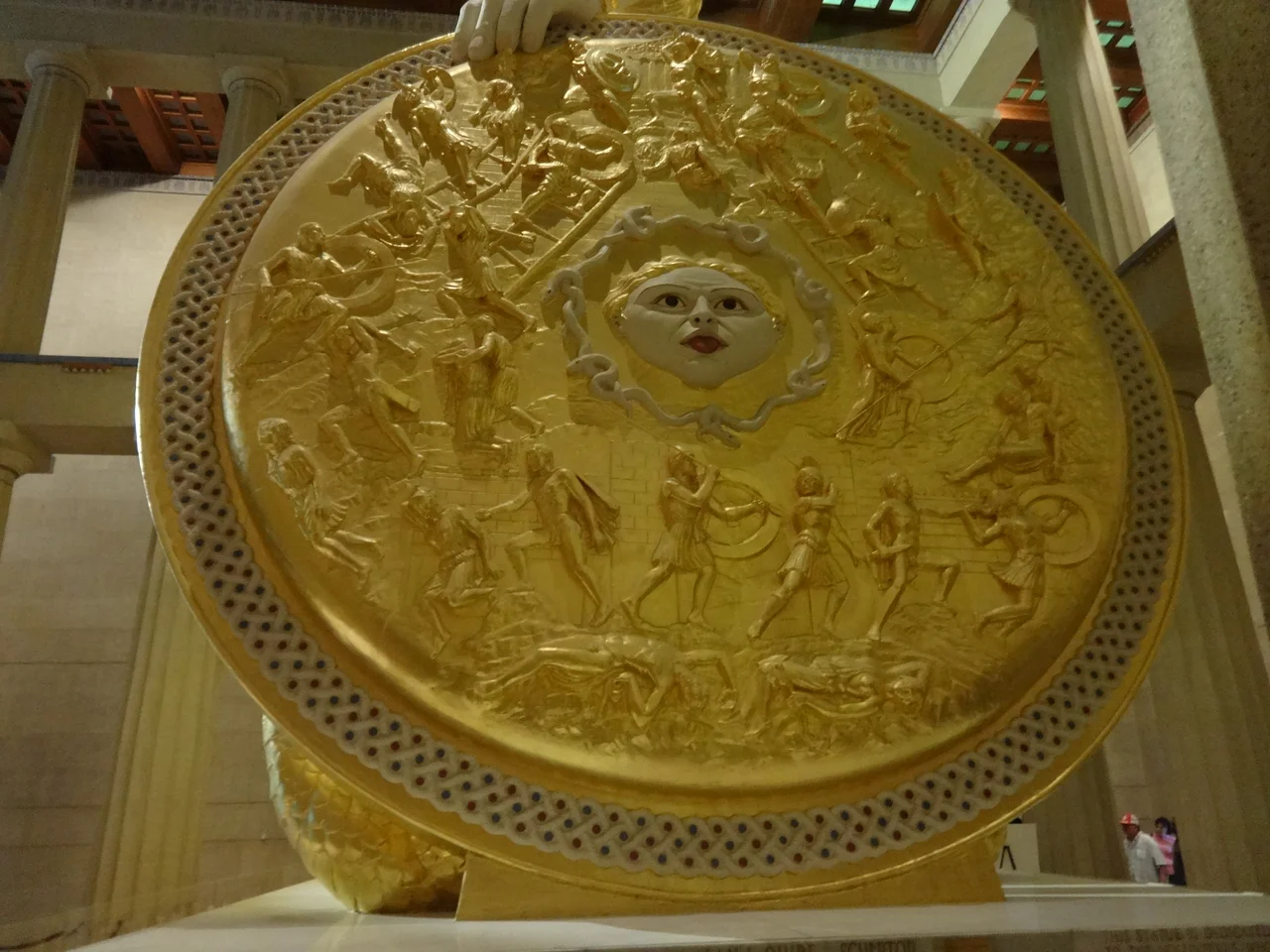
Every inch carried meaning. On her breast hung the aegis with an ivory gorgon's face; snakes coiled at her belt and wrists; her helmet bore a sphinx flanked by winged horses. In her right hand she held a two-meter figure of Nike, victory itself, reaching up to crown her. Her great shield, propped at her side, showed Greeks battling Amazons in carved relief, and in that crowd Phidias is said to have hidden a portrait of himself as a bald old man hurling a stone, with Pericles beside him. It was a small, dangerous vanity. Later, that self-portrait became evidence in a charge that the sculptor had stolen sacred gold.
The Long Disappearance
Phidias was accused of embezzling the goddess's metal, escaped, and reportedly fled to Olympia to make his colossal Zeus before dying there. Around 296 BCE, the tyrant Lachares is said to have torn the gold plates from the statue to pay his soldiers, leaving the bare wood and ivory beneath. A fire gutted the Parthenon in late antiquity; the statue was damaged, restored, and at some point lost for good. One tradition has her shipped to Constantinople, where she might have survived into the tenth century. The sources fall silent. Whether she was melted, burned, or simply carried away, no one recorded her end, the way no one records the moment a memory finally fades.
What We Build to Remember
We know her only through copies. At least sixty-nine small versions survive, scattered as far as a Crimean tomb, and a handful of careful Roman marbles, the Varvakeion Athena and the Lenormant, preserve her pose and her gorgon shield. In 1990, the sculptor Alan LeQuire built a full-size replica for the Nashville Parthenon, gilded with about 8.5 pounds (roughly 3.9 kilograms) of gold leaf, and standing beneath it is the closest a modern visitor can come to the scale the ancients felt. In 2024, researchers reconstructed her in physically accurate 3D, finally simulating how lamplight and the basin of water at her feet would have made the gold and ivory glow. We keep rebuilding her. Some absences are too large to leave empty.
From the Air
The Acropolis sits at 37.9715 N, 23.7269 E, in central Athens. The Parthenon's marble crown is the unmistakable visual landmark, floating above the city on its limestone rock and visible for miles in clear Attic light. Athens International Airport (LGAV) lies roughly 20 nm east. Recommended viewing altitude 2,500-4,000 ft AGL for the full Acropolis-and-city panorama; haze and summer heat shimmer can soften visibility midday, so early morning offers the cleanest sightlines.
Nearby Stories
- Great Sand Beach 5 km away
- Battle of Delium 7.7 km away
- Tower of Aliartos 9 km away
- HMHS Britannic 10 km away
- Saronic Gulf 15 km away
- Sousaki Volcano 17 km away
- Sanctuary of Apollo Maleatas 24 km away
- Skyros 66 km away