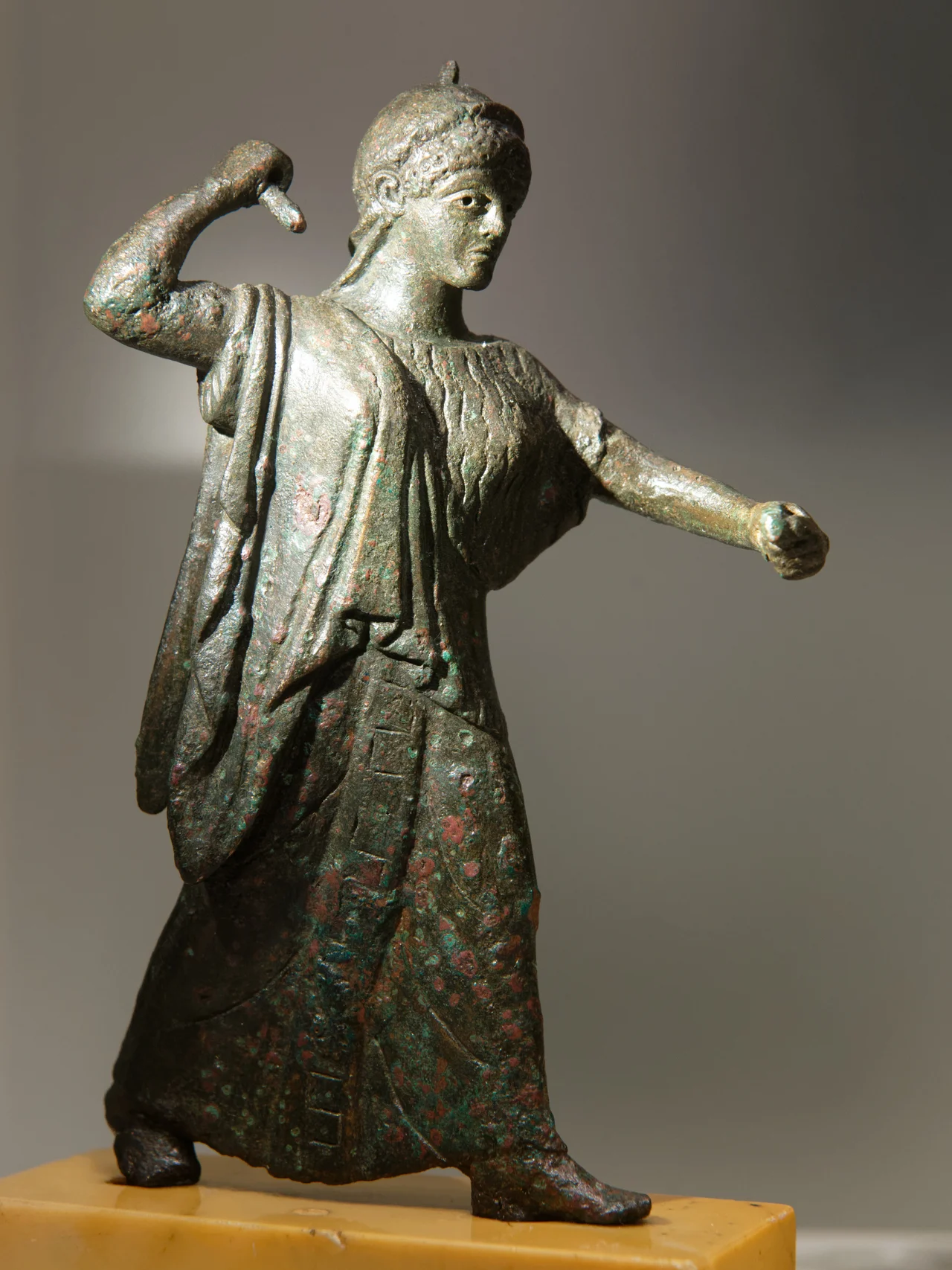

Athena Promachos
A sailor coming up from the south, beating around Cape Sounion toward Athens, would see her first. Not the city, not the harbor, not even the temples on the rock, but a single bright point catching the sun: the gilded tip of a spear, and above it the crest of a bronze helmet. According to the geographer Pausanias, that was how you knew you were nearly home. The statue was Athena Promachos, "Athena who fights in the front line," and she stood in the open air on the Acropolis, a beacon of metal so tall she announced the city from seventy kilometers away.
The First Great Phidias
Before the Parthenon, before the gold-and-ivory cult statue inside it, there was this. The Athena Promachos was one of the earliest recorded works of Phidias, raised around 456 BCE after roughly nine years of labor. She stood out in the open between the Propylaea and the Erechtheion, the gateway and the old temple, where everyone entering the sacred summit had to pass beneath her. Made entirely of bronze, she was known plainly to Athenians as "the great bronze Athena." Where the later Parthenos was sealed indoors like a treasure, Promachos belonged to the sky, weathering the wind off the Saronic Gulf in full view of the city she guarded.
A Monument to Victory
She was a war memorial. The dedicatory inscription tied her to the long struggle against Persia, and trophies won in those wars were once arranged around her pedestal. Scholars still debate exactly which victory she crowned, whether Marathon, the broader Greco-Persian Wars, Cimon's triumph at the Eurymedon in 466 BCE, or the peace that finally ended the fighting around 449. The bronze itself may have come from captured Persian arms, melted down and reborn as the goddess who had defended Greece. In 2001, archaeologists digging on the Acropolis's southern slope uncovered the casting workshop where she was almost certainly poured, the forge for a goddess hiding in plain sight for two and a half thousand years.
The Beacon of Attica
It is the detail that has outlived the statue: the claim, recorded by Pausanias, that her helmet crest and spear-point were visible to ships approaching from Sounion. Whether literally true or the kind of proud exaggeration cities tell about themselves, the image is unforgettable. To a sailor on the dark water, exhausted and far from land, the first sign of Athens was its goddess, catching the light before any human structure rose into view. She did not just stand on the Acropolis. She extended the city's reach to the horizon, a promise of safe harbor written in bronze and sun.
Destroyed by a Crowd
Her end was not slow erosion but a single violent night. Carried off to Constantinople, she was set up as a trophy in the Forum of Constantine, where the Eastern Roman court had become a refuge for the surviving bronzes of the Greek world. There the historian Niketas Choniates watched her die. In 1203 CE, during the chaos before the Fourth Crusade sacked the city, a frightened, drunken mob turned on the great bronze Athena, convinced she was beckoning the Western armies inward with her outstretched hand. They tore her down and smashed her. A statue that had stood for over sixteen centuries was destroyed by people who mistook a goddess for an omen.
Reconstructing a Ghost
No fragment of her survives, and we no longer know exactly how she looked. The clues are scattered and contradictory: Roman coins struck in Athens show a colossal female figure between the Propylaea and the Erechtheion, confirming where she stood; other images give her an owl, a shield, a column, a snake. The painter Leo von Klenze, in 1846, imagined her in a famous canvas of the Acropolis, spear raised, visible from far off exactly as the ancient texts described. Every reconstruction is a guess built on a coin, a sentence, a memory. She has become a shape we feel certain existed, and can no longer quite see.
From the Air
The Acropolis stands at 37.9718 N, 23.7257 E, in central Athens, with Promachos's original position on the open summit between the Propylaea and the Erechtheion. The marble Parthenon is the dominant visual landmark from the air. Cape Sounion, the legendary sightline point, lies roughly 38 nm to the southeast at the tip of Attica, its Temple of Poseidon a secondary landmark. Athens International (LGAV) is about 20 nm east. Recommended viewing altitude 3,000-5,000 ft for a combined Acropolis-and-Saronic-Gulf vista; clearest in morning light before haze builds.
Nearby Stories
- Great Sand Beach 5 km away
- Battle of Delium 7.7 km away
- Tower of Aliartos 9 km away
- HMHS Britannic 10 km away
- Saronic Gulf 15 km away
- Sousaki Volcano 17 km away
- Sanctuary of Apollo Maleatas 24 km away
- Skyros 66 km away