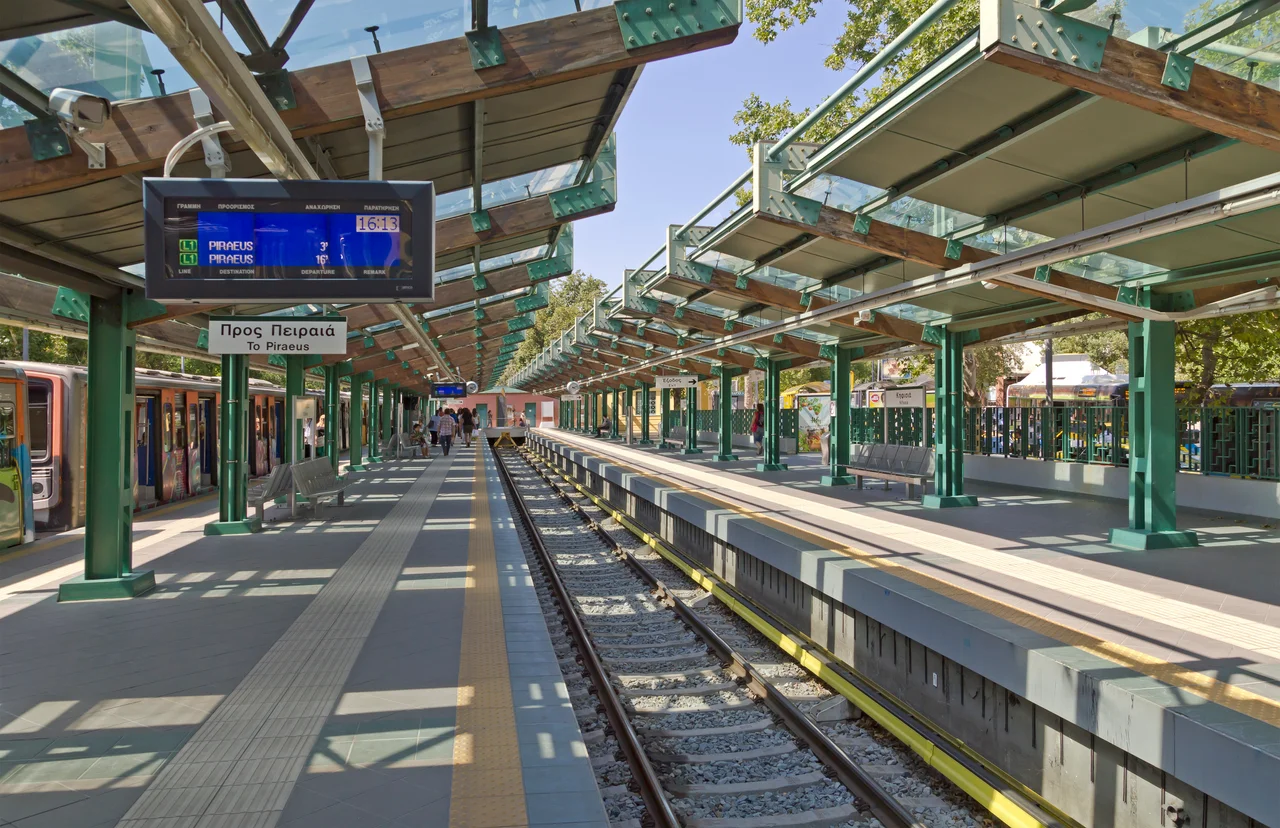

Athens–Piraeus Electric Railways
On 27 February 1869, Queen Olga of Greece climbed aboard a steam train and rode it from the port of Piraeus to the foot of the Acropolis. The prime minister came too. The occasion warranted royalty because the country had just opened its first railway, a line linking Athens to the sea, and no one in the small, young Greek state could be sure where such a thing might lead. It led, as it turned out, to one of the oldest urban rail lines in the world, a route that has been moving Athenians for more than a century and a half and is still running today.
Steam to the Sea
The first trains were modest: eight services a day in each direction between Piraeus and Thiseio, nine on Sundays, hauled by steam locomotives along a line that hugged the ground because it was built for steam, not tunnels. The route mattered out of all proportion to its length. Piraeus had been Athens' harbor since antiquity, and the railway stitched the ancient port to the capital in minutes rather than the better part of an hour on foot or by carriage. Ownership soon passed to a bank, the line crept north into the city, and a short underground stretch was dug toward Omonoia Square using the simple cut-and-cover method, trenching the street and roofing it over. The age of the Athens underground had quietly begun.
The Switch to Electric
In 1904 the line was electrified, and the transformation set its character for the next hundred years. Out went the smoke and the steam; in came electric trains drawing power from a third rail. The company changed hands and names more than once over the decades: a British power group bought it in 1926 and rebranded it as the Hellenic Electric Railways, absorbing a neighboring railway that carried the tracks ever farther north. The line reached the suburb of Attiki in 1948 and the leafy northern town of Kifissia in 1957. Steam had connected a port to a city; electricity turned that connection into a true urban transit line, threading the growing metropolis from the docks to the hills.
One of the Oldest in the World
Because that 1869 line never stopped running, it earned a quiet distinction. As it was gradually converted to full rapid-transit operation, it became one of the oldest metro lines anywhere, predating the subways of New York and most of continental Europe. When Athens opened two gleaming new deep-level lines in 2000, the old railway was folded into the unified Athens Metro as Line 1, the Green Line, the senior member of a three-line family. The company that ran it, Athens-Piraeus Electric Railways, known by its Greek initials ISAP, kept operating until 2011, when it was absorbed into a new operator, STASY, headquartered in the old ISAP offices near Omonoia. The name changed. The trains kept running.
Yellow Trains and Wooden Survivors
A railway this old accumulates stories in its rolling stock. The earliest cars were wooden, mounted on iron frames, and a single short train of two preserved wooden railcars still survives, wheeled out for special occasions. In the early 1980s, short of trains, the company leased six bright yellow four-car trainsets from East Berlin's U-Bahn, an unlikely splash of Cold War color rolling through Athens. There was even a brush with London: the company considered buying sixty secondhand cars from the London Underground before deciding to order new ones instead. Ride Line 1 today, from the salt air of Piraeus up through the city center to Kifissia, and you are traveling a route the Queen of Greece inaugurated when the American transcontinental railroad was still being spiked together. Few commutes are older.
From the Air
The historic line (now Athens Metro Line 1) runs north-south through the Athens basin, anchored at its southern end by the port of Piraeus on the Saronic Gulf and reaching north to the suburb of Kifissia. Its central districts cluster near Omonoia and Thiseio (around 37.9831 N, 23.7276 E), beside the Acropolis and the Ancient Agora. The line runs mostly at surface level, with a short underground section through the center, making the tracks visible from the air across much of their length. Athens International Airport (LGAV) lies about 30 km to the east; passengers connect to it via the Athens Suburban Railway at Neratziotissa. Recommended viewing altitude 3,000-5,000 ft following the rail corridor from the harbor inland toward the city core. Visibility over Attica is typically excellent, with summer heat haze common over the basin.
Nearby Stories
- Great Sand Beach 5 km away
- Battle of Delium 7.7 km away
- Tower of Aliartos 9 km away
- HMHS Britannic 10 km away
- Saronic Gulf 15 km away
- Sousaki Volcano 17 km away
- Sanctuary of Apollo Maleatas 24 km away
- Skyros 66 km away