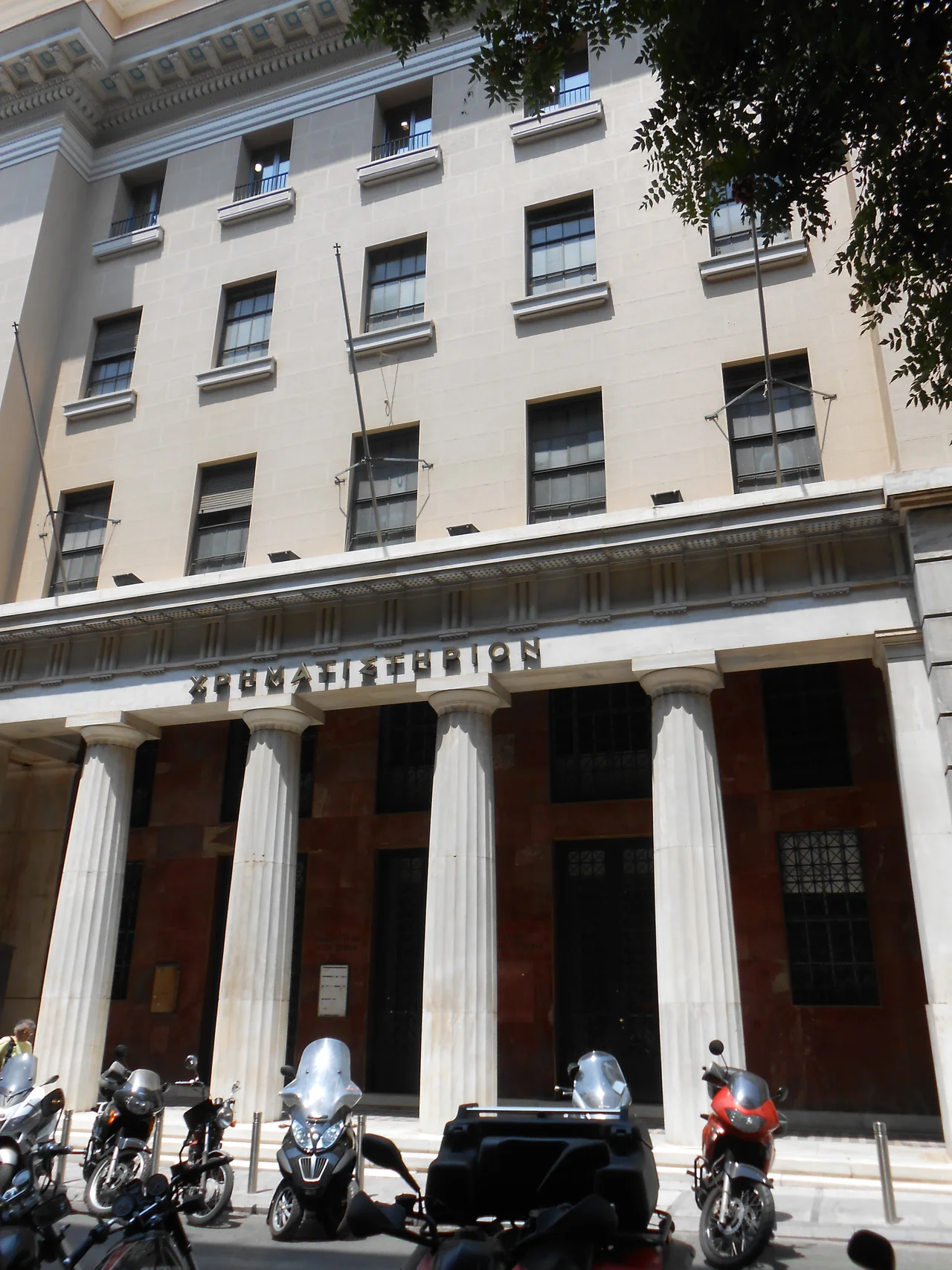

Athens Stock Exchange
For 131 years, one Athens street name meant money. Say 'Sofocleous' to a Greek of a certain age and you do not mean the playwright Sophocles - you mean the stock market, the way an American might say 'Wall Street' or a Londoner 'the City.' The Athens Stock Exchange and that downtown street grew so entwined that they became, in everyday speech, the same thing. Founded in 1876, it has outlasted monarchies, dictatorships, and a near-bankruptcy that froze the entire market for over a month. In 2025 it lost something it had kept for a century and a half: its independence.
A Market Older Than Modern Greece
Trading began in 1876, when Greece was a young kingdom still defining itself. The exchange became a public entity in 1918, then took the slow road that so many state institutions travel. In 1995 it was reorganized as a public limited company wholly owned by the Greek state. Over the next four years the government peeled off its stake in pieces - 39.67 percent sold in 1997, another 12 percent in 1998 - until the state held under half. In August 1999 the market widened beyond stocks and bonds with the launch of a derivatives exchange. Through all of it, the institution kept doing the unglamorous work of matching buyers and sellers, day after day, in the heart of the capital.
The Five Weeks It Went Dark
Then came the moment Athens stopped trading entirely. On 27 June 2015, at the worst of the Greek government-debt crisis, the exchange shut its doors. Capital controls had locked down the banks; the country was staring at the possibility of leaving the euro. For five weeks the market simply did not open. When it finally reopened on 3 August 2015, the reckoning was brutal: the main index fell more than 16 percent in a single session, and some bank stocks dropped 30 percent - the daily limit - the maximum a share was allowed to fall before trading halts kicked in. It was one of the steepest opening days any modern exchange has endured, a national crisis rendered as a wall of red numbers.
Leaving Sofocleous Behind
The exchange and its famous street parted ways in 2007, when it moved from Sofocleous Street to new headquarters out on Athinon Avenue, also called Kavalas Street. The old trading floor that had given the market its nickname fell silent. These days the work happens quietly behind screens: roughly 166 companies, more than 170 stocks, and a tangle of indices led by the Composite Index, known by the symbol GD. The exchange runs its own clearing house and central securities depository, the plumbing that settles every trade. The doors open at 10 in the morning and close at 5:20 in the afternoon, Monday to Friday - a far cry from the shouting crowds that once packed Sofocleous.
Absorbed Into Europe
The exchange's last chapter as a Greek-owned institution closed in 2025. On 1 July, the pan-European operator Euronext announced a takeover bid - an all-share deal valued at roughly 470 million dollars. By 19 November, Euronext confirmed that its offer had succeeded, securing a controlling stake of 74.3 percent and completing the acquisition. After 149 years of independence, Athens became one more market in a continental network stretching from Amsterdam to Milan. It was, in its way, the logical end of a long arc: a national institution born in a young kingdom, dissolving at last into the larger idea of a single European market.
From the Air
The Athens Stock Exchange headquarters sits at 37.9903 degrees N, 23.7286 degrees E, on Athinon (Kavalas) Avenue in the western part of central Athens, away from the old Sofocleous Street site downtown. From the air it is part of the dense Athenian basin, ringed by mountains - Hymettus to the east, Parnitha to the north, Aigaleo to the west. Nearest airport is Athens International (LGAV), about 25 km to the east-southeast. Visible from cruising altitude only in clear weather as part of the broader cityscape.
Nearby Stories
- Great Sand Beach 5 km away
- Battle of Delium 7.7 km away
- Tower of Aliartos 9 km away
- HMHS Britannic 10 km away
- Saronic Gulf 15 km away
- Sousaki Volcano 17 km away
- Sanctuary of Apollo Maleatas 24 km away
- Skyros 66 km away