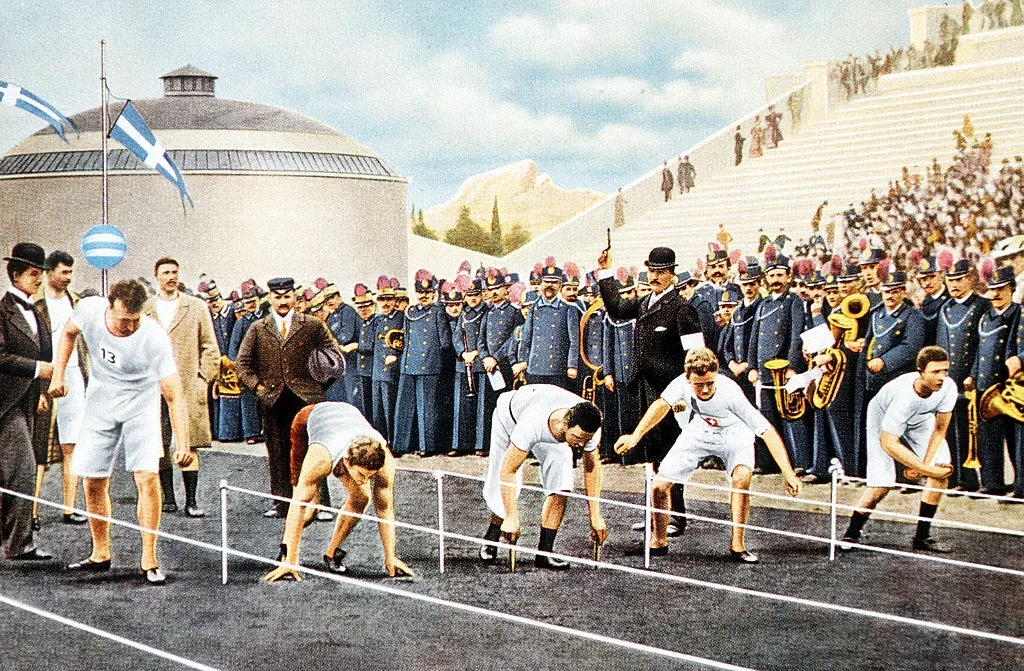

Athletics at the 1896 Summer Olympics – Men's 100 Metres
Nobody was sure what to expect from Thomas Burke. The American was the national champion in the 400 metres, a distance man, not a sprinter. When he crouched low at the starting line of the Panathenaic Stadium on the afternoon of 6 April 1896, the crowd found the posture strange — European runners stood upright to start. But that crouch worked. Burke ran 11.8 seconds in the qualifying heat, setting what would stand as the Olympic Record until the 1900 Games. Four days later, he crossed the finish line of the first Olympic 100-metre final two full meters ahead of the field. The modern Olympic sprint had its first champion.
The Race That Started Everything
The first heat of the men's 100 metres on 6 April 1896 was not just the opening race of the sprint program. It was the first competitive event of the modern Olympic Games, period. King George I of Greece arrived at the stadium at 3 p.m., the brief opening ceremony concluded, and then Francis Lane of the United States ran 12.2 seconds to win the first heat — becoming, in that moment, the first winner of a modern Olympic race. The inaugural Olympic Record was set before the crowds had fully settled into their seats. All three qualifying heats were won by American athletes, a fact that must have surprised the European competitors who had traveled to Athens expecting to dominate the sprint events.
Fifteen Men, Eight Nations
Twenty-one athletes were entered in the first round, divided into three heats of seven runners each. Six of them withdrew before competing, leaving fifteen to contest the event across the three heats. They came from eight nations — Greece, Germany, Hungary, France, Denmark, Great Britain, Chile, and the United States among them. Fritz Hofmann of Germany was considered the most prominent sprinter in the field; he had won the 1893 Championship of the Continent and was far better known as a sprinter than Burke. Thomas Curtis of the United States qualified for the final with a strong showing in the second heat, tying Lane's inaugural Olympic Record at 12.2 seconds. Then, when the final came, Curtis scratched — he had also qualified for the 110-metre hurdles, scheduled immediately after, and chose that race instead. He won it. The final of the 100 metres would be contested by five men.
Two Meters and Six Inches
The final ran on 10 April 1896. Burke, starting from his unconventional crouch, pulled away from Hofmann and held the gap. At the finish line, two meters separated them — a decisive margin. Behind Hofmann, the race for third place was anything but settled. Francis Lane and Alajos Szokolyi of Hungary ran so closely together that the finish could not be separated. They dead-heated — the first tie in Olympic history — both men edging out the Greek competitor Chalkokondylis by a margin of just six inches. The International Olympic Committee would later recognize Burke as gold medalist, Hofmann as silver, and both Lane and Szokolyi as bronze. But in 1896, none of those designations existed yet. The men received olive wreaths and diplomas, the ancient gestures resurrected for the modern age.
A Record That Traveled to Paris
Burke's winning time of 11.8 seconds in the qualifying heat stood as the Olympic Record for the 100 metres until the Paris Games of 1900. It is worth pausing to consider what that number meant: a 400-metre specialist, competing in a short sprint he had not particularly distinguished himself in before Athens, ran fast enough that the world's best sprinters could not improve on it for four years. Burke had not planned to win the 100 metres. He had come to Athens primarily for the 440-yard race. The sprint was almost incidental. And yet the Panathenaic Stadium's marble seats held a moment that no subsequent Olympic sprint final can claim: the first. Every world record broken since, every photo finish scrutinized by electronic eyes, every sprinter in starting blocks anywhere on Earth owes something to that afternoon in Athens, when a distance runner from America crouched low and ran.
From the Air
The Panathenaic Stadium sits at 37.968°N, 23.741°E in the Pangrati neighborhood of Athens, nestled into a natural valley between two low hills, its distinctive horseshoe of white Pentelic marble visible from the air. From low altitude on approach to Athens International Eleftherios Venizelos (LGAV, approximately 20 kilometers to the east-northeast), the stadium appears as a pale oval amid the dense Athens cityscape, close to the National Garden and the distant silhouette of the Acropolis to the west. A viewing altitude of 2,000 feet on a clear day makes the layout of the Pangrati neighborhood, the hill of Ardettus rising beside the stadium, and the line of Vasileos Konstantinou Avenue easily identifiable. The Saronic Gulf glitters to the south. LGAV runways align roughly east-west; aircraft on approach often pass directly over or near the stadium during instrument approaches from the west.
Nearby Stories
- Parnitha 3.4 km away
- Kea (island) 7.3 km away
- Sanctuary of Apollo Maleatas 11 km away
- Sousaki Volcano 12 km away
- Battle of Leuctra 14 km away
- Great Sand Beach 18 km away
- Agios Georgios (island) 23 km away
- Skyros 84 km away