
Attack on the Twentieth Convoy
It was a paper lantern. They had taken a railway signalman's lamp, fitted a candle behind a sheet of red paper, and placed it on the tracks between Boortmeerbeek and Haacht on the night of 19 April 1943. The German train driver saw the red light, believed it meant danger ahead, and slowed the convoy to a stop. Inside the freight wagons behind him, 1,631 Jewish men, women, and children were being deported from Mechelen to Auschwitz. Three young Belgians stood at the side of the track with one pistol between them. They had come to open the doors. Of the people on that train, more than seven hundred would be murdered within days of arriving at their destination. But for those they freed - and for the principle that someone, somewhere, tried - this remains the only known successful armed attack on a Holocaust train.
The Train
By the spring of 1943 the deportations from Belgium had been running for nine months. The Dossin barracks in Mechelen had become the gathering point - a sealed transit camp where Jewish families waited for the next convoy east. Between summer 1942 and 1944, twenty-eight transports would leave Belgium carrying 25,257 Jews and 351 Romani people, almost all bound for Auschwitz-Birkenau. The twentieth convoy was different. The Germans had stopped using third-class passenger carriages, whose windows could be broken or squeezed through, and switched to freight wagons with barbed wire over the small ventilation slits. A special carriage held nineteen prisoners marked on the back with painted red crosses - resistance members and previous escapees the SS had decided would be shot on arrival, no selection necessary.
Three Friends
Youra Livchitz was a Jewish doctor. He had grown up in Brussels, the son of immigrants from the old Russian Empire, and joined the resistance as the deportations began. Robert Maistriau and Jean Franklemon were his friends from school days - neither Jewish, both willing. They had no military training. They had no support from any larger resistance network, who told them the operation was impossible and refused to help. They went anyway. Their plan was almost embarrassingly simple: a pistol, a lantern, the wrench they would need to open the wagon doors. Fifteen armed Sicherheitspolizei guarded the train. Three students stood against them. Maistriau got one wagon open in the confusion before German fire drove them back into the darkness. Seventeen people climbed out and ran into the Brabant fields.
The Driver Who Slowed Down
Once the wagon was open and word passed through the train, the courage cascaded. People who had pried at the bars for hours now hurled themselves through openings. Albert Dumon, the Belgian railwayman at the controls, did what he could in the only language available to him - he kept the train's speed as low as he could plausibly excuse, stopping wherever the timetable allowed, between Tienen and Tongeren and beyond. Every minute slower was another minute someone might jump and live. A nurse named Régine Krochmal sawed through the wooden ventilation bars with a bread knife and dropped from a moving wagon near Haacht. An eleven-year-old boy named Simon Gronowski jumped from a different car and survived to become a lawyer, a jazz pianist, and one of the most patient witnesses of the twentieth century. In all, 233 people escaped that night. One hundred and eighteen of them would live to see the war end.
What Auschwitz Did With the Rest
The train arrived at Auschwitz on 22 April. The selection that followed was unusually brutal even by the standards of that place - the SS appeared to retaliate for the escape by sending almost everyone straight to the gas chambers. Of the 1,398 people who reached Auschwitz alive, only 521 received the tattooed numbers that marked them for slave labor. Of those, 150 survived. The other 874 were murdered within hours of stepping off the train. Seventy percent of the women on the convoy died on the day they arrived. The remainder were assigned to medical experimentation, which is to say they died more slowly. After this convoy, every subsequent transport from Belgium was reinforced with a German reserve company that stayed with the train until it crossed the border. There would be no more attacks.
What Happened to Them
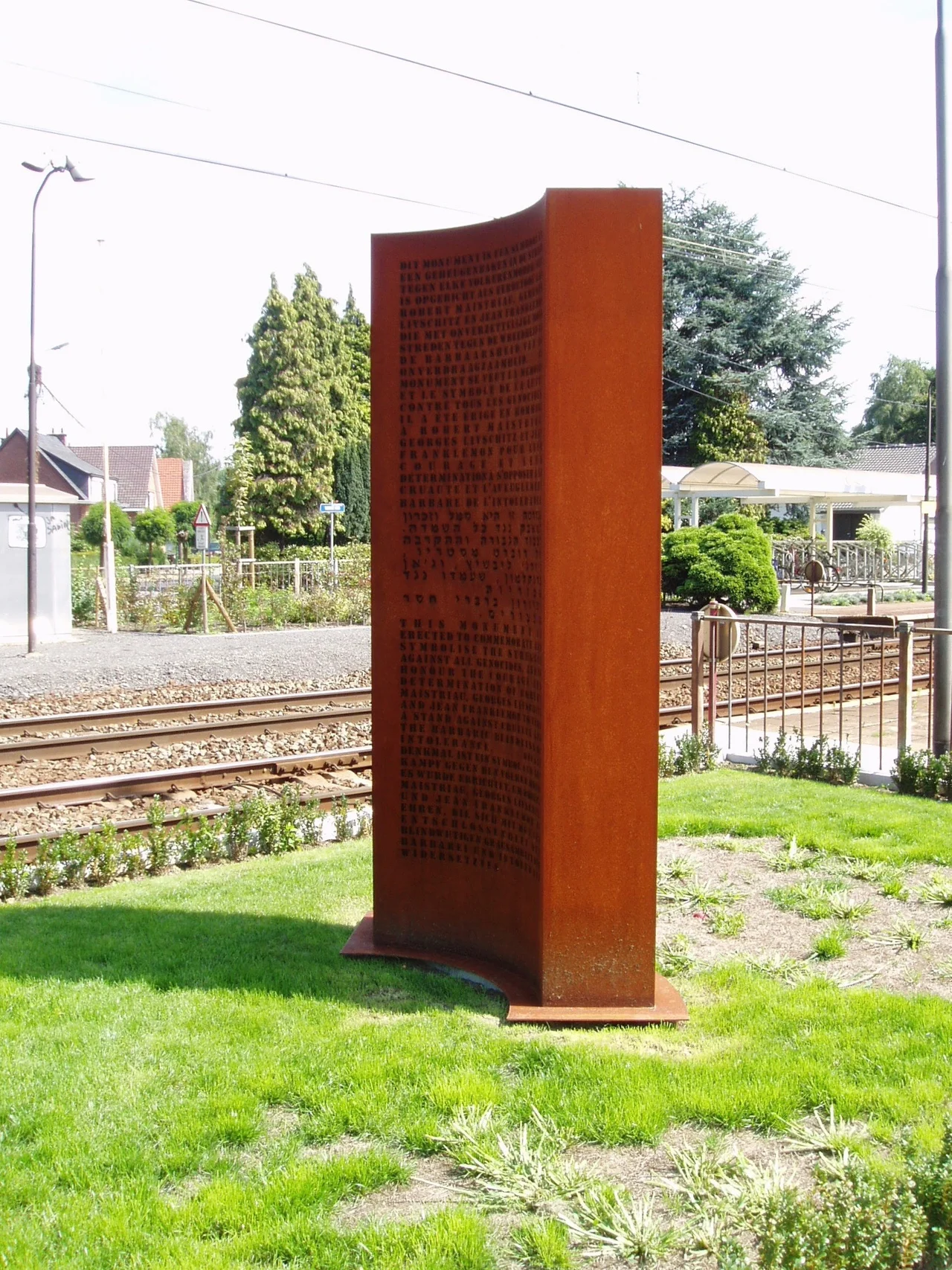
Youra Livchitz was arrested a month after the attack. He overpowered his guard at Gestapo headquarters in Brussels, put on the guard's uniform, and walked out the front door. He was free for less than a month before a roadside check caught him. The Germans shot him at Schaerbeek on 17 February 1944. Jean Franklemon survived years in Sonnenburg and Sachsenhausen, was liberated, and stayed in Germany until his death in 1977. Robert Maistriau hid with partisans in the Ardennes, helped destroy electricity pylons in another resistance action, was arrested, survived Buchenwald and Bergen-Belsen, and lived until 2008. A bronze statue at Boortmeerbeek station marks the place where they stood with their paper lantern. Most visitors do not know that next to it there is a list of names - the people who were on the train, the people they could not save, the people whose only memorial is the courage of three friends who refused to do nothing.
From the Air
Coordinates 50.98°N, 4.57°E. The site lies in flat Brabant farmland between Mechelen and Leuven. View from 2,500 ft on a clear day shows the straight rail line cutting across pale agricultural fields, with the Dossin Barracks Museum (Kazerne Dossin) visible 12 km northwest in Mechelen. Brussels Airport (EBBR) is 15 km south. Antwerp International (EBAW) is 25 km north. The memorial at Boortmeerbeek station is the small structure beside the tracks. Best visited at ground level, on foot, in any weather.
Nearby Stories
- Hertogin Hedwigepolder 1.5 km away
- Eersel 4.3 km away
- County of Loon 5.4 km away
- Bosteels Brewery 5.8 km away
- Hoogstraten 8.2 km away
- Zonhoven 11 km away
- SWIFT 20 km away
- Battle of Steenkerque 22 km away