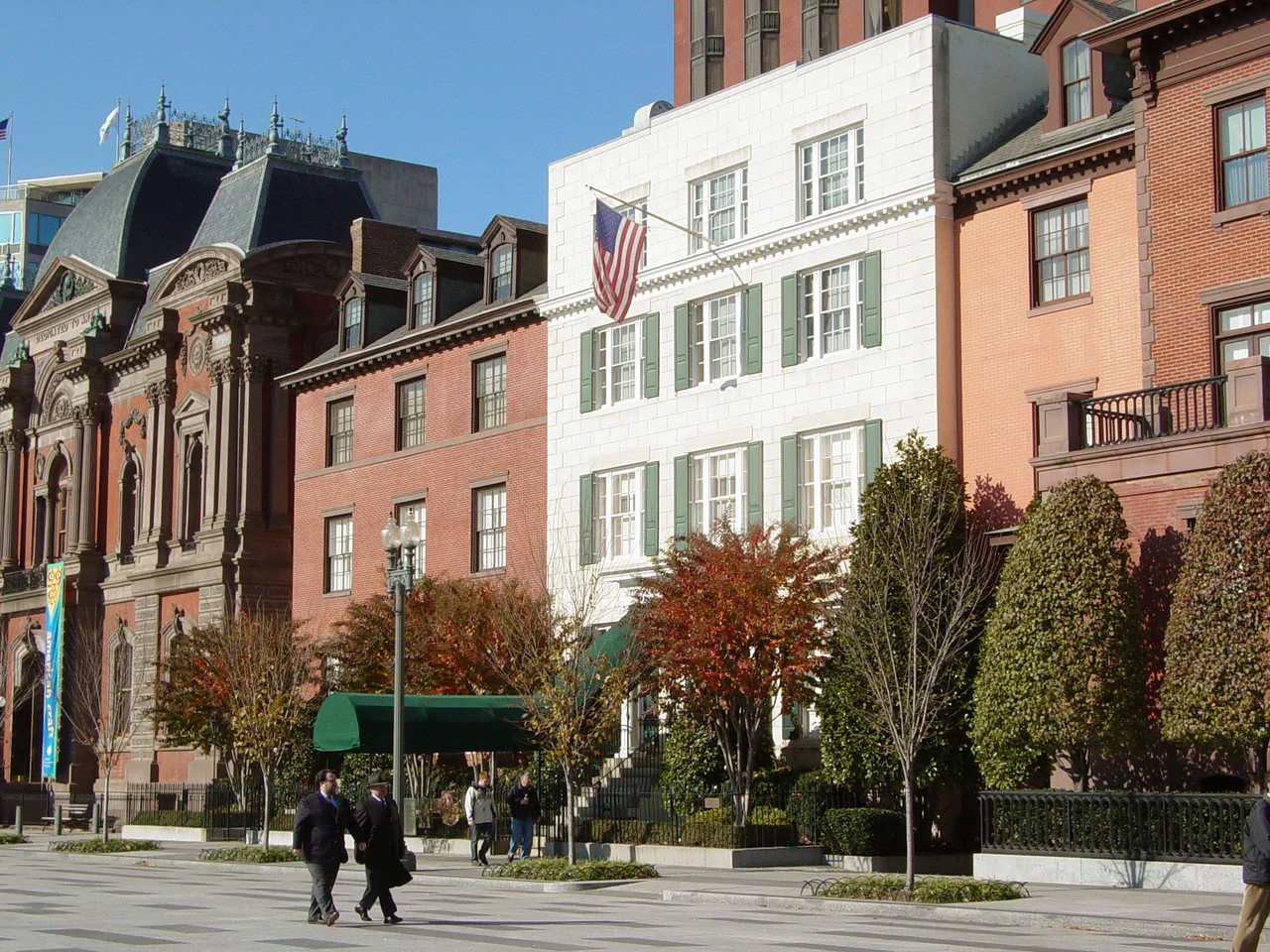

Attempted assassination of Harry S. Truman
Harry Truman was upstairs in his underwear, napping. The White House was being gutted and rebuilt, the floors and walls so structurally compromised that the First Family had been moved across Pennsylvania Avenue to Blair House, the modest yellow Federal-style townhouse that normally served as guest quarters for visiting heads of state. It was just after two o'clock on November 1, 1950. Outside, on the sidewalk a few feet from where tourists could lean against a low railing, two men from New York were walking toward the front door with loaded pistols. They had taken the train down the night before. Neither expected to survive what came next.
What Happened in Jayuya
The plan was born in failure. Two days earlier, in the mountain town of Jayuya in central Puerto Rico, Nationalist Party members had taken up arms against the United States government, declaring an independent republic and burning the post office. Uprisings spread to Utuado, Arecibo, Ponce, Mayaguez, and San Juan. The response was overwhelming. The Puerto Rico National Guard deployed P-47 Thunderbolts to bomb and strafe the towns. Jayuya, the birthplace of one of the men now walking toward Blair House, was badly damaged. The rebellion was crushed within days. Griselio Torresola and Oscar Collazo were nationalists living in New York. When they learned that the Jayuya uprising had failed and that Truman was living temporarily at Blair House, they decided to do something that would force the world to notice Puerto Rico.
Two Men, Two Pistols
Torresola was the gunman. He owned a German Luger and knew how to use it. Collazo, by his own admission, was not skilled with firearms, and Torresola had to teach him how to load and chamber the Walther P38 he would carry. They rode the train to Washington and scouted Blair House on foot. The defenses were not what either of them had imagined. There was no fence, no setback, no significant moat between the public sidewalk and the president's front door. Just a handful of uniformed officers in glass-walled booths and on the stoop. The two split up at the corner. Collazo would approach the front from the east, Torresola from the west. Both would shoot their way in. They had agreed on a signal and a meeting point inside.
The Gunfight
Collazo walked up behind Officer Donald Birdzell on the front steps, pulled out his pistol, and pulled the trigger. Nothing happened. He had not chambered a round. The mechanical click was loud enough for Birdzell to begin turning around. Collazo racked the slide and fired, striking Birdzell in the knee. Within seconds, gunfire erupted from three directions. On the west side, Officer Leslie Coffelt rose from his guard booth and was hit four times at close range by Torresola's Luger, three rounds in the chest and abdomen. Coffelt slumped back into the booth, blacked out for a moment, then dragged himself upright. Officers Joseph Downs and Vincent Mroz returned fire. Officer Birdzell, lying wounded in the street, kept shooting. Collazo was hit in the chest and went down on the steps. Inside the house, agents pushed Truman away from the second-floor window where he had heard the noise and gone to look. Mortally wounded Coffelt steadied himself against the booth, took careful aim from about thirty-one feet away, and shot Torresola through the head with a single bullet.
Forty Seconds
The entire firefight lasted less than forty seconds. Twenty-seven shots were fired. Leslie Coffelt died of his wounds four hours later at Emergency Hospital. He is the only White House Police officer ever killed defending a president. Torresola was dead on the sidewalk. Collazo survived his chest wound, was tried in federal court, and sentenced to death. Truman commuted the sentence to life in prison. Twenty-nine years later, President Jimmy Carter commuted it again, this time to time served, and Collazo went home to Puerto Rico, where he continued working for independence until his death in 1994. A plaque inside Blair House honors Coffelt today, and the Secret Service Uniformed Division names its day room there for him.
Aftermath and a Plebiscite
The men had wanted the world to notice Puerto Rico, and in a narrow sense it did. Truman supported a 1952 plebiscite on the island's new constitution, which voters approved by 81.9 percent, formalizing the Free Associated State that the Nationalists had rejected as colonialism. The structural debate Collazo and Torresola tried to force open with bullets is the same one that still defines the island's relationship with the United States today: statehood, status quo, or independence. Truman wrote about the attack the next day with characteristic plainness, noting that a president has to expect such things. Blair House still stands on Pennsylvania Avenue, still receives heads of state, still has officers in those booths.
From the Air
Blair House sits at 38.8990 degrees north, 77.0386 degrees west, on Pennsylvania Avenue directly across from the White House North Lawn. Best appreciated at 1,500 to 2,500 feet AGL with the Old Executive Office Building and Lafayette Square in the same frame. Reagan National (KDCA) is four nautical miles south across the Potomac. The site sits inside the P-56 prohibited area; overflight is restricted, and viewing is from authorized riverside or ground approaches only.
Nearby Stories
- Gunston Hall 1.1 km away
- 2023 Baltimore Shooting 4.9 km away
- Battle of Middleburg 6.6 km away
- Crownsville Hospital Center 10 km away
- Battle of Loudoun Heights 13 km away
- First Battle of Rappahannock Station 20 km away
- Howard County, Maryland 21 km away
- Harriet Tubman Underground Railroad 50 km away