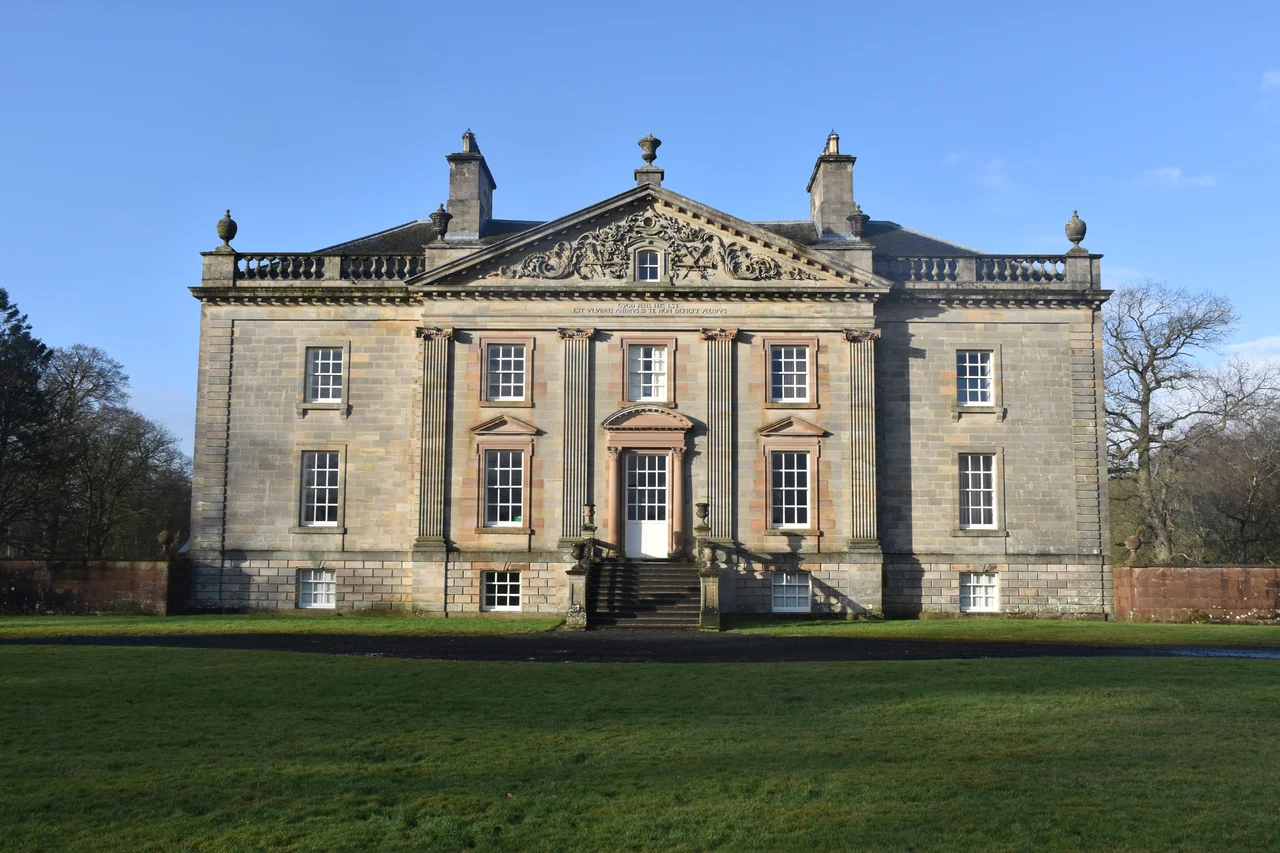

Auchinleck House
On 2 November 1773, Samuel Johnson and James Boswell rode into the avenue at Auchinleck House. Johnson was sixty-four, exhausted from a Hebridean tour that had taken him further from London than any literary figure of his stature had ever travelled. Boswell, his biographer-to-be, was bringing him home to meet his father - Alexander Boswell, Lord Auchinleck, the 8th Laird, a stern Presbyterian judge who disapproved of his son's metropolitan English friend on every available ground. The visit was tense. The two men argued about Whigs and Tories, the Church of England, and the legitimacy of Charles I. James, caught between them, recorded it all in the notebooks that would eventually become his Life of Johnson. The house they argued in still stands.
Eight Centuries on the Lugar
The Auchinleck Estate, on the low sandstone cliff above the confluence of the River Lugar and the Dippol Burn near Cumnock, has been inhabited continuously since at least the thirteenth century. Auchinleck Castle was first recorded in 1241 as the seat of the Auchinlecks of that Ilk, who held the barony for over two hundred and fifty years. When the Auchinleck male line failed in 1504, a daughter of Sir John Auchinleck married Thomas Boswell, and King James IV granted the estate and the title to Boswell. The castle's ruins still stand on the bluff above the rivers. Auchinleck Old House, built in 1612, served as the family home for nearly a century and a half before being abandoned in turn - its ruins also remain. The current Auchinleck House, the new house in eighteenth-century terms, was built around 1760 by Alexander Boswell. The design has been attributed to the great Scottish architect Robert Adam, though Boswell himself was an accomplished amateur architect and may have done it himself.
A Complicated Son
James Boswell, who inherited Auchinleck in 1782, is one of the most candid and self-aware figures in the history of English literature. His Life of Samuel Johnson - first published in 1791 - reinvented the form of biography and remains one of the great prose works in the language. Boswell could write Johnson better than Johnson could write himself, capturing speech rhythms and conversational asides with a fidelity nobody had attempted before. He was also a heavy drinker, a self-loathing diarist, a man who recorded his sexual encounters and venereal infections in the same notebooks that captured his hero's witticisms, and an inconsistent steward of the family estate. He was not a caricature. He was a person who knew his weaknesses, recorded them, and could not always defeat them. The house at Auchinleck - the rooms where he tried to argue Johnson into respecting his father, the avenue down which he rode to meet visitors, the library where he kept his papers - witnessed all of him, the genius and the wreck.
Witches, Wars, and Lairds
The Boswells of Auchinleck have always lived an interesting story. In 1591, John Boswell got into trouble with the Privy Council for practising witchcraft and consulting with witches. Richie Graham, the most notorious wizard of his day, testified that he had raised the Devil at Auchinleck. Boswell's response to all this, sensibly, was to flee the country. During the Second World War, the then Laird gave permission for officers from the Polish, Canadian, and French armies to occupy the house - exiled forces using a Scottish country seat as a place to wait out the war. After centuries of family occupation, the estate began to fade in the twentieth century. In 1986 a descendant named James Boswell turned the deteriorating buildings over to the Scottish Historic Buildings Trust, which fixed the roof and prevented the collapse that would otherwise have come. The Landmark Trust bought the property in 1999 and restored it as a holiday let, with public openings on selected days.
What Remains
The estate is layered like a geological cross-section of Scottish gentry life. The castle ruin on the cliff above the rivers; the Old House from 1612, also in ruins; the elegant Adam-attributed mansion of 1760; the Boswell Mausoleum at Auchinleck Kirk where James and his father are buried; the doocot and Deer House summerhouse scattered through the grounds. The current Auchinleck House is protected as a category A listed building, the highest grade in the Scottish system. The two earlier dwellings are scheduled monuments. Visitors who book a stay through the Landmark Trust find themselves in rooms that Johnson knew and Boswell wrote in - looking out across the same Ayrshire countryside, walking the same paths down to the Lugar, working their way through the same complicated inheritance that James spent his life trying to understand.
From the Air
Auchinleck House sits at 55.48 N, 4.36 W, about a mile west of the town of Auchinleck in East Ayrshire, on a low sandstone bluff above the confluence of the River Lugar and the Dippol Burn. Recommended viewing altitude: 2,000-3,500 ft AGL. The house is set in landscaped grounds with surrounding woodland; the ruined castle and Old House lie within walking distance on the same estate. Nearby landmarks include the town of Cumnock about 3 miles southeast and Dumfries House (King Charles's Scottish residence) about 3 miles south. Nearest airfield: Glasgow Prestwick (EGPK) approximately 15 miles west.
Nearby Stories
- HMS Ulysses (1917) 7.3 km away
- Greenbank Garden 9 km away
- Ballantrae Lifeboat Station 12 km away
- Shotts 12 km away
- Douglas Castle 12 km away
- Battle of Glen Trool 13 km away
- Ellisland Farm 14 km away
- Rothesay Castle 15 km away