,_August_2009.JPG)
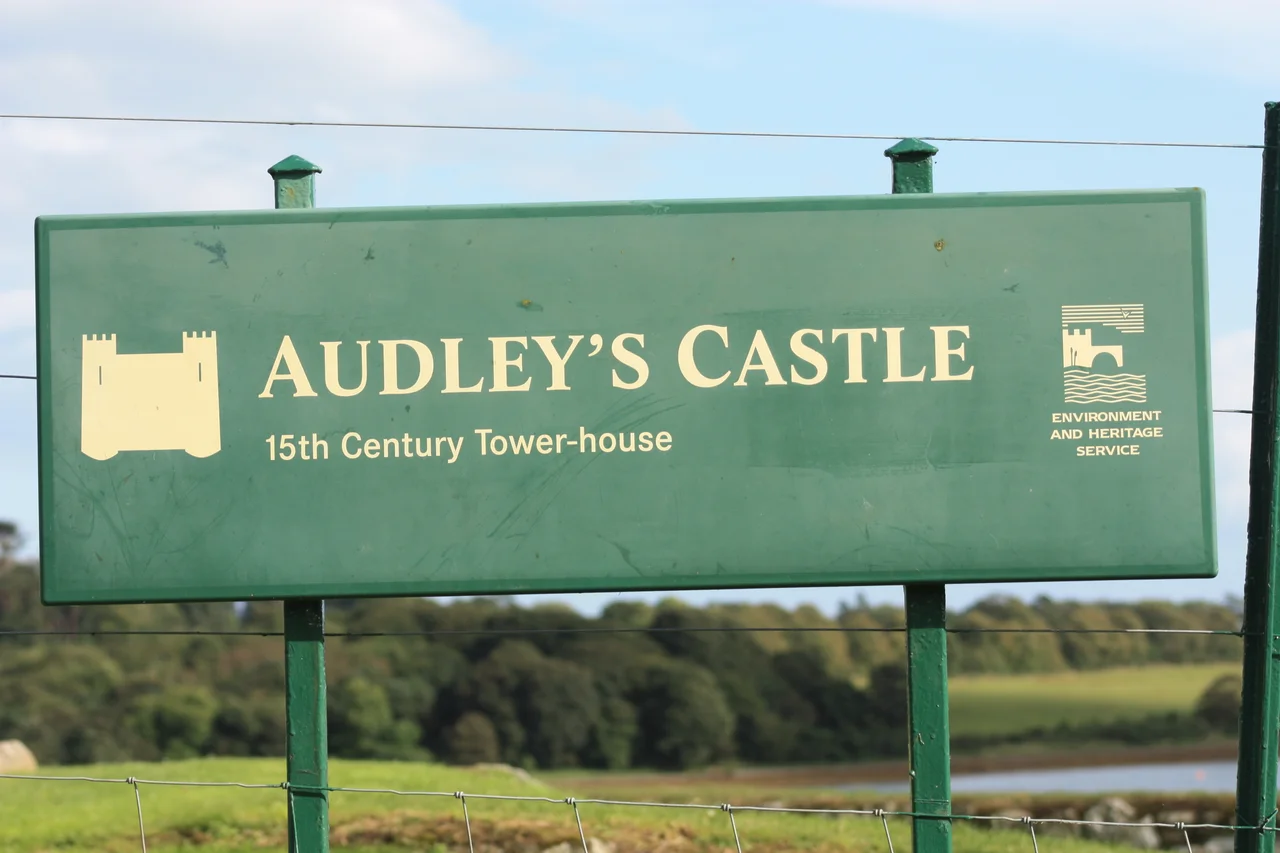
Audley's Castle
It is barely a castle. Three storeys, one room on each floor, a thin enclosing wall around a small yard, and the whole thing set on a rocky knob a mile north-east of Strangford village, where the land tips down toward the lough. There are thousands like it scattered across the Irish countryside. That is the point of Audley's Castle, and also the surprise of it. Half a millennium after John Audley's family put their name on the place, an HBO production company stood a camera on the rocks below and used the tower as a backdrop for Robb Stark's camp, where the young King in the North met a woman called Talisa Maegyr and walked, without knowing it, into the rest of his life.
The Architecture of the Lesser Lord
Towers like Audley's were not built for the great aristocracy. They were the architecture of lesser lords and gentry, the people who could afford stone but not splendour. Most went up between 1350 and 1550, and Audley's is from the tail end of that period, the late fifteenth century. The pattern is simple enough that you can read it from outside. A bawn, the small enclosed yard, with a wall thin enough to keep out cattle thieves but not artillery. A square tower in the middle, three storeys with an attic above. The ground floor is dark and unheated, the storeroom for whatever needs keeping cool and dry. The first floor has the big fireplace and the latrine chute, and that was the room where the lord lived and entertained, the cooking probably done at the same hearth where he warmed his hands. The second floor is more private, the family bedchamber. The servants slept up in the attic under the roof. A whole household compressed into a vertical structure no wider than a modern townhouse. That was the late medieval Irish lordship in stone.
The Audley Family
John Audley, whose name the castle still wears, was its sixteenth-century owner. The Audleys had been in Ireland since the early thirteenth century, part of the Anglo-Norman tide that came across with John de Courcy and put down roots along the eastern coast. By the time the tower was built, the family had been here for two hundred years, long enough to be locals in everything but the documents. The castle stands in the townland of Castleward, on the edge of the demesne that would one day belong to the much grander Castle Ward house. The State Care Historic Monument designation that protects the tower today was put in place by the Northern Ireland Environment Agency, and the path up to the rocks from the lough shore is well-trodden by walkers and, in the years since Game of Thrones, by viewers who still want to see where Robb pitched his tent.
Audley's Field
Game of Thrones used Audley's Castle twice, both times in the early seasons. The tower itself stood in as a backdrop for Robb Stark's army camp, and Audley's Field, the rough pasture below the rocks, was where Robb meets Talisa Maegyr in the aftermath of the Battle of Oxcross, the meeting that eventually leads to his marriage and to the Red Wedding in Season 3. It was also the setting for the Twins, the Frey stronghold, in the Red Wedding episode itself, the ninth of the third season. The location scouts had every reason to choose it. From the rocks above the bawn, on a grey day, the lough lies wide and grey to the north, the village of Strangford peeking out across the water, the ferry working its slow line between the two shores. There is nothing modern in the foreground. The fifteenth-century Audleys would still recognise the view. So would Robb Stark, if he had ever been real.
What's Inside
If you climb up through the tower, the upper rooms still show what they were for. The second floor was the lord's private chamber, with the better windows facing into the lough. The garderobe shaft, the medieval latrine, drops straight down inside the wall to the base of the building. There are remnants of plaster, the faint marks of a fireplace, the shape of a doorway that once led to a small subsidiary room. The roof is gone. Above your head is sky. Audley's Castle is small enough that you can stand in the bawn and put your hand on the tower wall and feel how much of a single working household this once was, how compact a unit of medieval Irish lordship could be. The tower would have looked taller then, because the modern eye is used to bigger things. To a tenant farmer in 1480, it was the seat of power.
From the Air
Audley's Castle sits at 54.3796°N, 5.5719°W on a rocky height in the townland of Castleward, one mile north-east of Strangford village on the western shore of Strangford Lough. From the air the tower is a small dark vertical against the green of the surrounding farmland and the grey-blue of the lough; Castle Ward house and demesne lie immediately to the south, the ferry route runs across the lough to the east. Recommended viewing altitude 1,500–3,000 feet for the tower and bawn detail against the water. Nearest airports: Newtownards (EGAD) 14 nm north, Belfast City (EGAC) 22 nm north-northwest, Belfast International (EGAA) 33 nm northwest. Watch for the tidal flow through the Strangford Narrows to the south, a strong current that can fog the local air during temperature inversions.
Nearby Stories
- Silent Valley Reservoir 1.7 km away
- Drummore 3 km away
- Copeland Islands 5.2 km away
- Castle Upton 8.4 km away
- Hillsborough Castle 9.5 km away
- Bradda Head 11 km away
- Pasages (steam trawler) 20 km away
- Chicken Rock Lighthouse 41 km away