
The Summer Jakarta Burned
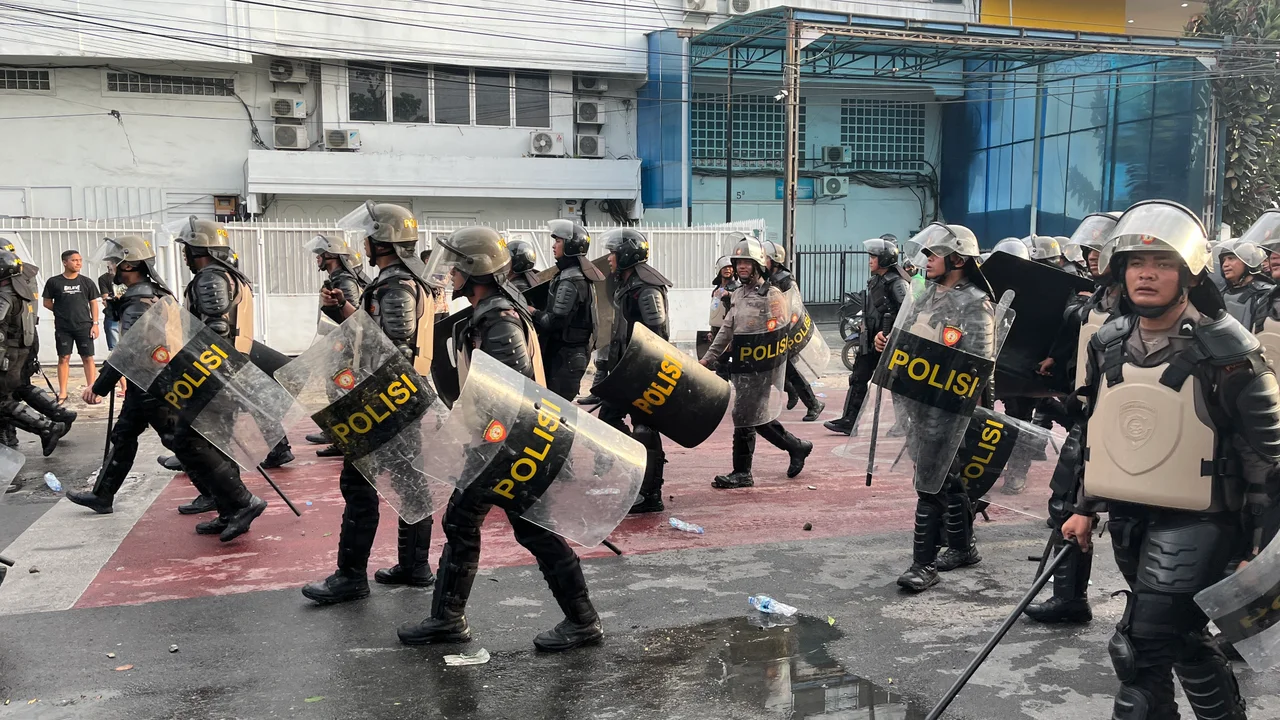
The numbers that started it were simple enough to understand. Members of Indonesia's House of Representatives were set to receive a monthly housing allowance ten times Jakarta's minimum wage, on top of existing food and transportation stipends. According to the Indonesian Forum for Budget Transparency, total take-home pay for each of the 580 members could reach 230 million rupiah per month — roughly $14,000 — while ordinary Indonesians contended with soaring food prices, rising education costs, mass layoffs, and property tax increases. Students gathered outside parliament on August 25, 2025. Within four days, one man was dead, cities across the archipelago were in flames, and the country was facing its most serious civil unrest since the fall of Suharto.
Tone-Deaf in the Chamber
The fury had been building before the first protest sign was painted. At a joint session of the MPR, DPR, and DPD on August 15, several members of parliament were filmed dancing — a display that drew savage criticism on social media as millions of Indonesians struggled with economic hardship. When challenged on the proposed allowance increase, NasDem Party representative Nafa Urbach defended the hike by citing her commuting difficulties, though she later apologized and pledged her allowance to constituents. More inflammatory was Commission III deputy chairman Ahmad Sahroni, who called those demanding parliament's dissolution "the dumbest people in the world" before offering the implausible clarification that he had meant "smart." National Mandate Party's Eko Patrio shared a parody video widely seen as mocking public suffering. Each misstep fed the anger, and the anger fed the streets.
The Death of Affan Kurniawan
On the night of August 28, after police used tear gas and rubber bullets to push protesters away from the parliament building, a 21-year-old motorcycle taxi driver named Affan Kurniawan was struck and killed by a Rimueng 4x4 armored vehicle belonging to the Mobile Brigade, the police's paramilitary force. Videos from multiple angles showed the vehicle stopping after hitting Affan, then driving on as an enraged crowd surrounded it. Affan was rushed to Dr. Cipto Mangunkusumo Hospital but died shortly after. He was not a protester. He was a Gojek-partnered driver who happened to be in the wrong place. The driver of the armored vehicle, Police Chief Brigadier Rohmat, claimed poor visibility from smoke and tinted windows and said he believed he was driving over rocks. Seven officers were detained and found to have violated police ethics. The hashtag #PolisiPembunuhRakyat — roughly, Police Kills the People — became the top trending topic on X in Indonesia.
A Country on Fire
Affan's funeral on August 29 at Karet Bivak Cemetery, escorted by hundreds of fellow motorcycle taxi drivers, became both a memorial and a flashpoint. When Jakarta's police chief arrived, drivers shouted "murderer" and threw water bottles. That same day, protests erupted in more than thirty cities — Banda Aceh, Medan, Surabaya, Bandung, Makassar, Yogyakarta, Pontianak, and dozens more. In Bandung, rioters burned the official residence of the MPR speaker and parts of the historic Gedung Sate; West Java governor Dedi Mulyadi went directly to the crowds and was struck by a hurled object. In Surakarta, tear gas fired at protesters blew back toward Brimob officers when the wind suddenly shifted, forcing them to retreat. In Surabaya, fires engulfed the eastern side of the Grahadi government building. In Makassar, three people died and five were injured when a provincial parliament building caught fire. A second motorcycle taxi driver, Rusdamdiansyah, was killed in Makassar on August 30.
Looting the Legislators
On August 30, the fury turned personal. Protesters descended on the private residence of Ahmad Sahroni in Tanjung Priok, broke through the front gate, and began carrying out his possessions. Footage circulated of crowds parading a life-sized Iron Man statue, pornographic film discs, Sahroni's school diploma, and an assault rifle along with a photocopy of his firearms license. His Tesla Model X, Porsche 356, first-generation Ford Mustang, and Lexus RZ were vandalized. Singapore dollar bills were seen being distributed among the crowd. People chanted "Duit rakyat" — the people's money. Later that night, mobs reached the home of Eko Patrio in Setiabudi, ejecting a refrigerator, television, and carpet. Entertainer Uya Kuya's residence in East Jakarta was also stormed; he later said he accepted the damage but grieved the loss of his pet cats, prompting parliamentarian Melly Goeslaw to publicly appeal for their return.
Aftermath and Reckoning
President Prabowo Subianto delivered a televised address the day after Affan's death, calling the police response "excessive" and pledging a transparent investigation. The government agreed to create a task force to address mass layoffs and established a new Labor Welfare Council. Protesters issued a list of 25 demands — 17 short-term, 8 long-term — covering everything from police reform to the abolition of outsourcing and the creation of a special court for labor disputes. Jakarta's Metropolitan Police arrested 1,240 individuals linked to the August 29 riots alone, most of them from outside the capital. Transjakarta suspended citywide bus operations, MRT stations suffered serious damage, and the provincial government later offered free transit for a week as recovery efforts continued. The protests drew comparisons to the May 1998 riots that preceded Suharto's fall — a reminder that in Indonesia, the distance between parliamentary excess and street revolution can be measured in days.
From the Air
The epicenter of the protests was the MPR/DPR/DPD complex on Jalan Jenderal Gatot Subroto in Central Jakarta, at approximately 6.20°S, 106.80°E. From the air, the parliamentary complex is identifiable by its distinctive roofline along one of Jakarta's main arterials. Protest damage was also concentrated around the Mobile Brigade headquarters in Kwitang and Senen district. Nearest airports: Soekarno-Hatta International Airport (WIII/CGK) approximately 25 km northwest; Halim Perdanakusuma Airport (WIHH) approximately 15 km southeast.
Nearby Stories
- The King's Footprints in the River 2.8 km away
- Rawagede Massacre 6.4 km away
- The Cruiser That Wouldn't Stop Fighting 14 km away
- Four Minutes Over the Java Sea 14 km away
- The Scholar's Mosque 21 km away
- Through the Cidepong Hills 37 km away
- Ujung Kulon National Park 97 km away
- The Islands That Vanished from Sight 352 km away