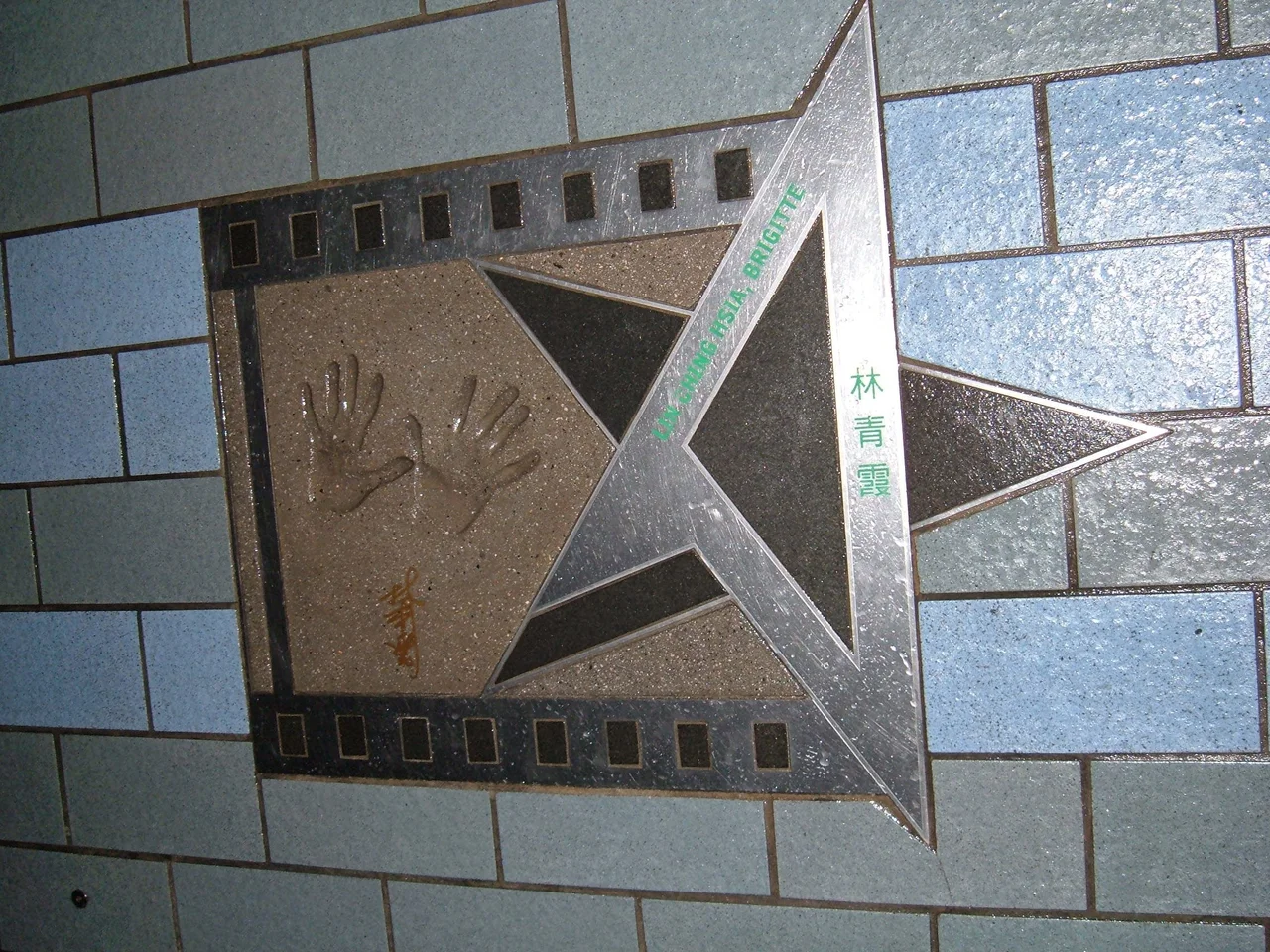

Avenue of Stars, Hong Kong
Press your hand into the cement beside John Woo's imprint and you'll feel the gap immediately — your fingers are shorter, your palm narrower, the comparison slightly humbling. The hand prints on the Avenue of Stars are not purely ceremonial. They are measurements. A hundred years of Hong Kong cinema compressed into a 440-metre promenade, where the story of an industry that helped define Asian popular culture is told not in a museum with explanatory placards, but in autographs and the proportions of human hands pressed into wet concrete on specific afternoons, by specific people, before their names were already carved into the pavement.
The Industry It Honors
Hong Kong cinema had its golden decades — roughly the 1970s through the 1990s — when the territory produced films at a per-capita rate that rivaled Hollywood and exported action choreography, melodrama, and comedy across Asia and eventually to audiences worldwide. Directors like John Woo and Wong Kar-wai, actors like Bruce Lee, Jackie Chan, Chow Yun-fat, and Anita Mui became international figures whose work influenced filmmakers from Los Angeles to Mumbai. The Avenue of Stars was designed to honor that legacy. When it opened on 28 April 2004, it enshrined 73 initial inductees selected by the Hong Kong Film Awards Association and readers of *City Entertainment* magazine. Along its nine red pillars, inscriptions trace a hundred years of cinematic history — from the silent era through the martial arts boom to the art-house films that brought the city to Cannes.
Bronze, Cement, and a Specific Afternoon
The most recognizable presence on the promenade belongs to someone who never had his hands pressed into it. Bruce Lee died in 1973, three decades before the Avenue existed. His 2.5-metre bronze statue was erected in 2005, positioned so the martial arts icon faces across Victoria Harbour toward the island where he was born. In 2014, a bronze statue of Anita Mui joined him — the Cantopop and film star who died in 2003 at forty, whose absence from any living ceremony the statue quietly acknowledges. Most plaques carry only names, because most of the people honored are gone. Some contain hand prints and autographs set in cement during rare living visits. The contrast between those personal impressions and the bare name-plates of the deceased gives the promenade an elegiac undertone that a straightforward hall-of-fame format would not.
Controversy, Closure, and the High Line Architect
After eleven years under management by the New World Group — the private company that originally spent HK$40 million to build it — the avenue's contract expired and the Hong Kong government announced a renovation in August 2015. The decision to award the redevelopment contract to the same company without competitive tender sparked public controversy. Residents' groups and neighboring property owners objected; the government promised consultation. The avenue closed for three years while expansion work proceeded, with its temporary replacement a short distance away at the Tsim Sha Tsui East Waterfront Podium Garden. When it reopened on 31 January 2019, the redesign bore the signature of James Corner Field Operations — the New York firm best known for designing the High Line. The new layout is wider, airier, and better integrated with the surrounding waterfront attractions: the Museum of Art, the Space Museum, the Cultural Centre, and the old Clock Tower that once served the Kowloon-Canton Railway terminus.
Harbour Light and the Symphony
The Avenue of Stars faces northwest across one of the world's most photographed urban waterfronts. Victoria Harbour narrows here between Tsim Sha Tsui and the towers of Central and Wan Chai on Hong Kong Island, creating a corridor of water that turns gold in late afternoon and electric with reflected light after dark. The promenade is the most popular viewing position for the Symphony of Lights — the nightly choreographed display of building-mounted lights and lasers that sweeps across the harbor skyline. On any given evening, visitors arriving to find Bruce Lee's silhouette against a lit skyline are getting exactly what the designers intended: a tableau that connects cinematic memory to a living city still generating images worth remembering.
From the Air
The Avenue of Stars runs along the Tsim Sha Tsui waterfront at approximately 22.293°N, 114.175°E on the Kowloon side of Victoria Harbour. Approaching from the south at 2,000 feet, the promenade is visible as a thin strip of tree-lined walkway between the New World Centre and the old Clock Tower, directly across the harbor from the Central business district on Hong Kong Island. Hong Kong International Airport (VHHH) is approximately 32 km to the west-northwest. The distinctive triangular glass of the Bank of China Tower on the island side, and the rounded podium of the Cultural Centre immediately adjacent, provide reliable visual anchors.
Nearby Stories
- Lok Ma Chau Loop 2.3 km away
- Portas do Cerco 2.3 km away
- Kweilin Incident 17 km away
- Wanshan Archipelago Campaign 34 km away
- Nanxiong Formation 115 km away
- Battle of Nanpeng Island 148 km away
- Heyuan 169 km away
- Cape Maobitou 632 km away