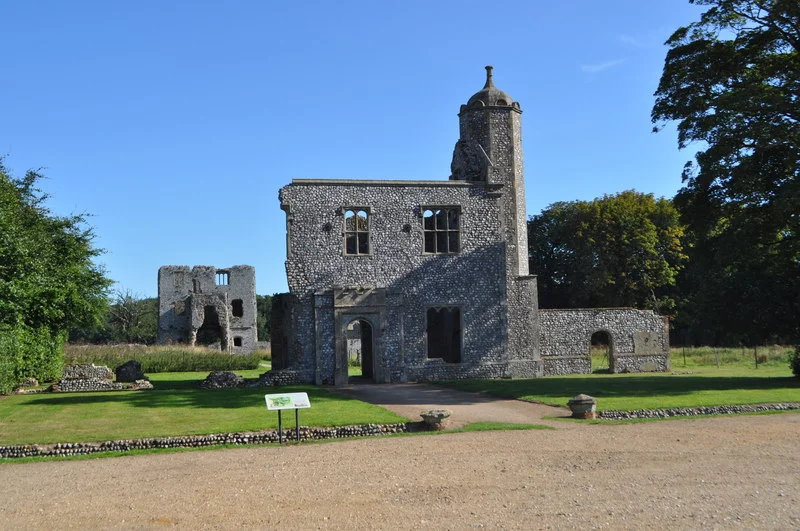

Baconsthorpe Castle
The causeway approaches across flat Norfolk farmland, a raised path that once carried visitors to a statement of ambition. Baconsthorpe Castle was never a military fortress in the full sense — it was a fortified manor house built by the Heydon family in the 15th century, its gun loops and moated inner court designed less to defend against attack than to announce that the people who lived here considered themselves noble. The ruins standing today tell the story of that aspiration, and what became of it.
Built for Status
The castle sits north of Baconsthorpe village in a valley formed by the River Glaven, approached by the remains of a raised causeway from the south. The Heydons built the inner court on a square earth platform 65 metres across, surrounded by a water-filled moat up to 15 metres wide and an external curtain wall up to 5 metres high, protected by seven square and circular mural towers. The main entrance passed through an inner gatehouse three storeys high, built from knapped flint and brick — an expensive material choice that underscored the family's aspirations.
The militarily inspired design drew deliberately on earlier medieval architectural traditions. Gun loops covered the entrance from the cellar beneath the hall. A postern gate in the north tower led to a bridge over the moat. The whole composition was theatre as much as defence. The eastern side of the inner court was adapted for the wool industry in the 16th century, with a long two-storey building constructed along the curtain wall for processing and fulling cloth — a reminder that the fortune funding this grandeur came from trade.
From Castle to Cottage
The Heydon family's finances declined over generations. When civil war broke out in 1642, one John Heydon fought for King Charles I. Parliament responded by seizing his lands and declaring him delinquent in 1646. He died in debt in 1653, leaving the castle to his son Charles Heydon. The stripping of the castle began almost immediately: 29 cartloads of stone were sold the following year for £30, destined for reuse at nearby Felbrigg Hall.
The outer gatehouse — a Perpendicular Gothic structure with octagonal turrets and a large first-floor chamber — was converted to residential use in the 17th century. Wings were added, a three-storey porch built onto the front, and the building took on a new life as a domestic residence. A doctor named Zurishaddai Lang lived in it. The Norfolk landowner John Thruston Mott bought the estate in 1801, and the gatehouse remained occupied until 1920, when one of the turrets collapsed. By then the moat had been drained and the castle's working life was over.
What Remains
In 1940, the owner Sir Charles Mott-Radclyffe placed the site under the care of what was then the Ministry of Public Works. The mere was dredged and refilled in 1972. Archaeological excavations have since revealed more of the castle's layout, including the remains of a formal garden to the south-east of the inner court — a raised platform 80 metres across, with a raised walkway around a square pond 35 metres wide.
Today Baconsthorpe Castle is managed by English Heritage and carries Grade I and Grade II listed building status, as well as scheduled monument protection. The ruins rise from fields that were once sheep pasture in the 16th century and are now used mainly for arable farming. The flint and brick towers stand in the Norfolk silence, reflecting in the refilled moat, the whole ensemble a study in how quickly a family's assertion of permanence can dissolve into landscape.
From the Air
Located at 52.90°N, 1.15°E, roughly 4 km south of Sheringham and 25 km northwest of Norwich. The castle ruins are identifiable from the air by the moated inner court and the characteristic outline of the ruined towers set in open farmland near the River Glaven. The nearest airport is Norwich International (EGSH), approximately 28 km to the southeast. Best viewed at 1,500–2,000 ft in clear conditions.
Nearby Stories
- Houghton Hall 3.1 km away
- Norfolk Tank Museum 7.5 km away
- Weeting Castle 11 km away
- Skegness Lifeboat Station 25 km away
- HMS Cobra 40 km away
- Battle of Lowestoft 79 km away
- SM U-97 101 km away
- Southern Bight 112 km away