
The Entertainers of Bada Valley
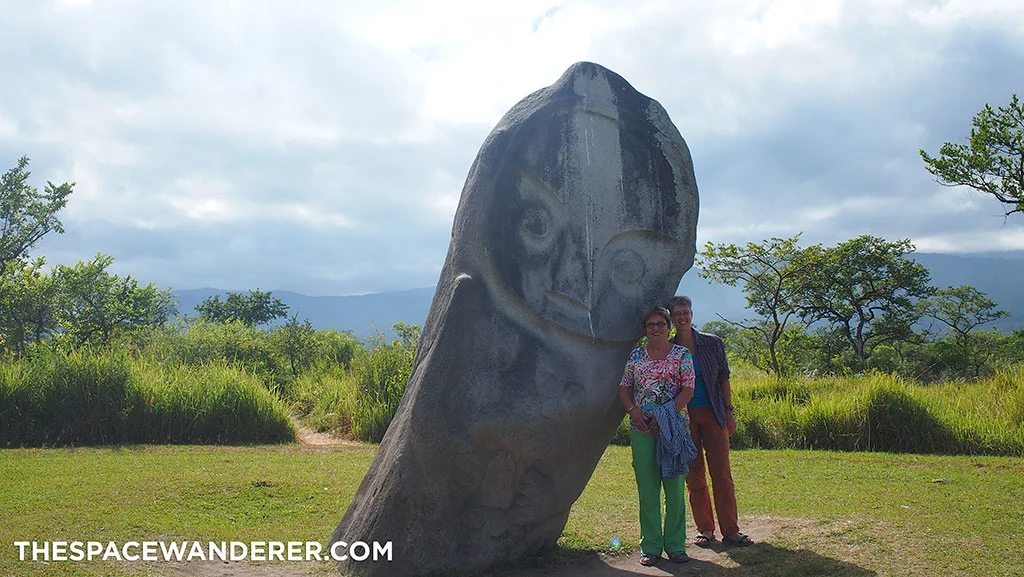
Palindo stands four and a half meters tall in a rice paddy outside Sepe Village, and the name the Lore people gave this statue translates to "the entertainer." It is an odd name for a stone figure that has no mouth. The eyebrows and nose are a single carved line. The eyes are round and wide. The body is broad and legless, planted in the earth like a post. Male anatomy is clearly rendered, but whoever carved Palindo did not bother with feet, hands, or anything resembling expression. The entertainer entertains by simply being there -- and by refusing, after centuries or perhaps millennia, to explain itself.
A Valley of Unknowns
The Bada Valley sits in the highlands of Central Sulawesi, a broad, flat basin surrounded by forested hills where clouds routinely get trapped against the ridgelines. Rain can fall on one end of the valley while the other end basks in equatorial sunlight. The Lariang River runs through the center, merging with the Malei River as it flows toward the western coast. It is a quiet, agricultural landscape -- rice paddies, vegetable gardens, traditional wooden houses roofed with sugar palm fiber. And standing among all of it, scattered across the valley floor without obvious pattern, are hundreds of megalithic statues and stone vessels that no one can fully explain. The megaliths were first reported to Europeans in 1908, but despite more than a century of study, the fundamental questions remain open: who carved them, when, and why.
Faces Carved from Silence
The statues follow a distinctive artistic convention. Faces are rendered with the eyebrows, cheeks, and chin suggested by a single continuous line that also forms the nose. Mouths are omitted entirely. Bodies are depicted without curves or legs -- large heads atop cylindrical trunks, as though the carvers were interested in presence rather than anatomy. Gender, however, is marked clearly. The Palindo and Meturu statues bear male anatomy. The Langke Bulawa statue is identifiably female, her face distinguished by a fringe carved across the forehead. Most statues stand alone, though some are grouped. Sizes vary dramatically. Some rise to over four meters. The Oba statue, by contrast, stands just 70 centimeters tall with a face locals describe as humorous -- possibly depicting a child, possibly a monkey, possibly something else entirely.
Vessels for the Dead
Alongside the human figures, the Bada Valley contains kalambas -- large stone vessels, one and a half to two meters in diameter, carved from single blocks of rock and often found with fitted stone lids. These are burial containers. Smaller stones found nearby are suspected to have held the remains of children or infants. The human statues and the kalambas appear to belong to the same culture, based on their frequent proximity and shared stylistic elements. Dating remains contentious. Some researchers place the megaliths at roughly 1,000 years old, linking them to the 14th-century traditions referenced in local oral histories. Others argue the stones could be as old as 5,000 years. A third school sees connections to megalithic traditions in Laos, Cambodia, and other parts of Indonesia dating back approximately 2,000 years.
The King Who Lost His Army
The elders of Sepe Village preserve a legend about Palindo and the other statues that carries a distinctly defiant undercurrent. According to the story, the King of Luwuk ordered 1,800 statues transported from Sepe to Palopo to mark his dominion over the Bada people. The statues were to face south. But the Bada placed them facing west instead -- a quiet act of resistance encoded in stone. When the king demanded the statues be repositioned, they toppled onto his troops, killing roughly 200 soldiers. The legend frames the megaliths not as passive monuments but as instruments of local power, objects that answered to the valley's own people rather than to outside rulers. Before undertaking major tasks like clearing new farmland, the Bada traditionally offered sacrifices to these statues -- a practice that suggests the stones were understood as ancestors, not mere art.
Indonesia's Easter Island
The comparison is imperfect but inevitable. Like Easter Island's moai, the Bada Valley megaliths are large, stylized human figures of uncertain origin, standing in an isolated landscape, carved by a culture that left no written record. Indonesian media has embraced the parallel, calling the valley a "nuansa Pulau Paskah" -- an echo of Easter Island -- on the Indonesian mainland. In 2025, Indonesia submitted the broader Megalithic Cultural Heritage of Lore Lindu Area to UNESCO's tentative list, recognizing over 2,000 monuments across four valley systems as evidence of ancient Austronesian migration. Lore Lindu National Park, which encompasses the Bada Valley, has held UNESCO Biosphere Reserve status since 1978. The statues have waited more than a century for formal global recognition. Palindo, the entertainer, has been waiting considerably longer than that.
From the Air
The Bada Valley is located at approximately -1.88N, 120.25E in Central Sulawesi, at roughly 1,100 meters elevation. From the air, the valley appears as a flat, green basin of rice paddies surrounded by forested hills rising to 2,800 meters. The Lariang and Malei Rivers are visible threading through the valley floor. The nearest major airport is Mutiara SIS Al-Jufrie Airport in Palu (WAML), about 90 km northwest. Cloud cover frequently clings to the surrounding hilltops, creating dramatic partial weather conditions across the valley. Approach from the northwest for the best perspective on the valley's relationship to the broader Lore Lindu mountain terrain.
Nearby Stories
- The Island That Shouldn't Exist 19 km away
- Stone Faces in the Cloud Forest 39 km away
- Central Sulawesi: Where the Earth Remembers 65 km away
- The Town the Lake Made Twice 65 km away
- Palu: The City That Knows the Ground Can Move 98 km away
- The Scholar's Gift: Palopo Old Mosque 101 km away
- The Drum of God 105 km away
- Blessing from the Hilltop 139 km away