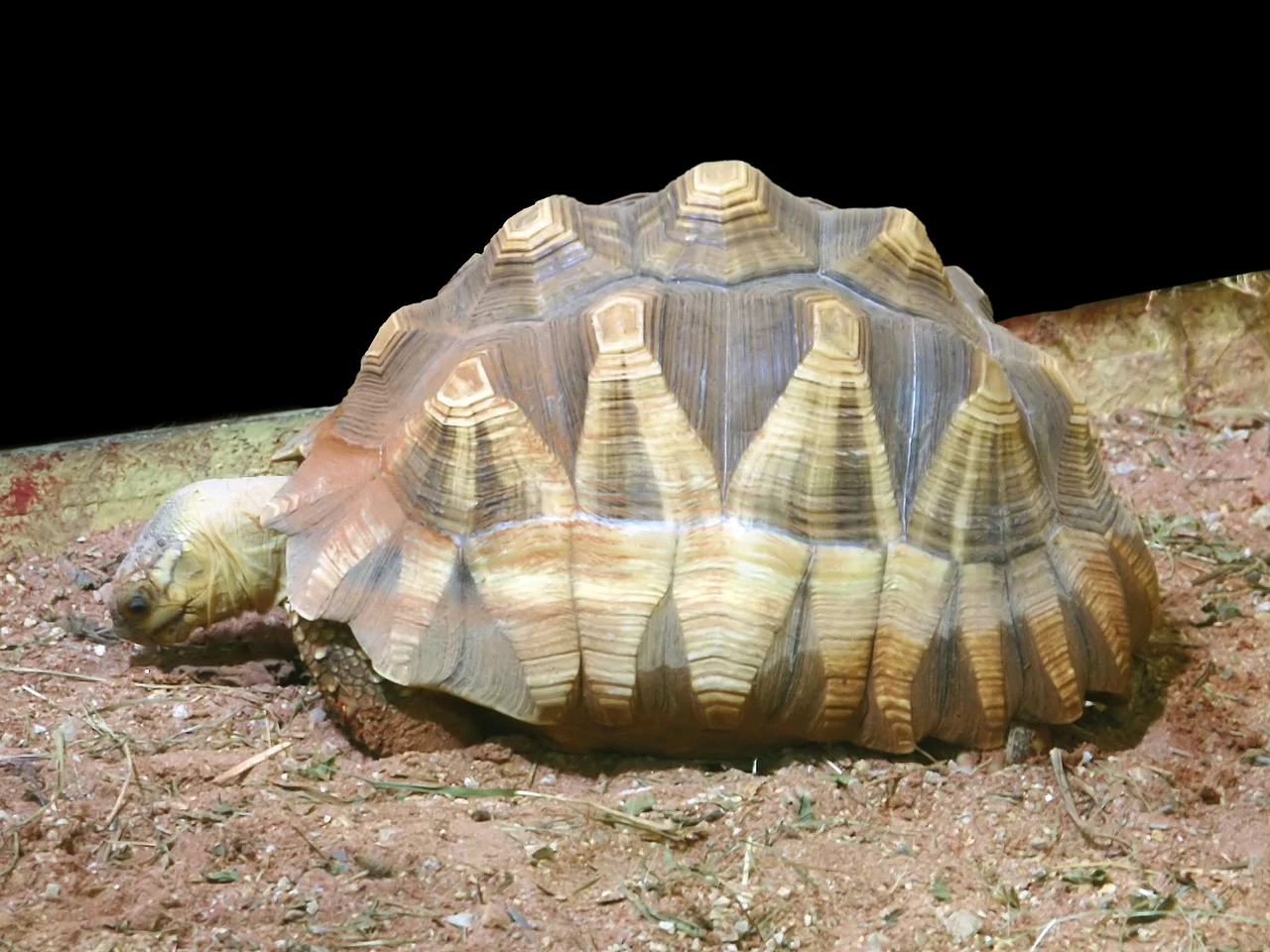

Baie de Baly National Park
There is a tortoise so rare that the entire wild population could fit inside a single village, and it lives nowhere on Earth but here. The ploughshare tortoise - known locally as the angonoka, its high golden dome unmistakable - survives only in the dry forests and savanna fringing Baie de Baly, a national park tucked into a remote corner of northwestern Madagascar. To reach it you travel a rough 150 kilometers from Mahajanga, the nearest city, into a landscape of bamboo scrub, mangrove, and deciduous forest hard against the Mozambique Channel. Few people come. For the world's most endangered tortoise, that isolation has been both the last refuge and, cruelly, no defense at all.
The Rarest Tortoise Alive
The angonoka takes its English name, ploughshare tortoise, from a curved projection on the front of its shell - a kind of horn the males use to flip rivals onto their backs during contests for mates. It is a striking animal, its high-domed carapace patterned in honey and amber. It is also vanishing. Once spread more widely, the species is now confined entirely to the Baie de Baly area, and recent surveys put the wild population at fewer than a hundred mature individuals and still falling. Conservationists rank it as one of the rarest tortoises in the world. Each surviving adult is, in a real sense, irreplaceable - a thread holding an entire species to existence.
Hunted for a Collector's Shelf
The angonoka's beauty has become its curse. Because its golden shell is prized by collectors of exotic pets, poaching for the illegal international trade has driven the decline, and animals smuggled out of this single Madagascar bay have surfaced in markets thousands of kilometers away. The pressure has been relentless: surveys recorded the wild population falling by roughly a third in just a few years, and poaching has already wiped the tortoise out of some sites entirely. The trade is so lucrative that conservationists have taken extraordinary measures - even deliberately engraving identifying marks into the tortoises' shells to make them harder to sell. It is a stark illustration of how a creature can be loved nearly to death: the same rarity that makes the angonoka precious to those who would protect it makes it valuable to those who would steal it from the wild.
An Ark of Endemics
The tortoise is the park's celebrity, but it shares this ground with a remarkable cast found almost nowhere else. The critically endangered Madagascar fish eagle hunts these shores - one of the rarest birds of prey on the planet, with only around a hundred breeding pairs left in the world, most of them along this northwest coast. Dugongs graze the offshore shallows, and the Madagascan big-headed turtle haunts the rivers. The park shelters thirteen mammal species, scores of reptiles, and well over a hundred kinds of birds. Even the plants are particular to this place: an endemic bamboo, and a tree called komanga whose wood is so poisonous that its smoke can sicken anyone foolish enough to burn it for cooking.
A Landscape of Edges
Baie de Baly is a place defined by transitions. Established as a national park in 1997, it sprawls across a mosaic of habitats: dry deciduous forest giving way to bamboo scrub, savanna opening onto lakes and swamps, and mangroves lining the bays where fresh water meets the salt of the channel. The Andranomavo River runs through it; the Kapiloza marks its southern edge; to the east lies the Bay of Marambitsy and to the north the open Mozambique Channel. Inland, it borders the otherworldly limestone pinnacles of Tsingy de Namoroka. It is precisely this layering of dry forest, water, and coast - rare and intact - that has let so many vanishing creatures hold on here, in one of the last corners wild enough to shelter them.
From the Air
Baie de Baly National Park occupies the coast of Madagascar's Boeny region, centered near 16.08°S, 45.23°E, on the Mozambique Channel about 150 km southwest of Mahajanga. From altitude, look for the deeply indented bays and the dark filigree of mangrove forest where rivers meet the sea, set against the tan-and-green patchwork of dry forest and savanna inland. The nearest airport is Amborovy / Philibert Tsiranana Airport at Mahajanga (ICAO: FMNM), roughly 150 km to the northeast; the region is otherwise extremely remote with little infrastructure. Best viewed in Madagascar's dry season (May-October), when haze and cloud over the deciduous forest are minimal and the coastline reads clearly.
Nearby Stories
- Bombetoka Bay 61 km away
- Mahajanga: Madagascar's Sunlit Gateway 77 km away
- Juan de Nova Island 219 km away
- Anjajavy Forest: Where Stone Forests Meet Living Ones 236 km away
- Tsingy de Bemaraha National Park 287 km away
- Lake Alaotra 324 km away
- 2008 Invasion of Anjouan 398 km away
- Tsiribihina River 423 km away