
Balaklava
From the Black Sea, you could sail past Balaklava's harbor entrance and never guess a town lay behind it. The bay hides behind a fold of cliffs, opening only at the last moment into a sheltered inlet so well concealed that the Soviet Union chose it to keep its submarines out of sight for four decades. Long before that, the same natural secrecy drew Genoese traders and Ottoman garrisons. Today the small port on the edge of Sevastopol holds more history per square meter than towns ten times its size, most of it written in stone, memorial, and the quiet water itself.
The Charge and the Word
In 1854, during the Crimean War, the fields four kilometers outside Balaklava witnessed the Charge of the Light Brigade, a near-suicidal advance by British cavalry directly into Russian cannon fire. The order was a blunder, the losses were terrible, and the episode passed into legend as an emblem of doomed courage. The valley the horsemen crossed is now planted with vineyards, its "Valley of Death" softened into rows of grapes, with only a scattering of memorials to mark it. The battle left another, stranger legacy: the balaclava, the close-fitting knitted hood that masks the face, takes its name from this very harbor, where British troops wintering in the cold reportedly relied on such coverings.
Fortress on the Heights
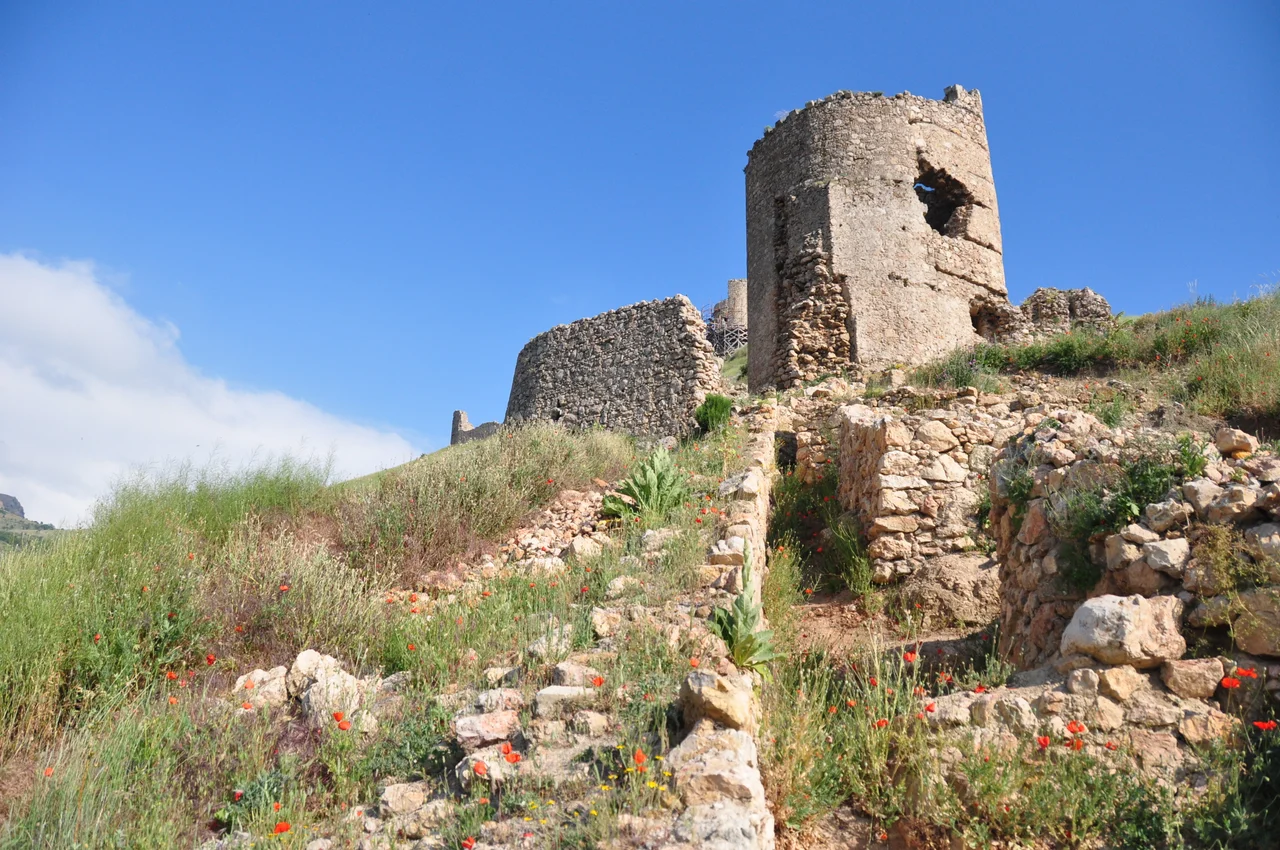
Above the harbor stand the remains of Cembalo, a Genoese fortress whose towers still crown the ridge. The Genoese held this port as a staging place for their trade in goods and in enslaved people, a brutal commerce that ran through many Black Sea harbors of the age. The Mongols took the town, and in 1475 the Ottoman Empire claimed it. The climb to the towers is steep and largely unmarked, rewarding the effort with silence and a coastline of quiet vineyards. Higher still, hidden among the hills toward the sea, lie the concrete fortifications of a Second World War German position: trenches, a cast-iron sentry tower overhanging the cliff, and bunkers a visitor could explore with a friend and a flashlight, guided only by the Orthodox cross visible on the hilltop.
The Secret Under the Hill
During the Cold War, the Soviets bored a submarine base straight into one of the hillsides beside the bay, turning Balaklava into one of the most secret places in the country. Vessels slipped in and out of the mountain, screened from satellites and from the town's own residents. The base remained operational until 1993, and the last submarine departed in 1996; the tunnels can now be toured. The waterfront that resulted is a study in contrasts, luxury yachts moored beside expensive new hotels, with derelict factories and empty buildings still dotting the shoreline. Over fifty monuments crowd the town, honoring soldiers of the Crimean War, the Russian Civil War, and the Second World War.
From the Air
Balaklava lies at 44.51 degrees north, 33.60 degrees east, just south of Sevastopol on Crimea's rugged southwestern coast. From 3,000 to 5,000 feet the hidden S-shaped harbor entrance and the Cembalo fortress ruins on the ridge are the clearest landmarks; the old Valley of the Charge sits about four kilometers inland. The nearest airfield is Sevastopol's Belbek (UKFB) to the north, with Simferopol (UKFF) farther inland.
Nearby Stories
- 1988 Black Sea Bumping Incident 5.4 km away
- Battle of the Alma 7.5 km away
- Yalta 8 km away
- Russian Battleship Ekaterina II 10 km away
- Akmesdzhyt Friday Mosque 12 km away
- Soviet Hospital Ship Armenia 15 km away
- KaZantip 52 km away
- Januarius MacGahan 338 km away