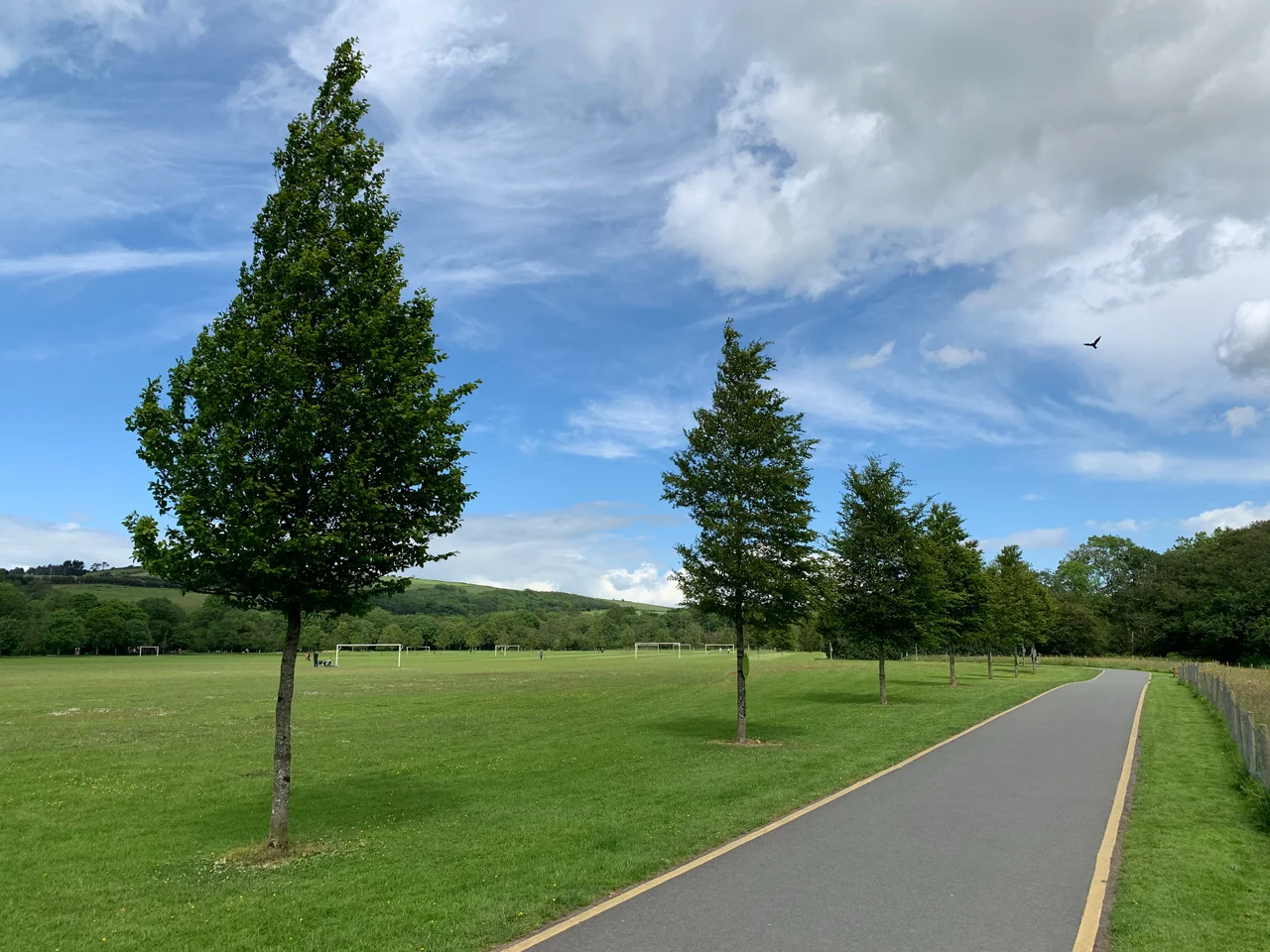

Ballincollig Regional Park
Fifty-two stone structures sit in varying states of decay along the River Lee, their roofs gone, their walls weathered, their purpose mostly forgotten. They once made gunpowder. Today they stand inside Ballincollig Regional Park, where 660,000 visitors a year walk dogs, push strollers, and stop occasionally to read a plaque explaining that the picturesque ruin in front of them was once a charcoal mill, a saltpeter refinery, or a granulating house feeding the cannons of empire. The park is 135 acres of contradiction: pastoral now, industrial then, and bound together by a flat-water canal system designed without a single lock so that powder barrels could float gently between the buildings without ever risking a spark.
A Site Almost Lost
By the early 1970s the old Royal Gunpowder Mills had been derelict for decades. Cork City Council bought the site in 1974, a purchase pushed through largely by the persistence of one local historian, George D. Kelleher, who refused to let the ruins disappear under another housing estate. Kelleher's argument was simple: this was rare industrial heritage, and once the buildings were gone they were gone. A plaque dedicated to him went up in the park in 2008, his name attached for good to the place he saved. The development was slow. Most of the tenders for car parks, footbridges, and pathways were not posted until 1987 and 1988, more than a decade after the council took ownership. The job advertisement for a park caretaker appeared in the same window.
An Architecture Competition for a Ruin
In 1991 the council did something unusual for a regional park. They held an international architectural design competition for the reception building at the Gunpowder Mills. Irish architects Tom de Paor and Emma O'Neill won the brief, and their building went on to take awards from the Architectural Association of Ireland in 1993 and the Royal Institute of the Architects of Ireland the following year. It was the kind of attention rarely paid to suburban park infrastructure. The decision signalled how seriously Cork was treating the heritage of the site. By 2019 the council had spent 1.4 million euro on facilities, adding soccer and rugby pitches, walkways, outdoor fitness equipment, a 170,000-euro skateboard facility, and eventually a children's playground at the western end.
Water Without Locks
The most ingenious feature of the original gunpowder works is also the easiest to miss. The River Lee runs along the northern boundary of the park, and the gunpowder canals were fed from the river at the western end, then carried completely flat through the entire site without a single lock. The reason was safety. Gunpowder was moved between the charcoal mill, the saltpeter refinery, the sulphur house, the granulating mill, and the dusting house by barge, and any abrupt change in water level - any jolt or splash - risked igniting the cargo. So the engineers laid out a single flat plane of canals across the whole property. Cork City Council regraded and reformed those canals in the late 1980s, and they still hold water today. Walking the towpath, you can see the entire historic process laid out as a horizontal sequence.
A Park That Keeps Growing
The park has not been content to sit still. Horse and pony races were held on its grounds in the 1990s. Public toilets and wheelchair-friendly parking went in during the late 2010s. In 2019 the park extended east to Fionn Laoi, an adjacent riverside neighbourhood, adding a new walk and cycleway. In 2021 staff planted hundreds of additional trees. By 2024 a Little Free Library had appeared near the western entrance, the smallest possible institution but the most personal. The 660,000 annual visitors come for the dog walks, the playgrounds, the riverside paths - but the ruins are always there in the background, mossy and patient. The park has become, almost without comment, one of the most popular outdoor spaces in County Cork.
The Old Industry Resting in the Trees
Stand quiet near the eastern ruins for a moment and the dimensions reveal themselves. The buildings are small, deliberately so, with thick walls and lightweight roofs designed to blow upward and outward rather than collapse on the workers inside if anything went wrong. The processes were dangerous and the death toll over the working life of the mills was real. The strategy that preserved Ballincollig was simply leaving the buildings standing - not restoring them to working order, not demolishing them, but letting them weather inside a public park where their proportions could speak for themselves. The result is one of the more honest pieces of industrial archaeology in Ireland. The ruins are not a museum. They are part of the walk.
From the Air
Located at 51.89°N, 8.61°W, just west of Cork city on the south bank of the River Lee. The park forms a distinctive green corridor about 2 km long, with Cork Airport (EICK) approximately 7 nm south-southeast. Recommended viewing altitude 2,000-3,000 ft for tracing the canal system and ruined mill complexes against the river curve. The Carrigrohane Straight runs along the southern edge of the area.
Nearby Stories
- Ballyvourney 1.6 km away
- Castlemartyr 3.9 km away
- Ballybeg Priory 4.1 km away
- Kilbrittain 5.2 km away
- Shanbally Castle 10 km away
- Skibbereen 17 km away
- Castleisland 22 km away
- SM U-27 118 km away