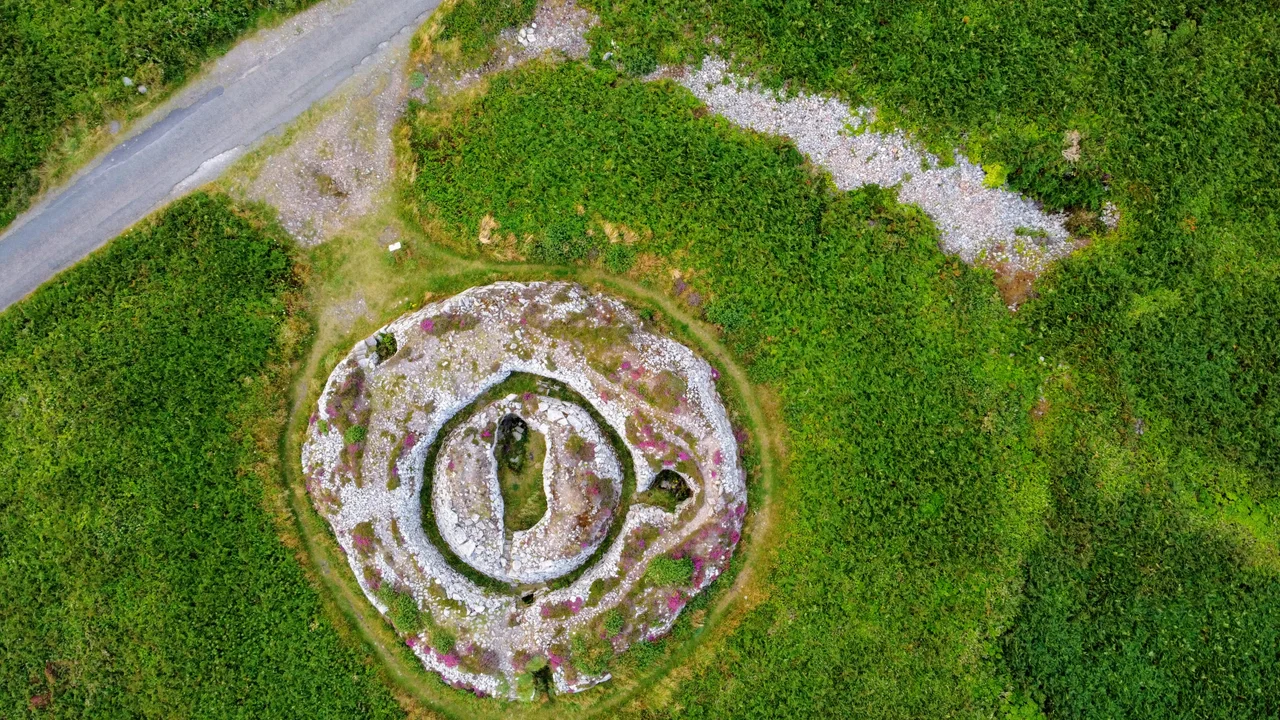

Ballowall Barrow
For most of recorded history, Ballowall Barrow simply was not there. The tin miners working the cliffs near St Just had heaped their spoil across it generation after generation, and the great cairn of the dead vanished beneath the waste of the living. Then in 1878, William Copeland Borlase ordered the rubble cleared away, and out of the mining tip rose a 72-foot-wide monument that had been holding the bones of Cornwall's first peoples since the Bronze Age. The miners had walked over it for centuries without knowing.
Where the Cliff Falls Away
Ballowall sits on Ballowall Common, a flat shelf of moorland where the land of Penwith makes its last stand before dropping straight into the Atlantic. From the barrow, the Brisons rise out of the water a mile offshore, twin teeth in the western swell. Cape Cornwall hooks south. On clear days the horizon is nothing but water all the way to Newfoundland, three thousand miles of empty Atlantic. The people who built this place chose the edge of the world deliberately. Their dead would lie facing the setting sun, with the sea at their feet and the long peninsula at their backs.
A Monument in Layers
Ballowall is not one tomb but several, stacked across a thousand years. At its heart sits a central domed structure containing stone-lined burial cists, with a pit dug beneath. Around this inner monument runs an outer cairn ring, itself studded with cists. Set into the outer wall is an entrance grave, a doorway type of tomb characteristic of the Scillonian-Cornish tradition. The Neolithic builders started it. Bronze Age communities adopted, expanded, and reused it. The English Heritage record calls the combination unique: nowhere else in Britain do these two funerary traditions overlap so completely in a single structure. The people of Penwith kept coming back to bury their dead in the same sacred ground for more than a millennium.
Borlase's Excavation
William Copeland Borlase was thirty years old in 1878, a Cornish gentleman antiquarian with a famous archaeological surname and a habit of digging into anything ancient he could find. When he heard the mining captains describe a strange mound buried under the spoil tips at Ballowall, he assembled a crew and began to clear it. What he uncovered astonished him. The finds, including pottery and human remains, went off to museums in Truro, Cambridge, and the British Museum, where they remain. Borlase recorded a similar barrow nearby, but the notes on its location have been lost, and that second monument has never been found again. Ballowall stands alone now, its sister hidden somewhere under Cornish gorse, or perhaps quarried away by the miners who never knew what they were destroying.
Where the Past Touches the Present
Today the barrow is in the guardianship of English Heritage and managed by the National Trust. The South West Coast Path runs past it, and walkers stopping for a breather on the cliff edge often miss it entirely, mistaking the low concentric rings of stone for a quirk of the moorland. There are no signs, no fences, no ticket booth. You can step inside the cists where Bronze Age families laid their kin. The wind off the Atlantic carries the same salt those mourners breathed four thousand years ago. Cornish people have always lived close to their dead, in the chambered tombs scattered across this peninsula, in the rusting headworks of the abandoned mines just over the rise. At Ballowall, the two kinds of grave site sit beside each other on the same cliff.
From the Air
Located at 50.1223°N, 5.7014°W on the cliff top of Ballowall Common, immediately west of St Just in Penwith. Best viewed from 1,000-2,000 feet AGL approaching from the south or west. Nearest airport: Land's End (EGHC), 4 nautical miles south. From the air the barrow appears as a low circular earthwork on the moorland shelf between the village and the cliff edge, with the Brisons visible offshore to the southwest. Atlantic weather rolls in quickly here; clear days reveal the full sweep from Cape Cornwall to Sennen Cove.
Nearby Stories
- Bartholomew Ledges Wreck 1.8 km away
- Carn Brea Castle 4.6 km away
- Battle off Lizard Point 12 km away
- Carnewas and Bedruthan Steps 18 km away
- King Charles's Castle 25 km away
- MV Cita 34 km away
- 1979 Fastnet Race 47 km away
- Trevose Head Lighthouse 55 km away