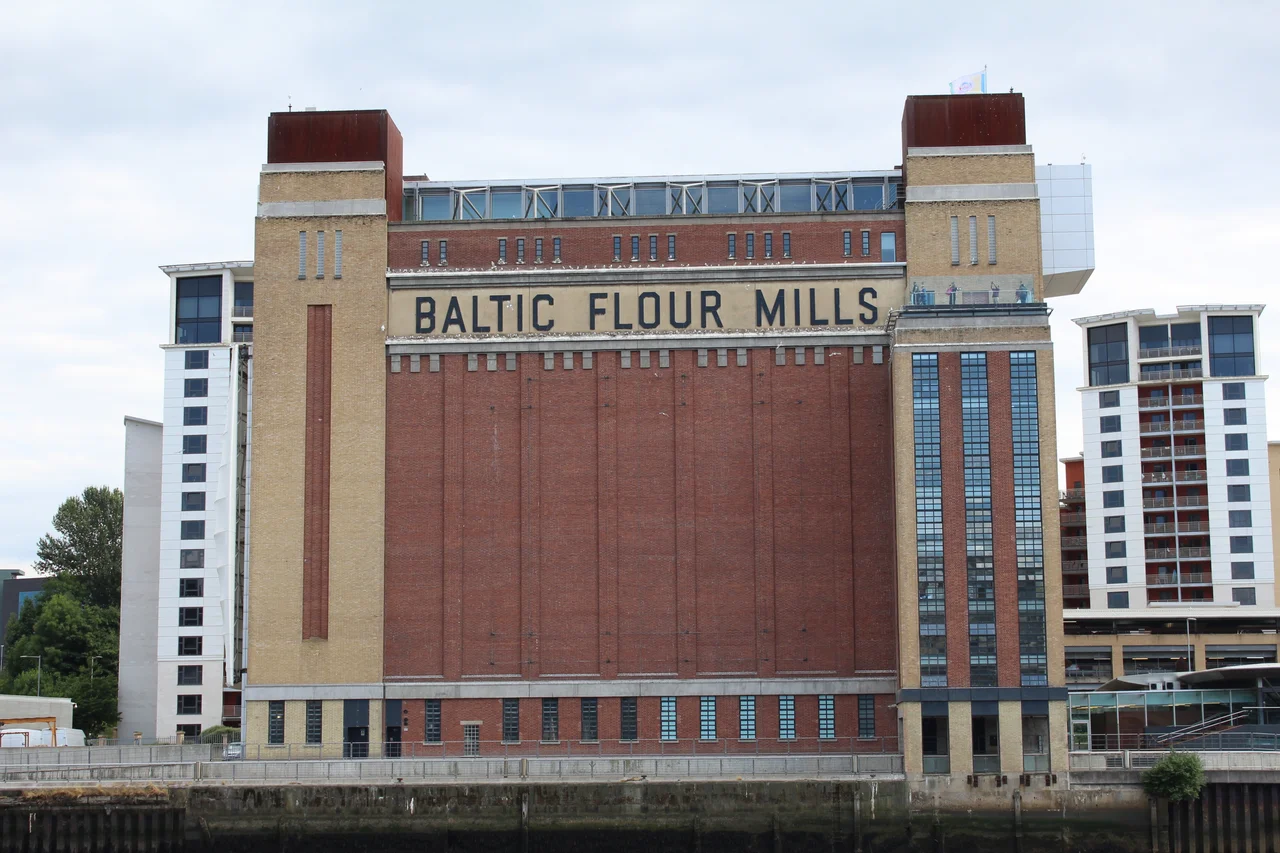

Baltic Centre for Contemporary Art
In 1999, before any new floors had been added inside the half-gutted Baltic Flour Mills, Anish Kapoor stretched 50 metres of red PVC into a vast trumpet shape down the centre of the empty silo-less shell. Taratantara, he called it. Sixteen thousand people queued to walk through a building that wasn't yet a gallery and wasn't a mill anymore. The flour had stopped flowing in 1981 after a fire. The grain silos had clung on until 1984, finally storing wheat that belonged to the European Economic Community. Then nothing. For fifteen years the building sat dark on the Gateshead side of the Tyne, waiting for somebody to decide what a flour mill could become.
The Pride of Tyneside
Joseph Rank of Rank Hovis commissioned the mill in the late 1930s to a design by Hull architects Gelder and Kitchen. Wartime delayed construction; it didn't start operating until 1950. At its peak, 300 people worked there, and the structure could hold 22,000 tons of grain. Locally it was known as 'the pride of Tyneside,' which was as much about scale as affection - two parallel brick facades running east to west, sandwiched between concrete silos visible for miles along the river. By the 1980s the mill was one of several Tyne-side industrial cathedrals slowly emptying out. The Spillers mill across the river held on into 2011 before being demolished. The Baltic had a different future. In 1994, Gateshead Council asked the Royal Institute of British Architects to launch a design competition for converting it. One hundred and forty entries arrived. The winner was Dominic Williams of Ellis Williams Architects, three years out of school.
Glass at the Ends, Brick in the Middle
Williams's design kept the north and south brick elevations intact, including the original BALTIC FLOUR MILLS lettering that still spells the building's history across the riverfront. The east and west sides were stripped and fully glazed, letting in Tyne light and giving the upstairs galleries views straight down the river to Newcastle and the bridges. Glass lifts were tucked into the building's corners. A rooftop restaurant was perched on top in a way that still let natural light reach the top-floor gallery beneath. The interiors mix glass, concrete, aluminium, Welsh slate, COR-TEN steel and Swedish pine, with flexible furniture by Åke Axelsson. The ductwork was hidden inside the structural beams - an early example, in the early 2000s, of environmental engineering by Atelier Ten. The building won a RIBA award in 2003, a Civic Trust Award in 2004, and a place on the Gulbenkian Prize shortlist of the UK's ten most outstanding cultural projects in 2006.
A Gallery Without a Collection
Baltic opened to the public in July 2002. Its founding decision was radical: no permanent collection. Every exhibition would be temporary, every wall would change. The inaugural show, B.OPEN, brought together work by Chris Burden, Carsten Holler, Julian Opie, Jaume Plensa, and Jane and Louise Wilson - including a 1/20-scale Meccano replica of the Tyne Bridge, a roomful of playable gongs, and a video of a rocket launch. The opening weekend drew 35,000 visitors in a single week against a year-one target of 250,000. Bread was handed out on the riverside in memory of the mill. Founding director Sune Nordgren had wanted a dramatic gesture; he got one. Subsequent directors have struggled, sometimes spectacularly. Nordgren left in 2003 amid accusations of overspending. His successor Peter Doroshenko departed in 2007 after staff complaints about a bullying management style. A 2007 controversy over a photograph in an Elton John-owned exhibition led to police involvement and the show closing after nine days.
Turner Comes North
In 2011, Baltic hosted the Turner Prize - the first time the prize had been awarded outside London or Liverpool Tate. Attendance reached 149,770, nearly double Tate Britain's average. Crucially, entry was free, breaking the Tate's tradition of charging. Martin Boyce won, with Karla Black, Hilary Lloyd and George Shaw as runners-up. The current director, Sarah Munro MBE, took over in November 2015; she had previously run Tramway in Glasgow. By January 2022, the building had welcomed over 8 million visitors. Judy Chicago's first major retrospective opened here in November 2019, a four-metre tapestry bookending the show with creation and grief. Baltic Open Submission in May 2021 featured 158 North East artists chosen from 540 lockdown submissions. The building that once stored European grain now stores nothing for long - which is, somehow, exactly the point.
From the Air
54.969N, 1.598W. The Baltic stands on the south bank of the Tyne directly across from Newcastle Quayside, adjacent to the Gateshead Millennium Bridge and immediately east of the Tyne Bridge. The original BALTIC FLOUR MILLS lettering is visible from the air. Best viewed at 1,500-3,000 ft AGL with the Tyne arching beneath. Nearest airport: Newcastle International (EGNT), 5 nm to the northwest.
Nearby Stories
- Cresswell Lifeboat Station 5.2 km away
- Auckland Castle 5.7 km away
- Battle of Otterburn 7.1 km away
- Saltburn Pier 11 km away
- Hadrian's Wall Path 11 km away
- Battle of Stainmore 18 km away
- Saltburn-by-the-Sea 39 km away
- Alexander L. Kielland (Platform) 296 km away