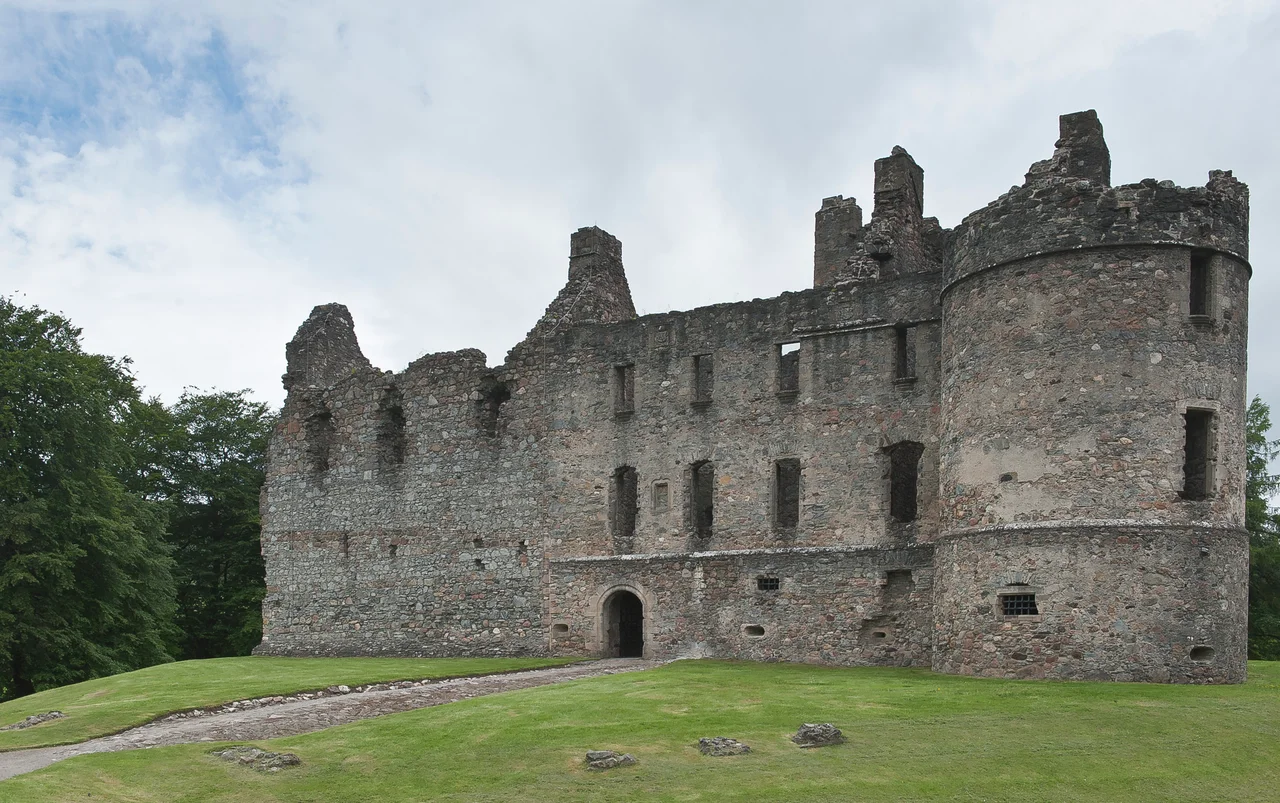

Balvenie Castle
The castle is called Balvenie now, but it started as Mortlach. In 1285, by a charter recorded a generation later, Alexander Comyn, Earl of Buchan, traded land in East Lothian to acquire it. The Comyns were one of the great Scottish noble families before they were destroyed, and this hilltop above the River Fiddich was strategically valuable to them — a bridge between Comyn power in Buchan to the east and Badenoch to the south. Robert the Bruce wrecked it in 1308 as part of his systematic destruction of Comyn strongholds. What rose on the ruins, through the 15th and 16th centuries, was a Douglas castle, then a Stewart one. The whisky that takes its name today is made down the hill.
The Comyn Stronghold
When Alexander Comyn took Mortlach in 1285, the Comyns were arguably the most powerful family in Scotland — more powerful, briefly, than the Bruces. The charter of 1285 records the trade: Comyn lands at Tranent in East Lothian for this hilltop in Highland Banffshire. The reason was geography. Mortlach connected Buchan to Badenoch and Lochaber, the two real seats of Comyn power. Holding this fort meant holding the country between them. The choice proved fatal during the wars of independence. When Robert the Bruce moved to consolidate his crown, he targeted Comyn castles systematically. In 1308 his army wrecked Mortlach, leaving the site uninhabitable. The Comyn era ended in fire and rubble at the foot of the hill.
The Black Douglases
Sometime in the 14th century, Balvenie passed to the Earls of Douglas. The likely path is through Joanna Murray's marriage to Archibald the Grim, 3rd Earl of Douglas, in 1362. Archibald's son, the 4th Earl, granted Balvenie to his younger brother James in 1408 — the man who became known as James the Gross. In 1440, James the Gross probably conspired with William Crichton and Alexander Livingston to murder his nephew William, 6th Earl of Douglas. James then became the 7th Earl himself, immediately settling Balvenie on his youngest son, John Douglas, Lord of Balvenie. The Black Douglas line was riding high but on borrowed time. At Arkinholm in May 1455, an army loyal to James II crushed them. All their lands were forfeited to the Crown. Balvenie went to Sir John Stewart, who became the first Earl of Atholl.
A Suicide and a Final Garrison
The castle's quieter centuries are harder to reconstruct. Some of the finest work — the elegant 16th-century range with its great windows — was added during the early Stewart ownership, turning a defensive structure into something closer to a fortified house. In 1718, William Duff died by suicide inside the castle. After that the building was effectively abandoned. Its last useful service came in 1746, when Hanoverian forces moving against the Jacobite rising encamped there, using the surviving structure as a shelter. They left it as they found it, and the place has been a ruin ever since. The current owner, Jeremy Duncan Nicholson, the Baron of Balvenie, lives in Atlanta, Georgia, an ocean and continent away from the empty rooms that bear his title.
The Castle and the Distillery
Today Historic Environment Scotland manages the ruin as a scheduled monument, opening it to the public from April through September. The yett — the wrought-iron grille gate at the entrance — is one of the finest surviving in Scotland. The Douglas tower, the 16th-century Stewart range, the courtyard walls: enough remains to walk through a thousand years of Scottish architectural ambition. Down the hill, William Grant founded the Balvenie distillery in 1893, naming it for the castle that had given the area its identity for six centuries. The Balvenie whisky now made there is one of Speyside's most respected single malts. The castle above is a quiet ruin. The distillery below is a working factory. They share a name and a hill.
From the Air
Located at 57.453 N, 3.124 W on a low hill 1 km north of Dufftown, in the Speyside whisky belt of Moray. The River Fiddich runs immediately south, and the Balvenie distillery sits at the foot of the castle hill. Inverness (EGPE) is about 65 km west; Aberdeen (EGPD) is about 65 km east. Cruise at 2,500-3,500 feet AGL for the best view of the rectangular courtyard ruin, with its distinctive square keep and curtain wall. The setting is classic Speyside: small green fields, scattered distilleries identifiable by their pagoda kilns, and the deep cut of the Fiddich valley.
Nearby Stories
- Battle of Corrichie 3.2 km away
- Loanhead of Daviot Stone Circle 5.4 km away
- Battle of Culblean 5.4 km away
- Moray Firth Fishing Disaster 6.8 km away
- Gardenstown 7.5 km away
- Cairn Gorm 7.9 km away
- Grantown-on-Spey 9 km away
- Cullen Viaduct 10 km away