.jpg)
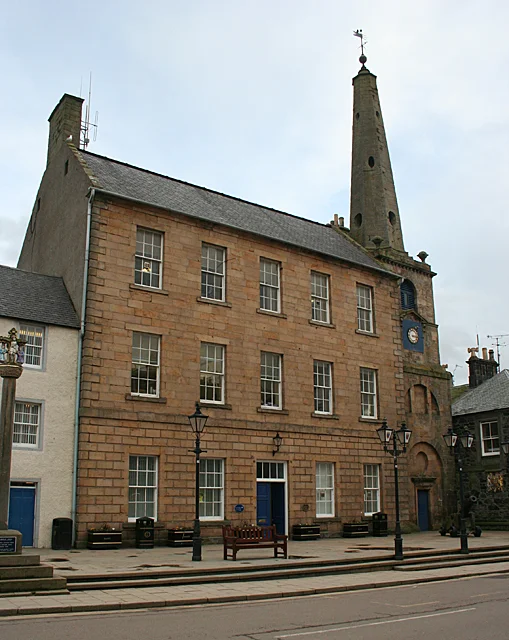
Banff Town House
John Adam designed the steeple before he designed Wedderburn Castle. He was the eldest of the famous Adam brothers, and in 1767 he gave the burgh of Banff a five-stage tower of ashlar stone, one bay wide, hexagonal at the top, with a clock and a Diocletian window and a small architectural showmanship usually reserved for far grander commissions. The town wanted something that would announce itself from the harbour and the bridge, and Adam delivered. Two and a half centuries later the steeple still does its job, and so does the town house that grew up around it.
Before the Steeple, the Tolbooth
Every Scottish burgh of any age once had a tolbooth. Banff's stood on the west side of Low Street at the corner with Strait Path, an early sixteenth century building that combined courthouse, jail, weighing station and town meeting hall in one cramped stone box. By the middle of the eighteenth century the tolbooth was dilapidated, and Banff's leaders decided to start again on the east side of the street. They commissioned John Adam for the steeple, and master mason John Marr cut and laid the ashlar. The building was complete in 1767. The town house itself, the larger administrative building beside the steeple, came thirty years later in 1797.
Architecture That Wants Attention
Adam's steeple is designed to be read upward in stages. The doorway carries a cornice and a blind oculus above it, a round window with no glass that simply implies depth. The second stage holds a blind Diocletian window, the three-part semicircular form named for the Roman emperor's baths. Above that, a clock with its own pediment. Above the clock, a round-headed louvered opening where the bell hangs. The whole composition tapers into a hexagonal spire. For a building only one bay wide, it carries the architectural vocabulary of something much grander. Both the steeple and the 1797 town house now hold Category A listed building status, the highest in Scotland.
Police Burgh and the Plainstones
Banff's fishing industry grew rapidly in the early nineteenth century, and the town's population grew with it. In 1840 Banff became a police burgh, which meant it had taken on the modern responsibilities of paving, lighting, water and sanitation, and the town house became the headquarters from which these were administered. The mercat cross, the medieval market cross that proved a burgh's right to hold a market, had wandered around Banff for centuries before finally settling on the Plainstones in June 1900. The Plainstones are the raised stone pavement directly in front of the town house, and they made a natural civic stage. In 1901 a captured Russian cannon from the Siege of Sevastopol joined the cross. The cannon has since disappeared. The cross is still there.
Council Seat to Customer Service Point
The town house served as headquarters for the burgh through most of the twentieth century, and for the enlarged Banff and Buchan District Council after 1975. Local government reorganisation in 1996 created Aberdeenshire Council, headquartered in Aberdeen, and the Banff building lost its role as a seat of government. It did not lose its role entirely. Morrison Construction completed a 1.75 million pound refurbishment in July 2015 that turned the interior into a modern customer service point and job centre. Walk in today and you can ask the council about your bins or apply for benefits, and you do it in a building whose steeple was designed before the American Revolution. The continuity is the point. Scottish burghs do not abandon their civic centres. They renovate them.
From the Air
Banff Town House stands on Low Street in central Banff at 57.66 degrees N, 2.52 degrees W. From the air the steeple is one of the more distinctive features of the small town centre; its hexagonal spire reaches above the surrounding two and three storey buildings. The Plainstones and the mercat cross are immediately in front. Cruise altitude two to five thousand feet gives a fine view of the relationship between the steeple, the bridge over the Deveron, and Duff House in its grounds to the south. Nearest airports are Aberdeen (EGPD) about forty nautical miles southeast and Inverness (EGPE) about fifty nautical miles west.
Nearby Stories
- Aberlour Distillery 4.2 km away
- Pitsligo Castle 5.8 km away
- Lossiemouth 7.7 km away
- Battle of Slioch 7.8 km away
- Old Slains Castle 18 km away
- Helmsdale 32 km away
- HMS Exmouth (H02) 35 km away
- German submarine U-58 (1938) 39 km away