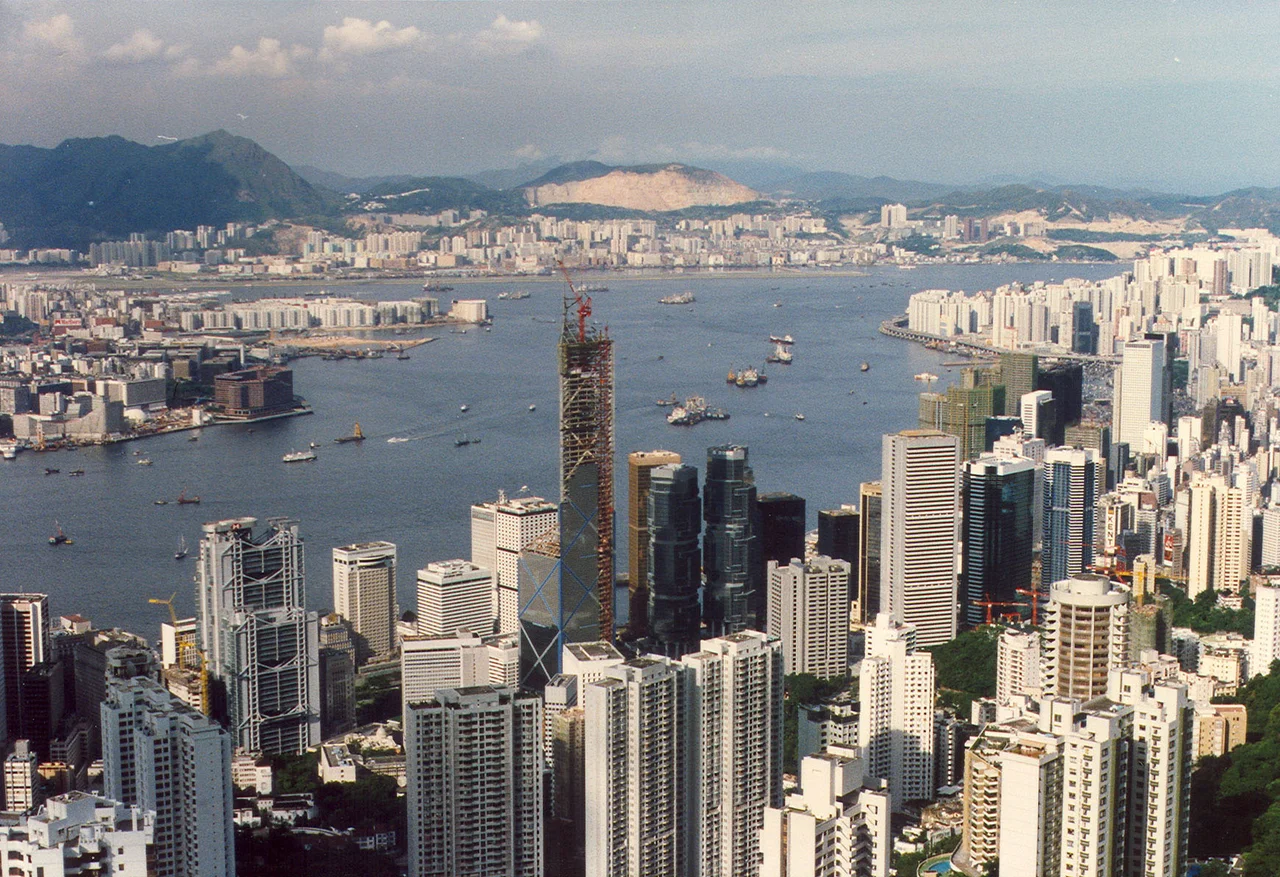

Bank of China Tower (Hong Kong)
The nickname arrived before the building did. While the Bank of China Tower was still rising above Central in the late 1980s, Cantonese speakers had already begun calling it 一把刀 — *yaat baa dou*, one knife. Seen from certain angles, the triangular glass profile does suggest a cleaver blade, its sharp edges catching Hong Kong's subtropical light without apology. The feng shui objections followed: practitioners warned that a building with so many X-shapes in its structural frame, and edges that pointed toward neighboring structures, violated principles that virtually every major Hong Kong developer consulted before breaking ground. The Bank of China had not consulted anyone. Whether this was cultural oversight or deliberate statement, the result was a tower that spent its first years as a controversy and its subsequent decades as one of the most recognizable forms in any Asian skyline.
The Architect and the Auspicious Date
I.M. Pei was Chinese-American, born in Guangzhou, educated at MIT and Harvard, and by the time he received the Bank of China commission he had already designed the East Building of the National Gallery of Art in Washington and would go on to win the Pritzker Prize in 1983. The tower at 1 Garden Road was his most personal large-scale work in many ways — a return, architecturally, to a city and a culture he knew from childhood. The original target completion date was 8 August 1988: triple eights, among the most auspicious combinations in Chinese numerology. Project delays pushed groundbreaking back to March 1985, and the completion slipped nearly two years. The building was topped out in 1989 and first occupied on 15 June 1990. By then, a press conference planned for May 1989 to celebrate the building's "designer socialist furnishings" had been quietly cancelled — the Tiananmen Square protests had made any Bank of China publicity untenable.
Engineering a New Kind of Skyscraper
At 315 metres, with twin masts reaching 367.4 metres, the Bank of China Tower was the tallest building in Hong Kong and Asia from 1990 to 1992. More significantly, it was the first building outside the United States to exceed 305 metres — the 1,000-foot threshold that had been an American monopoly since the skyscraper era began. It was also the first composite space frame high-rise ever built. The structural logic Pei devised with engineer Leslie E. Robertson — who had previously worked on the original World Trade Center towers — eliminated the need for internal columns. The entire weight of the 72-storey building transfers through triangular frameworks to four steel columns at the building's corners. This is why the interior floors are unobstructed: the structure is essentially a self-bracing geometric skeleton, the 'X' shapes that troubled feng shui practitioners being the visible expression of a sophisticated load-transfer system. It is now the fourth-tallest skyscraper in Hong Kong, surpassed by the International Commerce Centre, Two International Finance Centre, and Central Plaza.
The X Shapes and What They Mean
Feng shui masters who examined the building's design identified two classes of problem. The sharp triangular edges pointed outward toward other buildings — the Government House in particular — and were thought to project cutting energy toward their neighbors. The numerous X-shaped bracing elements in the facade suggested, in the symbolic vocabulary of feng shui, negation or cancellation. Pei reportedly modified the design to some degree after these concerns were raised, though the building retained its fundamental geometry. Whether or not one takes feng shui seriously as a system of environmental philosophy, the controversy revealed something real about Hong Kong's architectural culture: that a developer's decision to bypass these consultations entirely was not merely eccentric but legible as a political statement. In a city where major institutions took such things seriously as a matter of course, opting out read as a message. The Bank of China's message, intentional or not, was about who this building represented and what it thought about local conventions.
Life in the Skyline
The tower houses the headquarters of Bank of China (Hong Kong) Limited at 1 Garden Road, accessible on foot through Chater Garden from Central MTR station. A public observation deck on the 43rd floor offered harbor views for some years but is now closed. What persists is the building's role in Hong Kong's visual identity: it appears in the *It's a Small World* attraction at Hong Kong Disneyland, featured in two *SimCity* games as a placeable landmark, and has been destroyed or threatened by aliens, giant robots, and a fictional kaiju in a range of Hollywood productions while surviving unscathed in all of them. In *Godzilla vs. Kong*, the tower stands intact after Godzilla and Kong level everything around it — a durability the building's real structural engineers would probably consider appropriate.
From the Air
The Bank of China Tower stands at approximately 22.279°N, 114.161°E in Central, Hong Kong Island, instantly recognizable from the air by its triangular cross-section and the way its glass faces catch light differently depending on the sun angle. Approaching from the harbor at 2,500 feet, the tower's distinctive stepped-prism profile distinguishes it clearly from the rectangular masses of neighboring buildings. Its 367-metre masts make it one of the most reliable vertical references in the Central cluster. Hong Kong International Airport (VHHH) lies approximately 30 km to the west-northwest. The HSBC headquarters immediately to the west — with its distinctive external suspension trusses — and the neoclassical Court of Final Appeal provide orientation at street level.
Nearby Stories
- Lok Ma Chau Loop 2.3 km away
- Portas do Cerco 2.3 km away
- Kweilin Incident 17 km away
- Wanshan Archipelago Campaign 34 km away
- Nanxiong Formation 115 km away
- Battle of Nanpeng Island 148 km away
- Heyuan 169 km away
- Cape Maobitou 632 km away