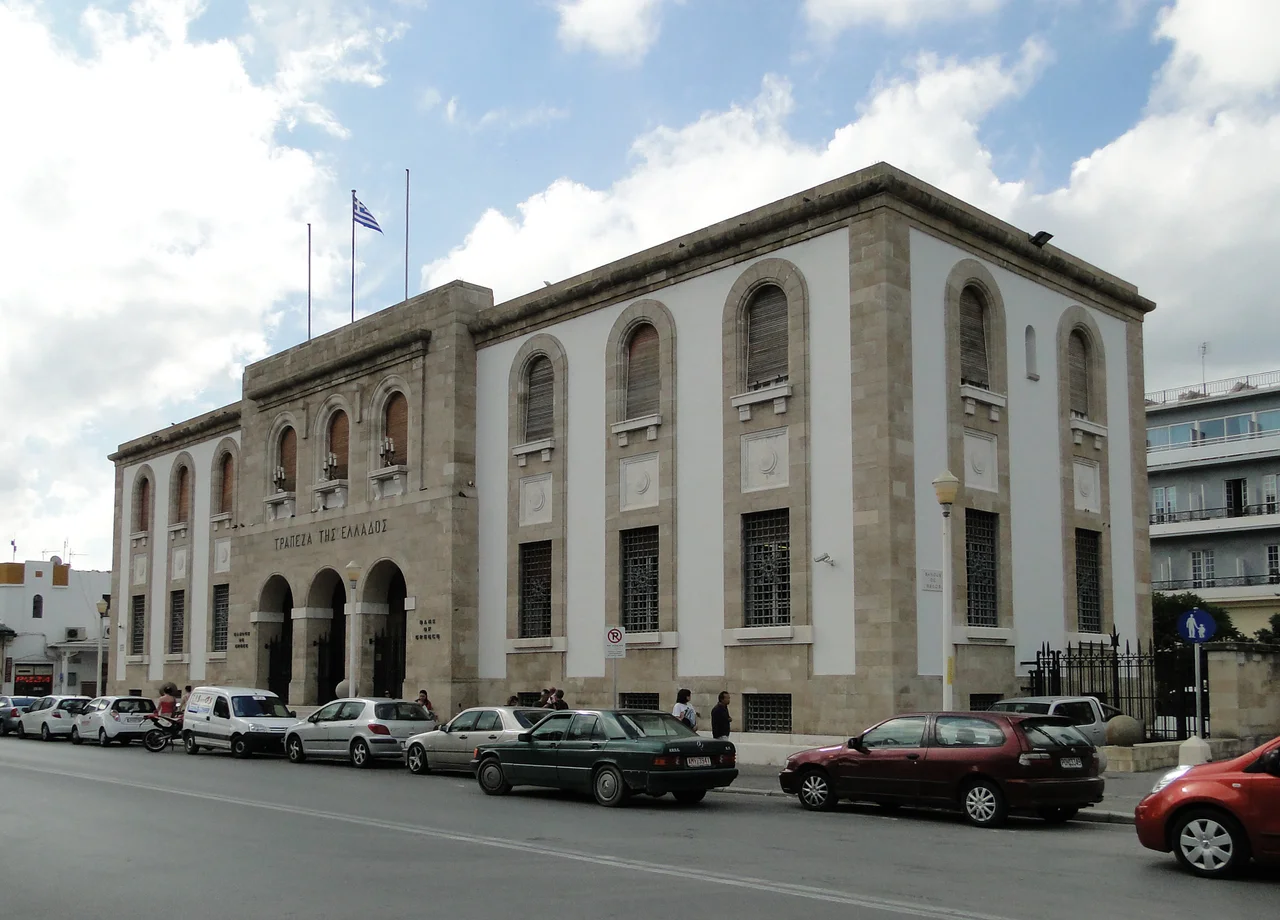

Bank of Greece
When the Germans marched into Athens in April 1941, the most important thing the Bank of Greece owned was already gone. Its governor and deputy governor had slipped away with the government-in-exile, bound for London by way of Egypt and South Africa, and Greece's gold reserves - hundreds of thousands of ounces - were being hustled out of the country under enemy bombs. The neoclassical headquarters on Panepistimiou Street would spend the war under a puppet administration. But the bank itself, in the form that mattered, had become a fugitive.
Born From a Bailout
The Bank of Greece did not grow up gradually like older central banks. It was imposed. After the upheavals of the 1920s, the League of Nations coordinated a stabilization loan for Greece, and a condition of that loan was the creation of a proper central bank. Law was passed in December 1927, operations began in 1928, and by 1930 the bank's shares were listed on the Athens Exchange. From the start it carried a peculiar feature it keeps to this day: unusually for a central bank, it has private shareholders, and its stock still trades publicly. The institution that prints a nation's money is itself partly owned by ordinary investors.
The War Years
The Axis occupation of 1941 to 1944 split the bank in two. Governor Kyriakos Varvaresos and Deputy Governor Georgios Mantzavinos followed the legitimate Greek government into exile in London. In occupied Athens, collaborationist authorities fired them and installed a revolving cast of replacement governors who served at the pleasure of the occupiers. Meanwhile the nation's gold had been loaded onto warships, rerouted to Egypt under air attack when Crete proved unsafe, and eventually carried to South Africa and then London for safekeeping - a desperate journey to keep Greece's reserves out of German hands. When liberation came, the legal record was set right with a single stroke: every appointment and dismissal made by the occupation-era administrations was declared null and void, as though the puppet bank had never existed.
The Long Goodbye to the Drachma
For most of its history the bank had one defining job: guarding the drachma, the currency that had jingled in Greek pockets for generations. That ended at the turn of the millennium. Greece initially failed to meet the criteria for the euro and was left out when the new currency launched on 1 January 1999. The country qualified soon after, adopting the euro in January 2001, though physical drachma notes and coins remained legal tender until 28 February 2002, when the dual-circulation period ended. After more than seven decades, the bank stopped issuing a Greek currency and became one node in the Eurosystem - its banknotes now marked with the printer code 'Y'.
A Bank of Stone
The bank built itself into the cityscape deliberately. Its central building on Panepistimiou Street, designed in the early 1930s and inaugurated in 1938, was later extended to swallow an entire Athens block. In Thessaloniki it shares a single building with the National Bank of Greece, the two institutions entering from opposite ends. And across the country it raised branch after branch in a sober neoclassical style during the 1930s - in Chania, Larissa, Mytilene, Volos and beyond - not merely to do business but to project stability after the European banking crisis of 1931 rattled the continent. In an age of bank runs and collapsing currencies, solid marble columns were a message: this institution will outlast the panic.
Today's Role
The modern Bank of Greece does far more than supervise money. With a staff of more than 1,800, it polices the country's private banks and insurers, acts as treasurer to the Greek state, and increasingly carries out policies set in Brussels and Frankfurt rather than Athens. It sits on the supervisory boards of Europe's banking and insurance authorities and helps wind down failing banks as Greece's national resolution authority. The drachma is a memory and the gold long since returned, but the building on Panepistimiou Street still anchors Greek finance - a central bank that survived occupation, exile, and the loss of its own currency, and kept going.
From the Air
The Bank of Greece headquarters stands at 37.9786°N, 23.7333°E on Panepistimiou Street in central Athens, a short distance northeast of the Acropolis amid the city's grand neoclassical core. From the air the building reads as a dense city block; the nearby Acropolis, a flat limestone rock topped by the Parthenon, is the navigational landmark. Nearest airport is Athens International (LGAV), about 33 km east-southeast. Expect clear, bright skies through the dry summer, with occasional haze over the Athenian basin in calm conditions.
Nearby Stories
- Great Sand Beach 5 km away
- Battle of Delium 7.7 km away
- Tower of Aliartos 9 km away
- HMHS Britannic 10 km away
- Saronic Gulf 15 km away
- Sousaki Volcano 17 km away
- Sanctuary of Apollo Maleatas 24 km away
- Skyros 66 km away