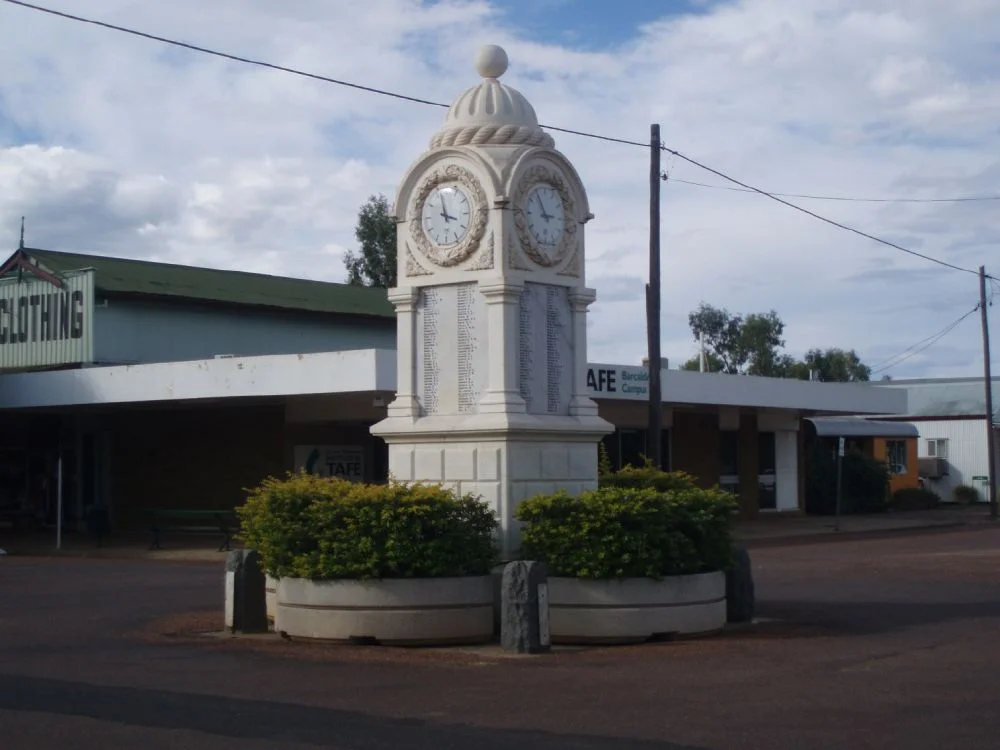

Barcaldine War Memorial Clock
The town chose a clock. In 1922, when the Barcaldine Shire Council asked how the district should remember its soldiers, the answer came back by public ballot: not an obelisk, not a digger cast in bronze, but a tower that would mark the passing hours over Ash Street for as long as the town stood. It is a strangely fitting choice. Of all the war memorials raised across Queensland in those grieving inter-war years, the clock type is rare, and this one, unveiled in 1924, remains the only memorial of its style in the entire state.
The Names It Keeps
The memorial honours 292 local men who served in the First World War, among them the 38 who did not return. Set those numbers against the size of the place. Barcaldine was a small railway town on the edge of the outback, and 292 men is a substantial portion of a generation. Nearly every family on the western plains would have had a son, a brother, a husband counted in that figure, and 38 households would have learned that theirs was among the names now carved in stone. The men had gone to a war on the far side of the world, to Gallipoli and the mud of the Western Front, and the town that waved them off was the same town that now read the casualty lists. The clock does not abstract them into statistics. It fixes them in marble and granite at the centre of town, where the people who loved them would pass beneath the names every day.
A Day in May
On 21 May 1924, the Governor of Queensland, Sir Matthew Nathan, unveiled the memorial before the assembled town. It is not hard to imagine that morning: the new tower draped and then revealed, the families of the fallen standing close, the silence that falls over such gatherings when a community looks together at what a war has cost it. For the people of Barcaldine the war was not distant history but raw and recent grief, the men gone barely a few years. The clock began keeping time that day, and it has kept it ever since, the focal point for every act of remembrance the town has held in the century since.
The Mason's Hand
The memorial came from the Brisbane workshop of Andrew Lang Petrie and Son, monumental masons of Toowong, at a cost of £524. In their records the design is listed plainly as clock tower number two, but there is nothing plain in the result. The marble and granite were worked with a craftsmanship that has made the tower a landmark in the streetscape, admired for the quality of its materials and the skill of its execution. The Petrie firm shaped grief into something that could endure the western weather and the decades, and the tower stands as much a record of their workmanship as of the men it honours.
Still Standing, Still Counting
A hundred years on, the clock still rises over Ash Street, listed on the Queensland Heritage Register since 1992 and freshly commemorated at its centenary in 2024. War memorials like this one were raised in nearly every Queensland community in the years after the Armistice, a recurrent answer to a shared catastrophe, and together they form a documentary record of how a young nation chose to carry its sorrow. Most reached for the familiar forms, the soldier at rest, the obelisk, the cenotaph. Barcaldine, in a town meeting, reached for a clock, an instrument whose whole purpose is to keep time, and gave it the task of keeping time for the dead. There is something quietly insistent in that choice. A monument can be walked past; a clock must be consulted. Every glance up to check the hour is also, whether the looker means it or not, a glance at the names. The choice has outlasted everyone who made it.
From the Air
The War Memorial Clock stands at roughly 23.55 degrees south, 145.29 degrees east, on Ash Street in central Barcaldine, only a short walk from the Shire Hall and the Tree of Knowledge memorial. From the air, Barcaldine reads as a compact grid of green, tree-shaded streets surrounded by flat brigalow plains, with the Central Western Railway running through the heart of town. Nearest field is Barcaldine Airport (ICAO YBAR); Longreach Airport (YLRE) lies about 100 km to the west-northwest. The dry-season skies of central-western Queensland offer long, clear visibility for low-level viewing.
Nearby Stories
- Aramac Tramway Museum 28 km away
- Beaconsfield Station Sheep Wash 34 km away
- Wellshot Station 44 km away
- Bexley Station 53 km away
- Yalleroi 54 km away
- Augustus Charles Gregory 97 km away
- Cullin-la-ringo Massacre 230 km away
- Brigalow Belt 265 km away