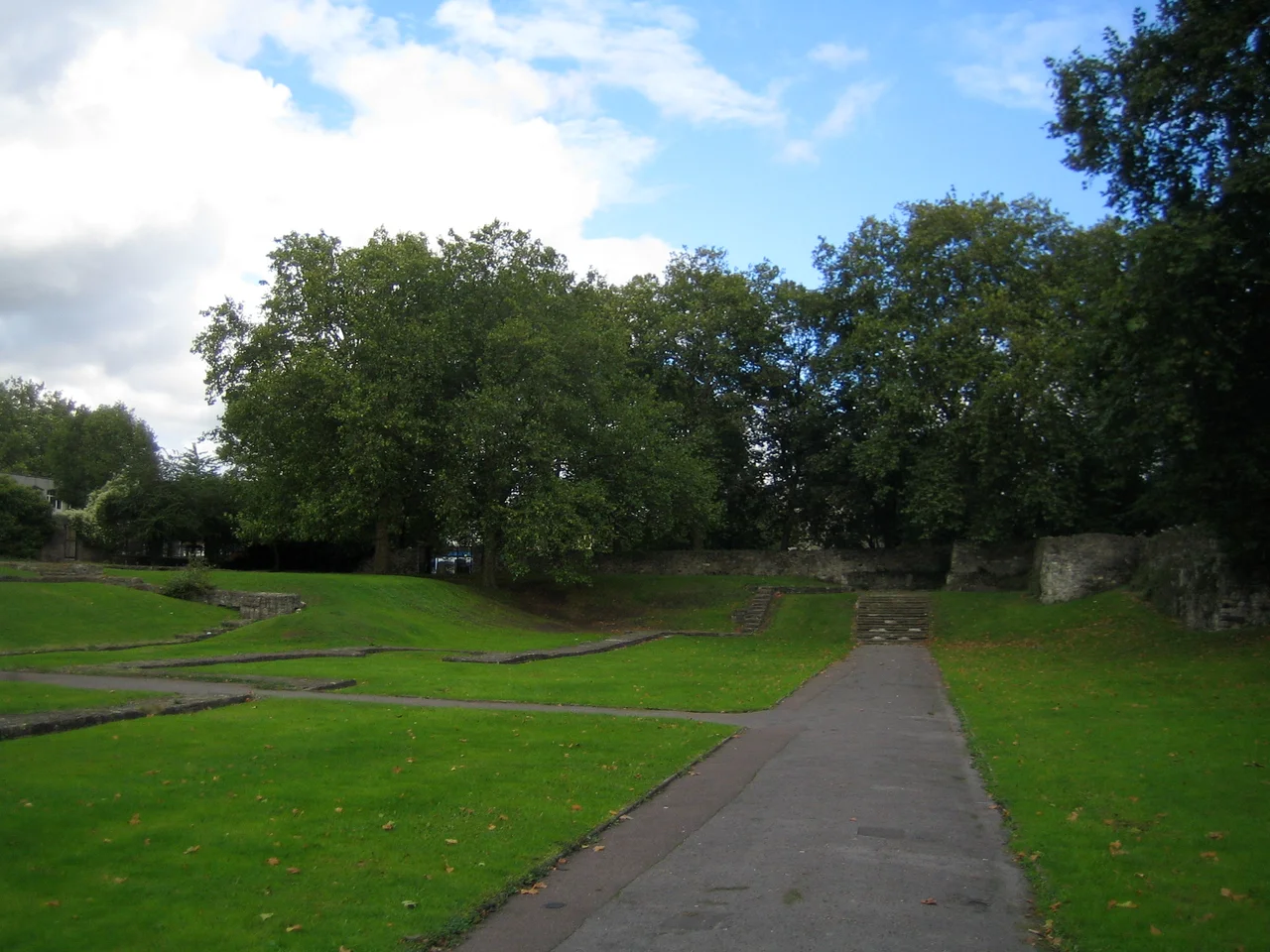

Barking Abbey
Around the year 660 a man named Earconwald, who would later become Bishop of London, founded two monasteries at the same time. He built Chertsey Abbey for himself and his fellow monks. And he built Barking Abbey, on a flat reach of the River Roding east of London, for his sister Ethelburga. She became the first abbess. By the time the abbey was dissolved nearly nine centuries later in 1539, it was the third-wealthiest nunnery in England. Its abbesses had included two queens of England. Two future Tudor kings had been raised inside its walls. Today only the Curfew Tower still stands, but the foundations of the rest are traced out in stone on the green where the church once was.
A Brother and Sister Build Two Monasteries
Earconwald and Ethelburga were Anglo-Saxon nobles who chose religious life and then quietly built infrastructure for it. Earconwald died in 693, was carried back to St Paul's Cathedral for burial, and was later canonised. Ethelburga was succeeded as abbess by Saint Hildelith of Faremoutier, who held the post until around 712. Bede wrote that miracles attended the early abbey. It was built simply, of wood and wattle-and-daub with reused Roman tile, but the holdings grew steadily through Anglo-Saxon charters. Then around 871 the Vikings sailed up the Roding and burned it. The nuns fled to their London estate, probably the church now called All Hallows-by-the-Tower. They came back. Saint Dunstan, Archbishop of Canterbury, eventually placed Barking under the Rule of St Benedict, and the abbey resumed its role as one of the most important religious houses in the country.
Where the Conqueror Stayed
When William the Conqueror crossed from Normandy in 1066, defeated Harold at Hastings, and began organising his hold on England, he chose Barking Abbey as his temporary headquarters while the Tower of London was being built. He confirmed the abbess Æfgiva in her position with a royal charter granting her his 'peace and love and all my rights within and without the burgh as fully as any abbess in that monastery of Saint Mary had them in the time of King Edward'. It was at Barking that William received the formal submissions of Morcar Earl of Northumbria and Edwin Earl of Mercia, the two great Anglo-Saxon earls who had not yet fought him. Their sister Ealdgyth was the widow of King Harold. The Norman Conquest of England was, in a real sense, signed off in a Saxon nunnery at Barking.
Royal Daughters and the Three Saints
The abbesses of Barking included some of the most powerful women in medieval England. Matilda of Scotland, wife of King Henry I. Matilda of Boulogne, wife of King Stephen. Matilda of England, daughter of Henry II. Mary, sister of Thomas Becket, who was made abbess in 1173 as an act of reparation for her brother's murder. By the early thirteenth century the east end of the abbey church had been expanded to a saints' chapel, where the relics of Ethelburga, Hildelith, and Wulfhilda were placed for veneration. Pilgrims came. In 1404 Barking was one of only three English abbeys recorded as employing a dedicated librarian, a remarkable institutional sophistication for a women's house at that date. The abbey produced its own Ordinale and Customary: a calendar, instructions for rites, and commemorations of its three saintly abbesses.
Where Two Future Kings Grew Up
During the abbacy of Katherine de la Pole, from 1433 to 1473, two small boys were sent to live in her custody by the council of King Henry VI. They were the king's young half-brothers, Edmund and Jasper Tudor, sons of Owen Tudor and Catherine of Valois, widow of Henry V. The abbey received £52 12 shillings a year for their upkeep. Edmund Tudor went on to marry Margaret Beaufort and become the father of Henry Tudor, who would seize the English throne at Bosworth in 1485 and become King Henry VII. Jasper became his uncle's principal supporter and the architect of his survival in exile. The dynasty that would rule England through the Reformation and the Elizabethan age learned its first lessons in a Benedictine girls' school by the Roding.
Dissolution and the Surviving Tower
The Valor Ecclesiasticus survey of 1535 recorded Barking's gross income as £1,084 6 shillings and 2¼ pence, third-wealthiest nunnery in England behind only Sion Abbey and Shaftesbury. Four years later Henry VIII dissolved it. On 14 November 1539 the abbess Dorothy Barley and her thirty nuns formally surrendered in their chapter house. Twelve days later they were granted pensions, with the abbess's set at 200 marks a year. Some of these pensions were still being paid in the 1550s under Queen Mary. Most of the abbey was demolished. In 1551 Edward VI granted the land to Edward Clinton, who later became the first Earl of Lincoln. The Curfew Tower, also called the Fire Bell Gate, is the only complete building that survives. Built around 1460 to replace an earlier tower from 1370, it now appears on the coat of arms of the London Borough of Barking and Dagenham. Below it, the foundations of the abbey church are traced out in low stone on Abbey Green, with a small sculpture made from two old London Bridge stones standing in front.
From the Air
Barking Abbey stands at 51.54 degrees N, 0.08 degrees E in central Barking, east London. London City Airport (EGLC) lies about 4 km south. Stansted (EGSS) is roughly 30 km north. From low altitude on approach to City Airport, the Roding valley and the modern Barking town centre are visible, with the small green patch of Abbey Green just east of the railway station marking where the abbey once stood.
Nearby Stories
- Waytemore Castle 2 km away
- Prittlewell Royal Anglo-Saxon Burial 4.2 km away
- Sevenoaks 5.6 km away
- Central line (London Underground) 6.4 km away
- River Lea 9.7 km away
- Surrey 11 km away
- Mercury Theatre, Colchester 14 km away
- Faversham Munitions Explosion Memorial 14 km away