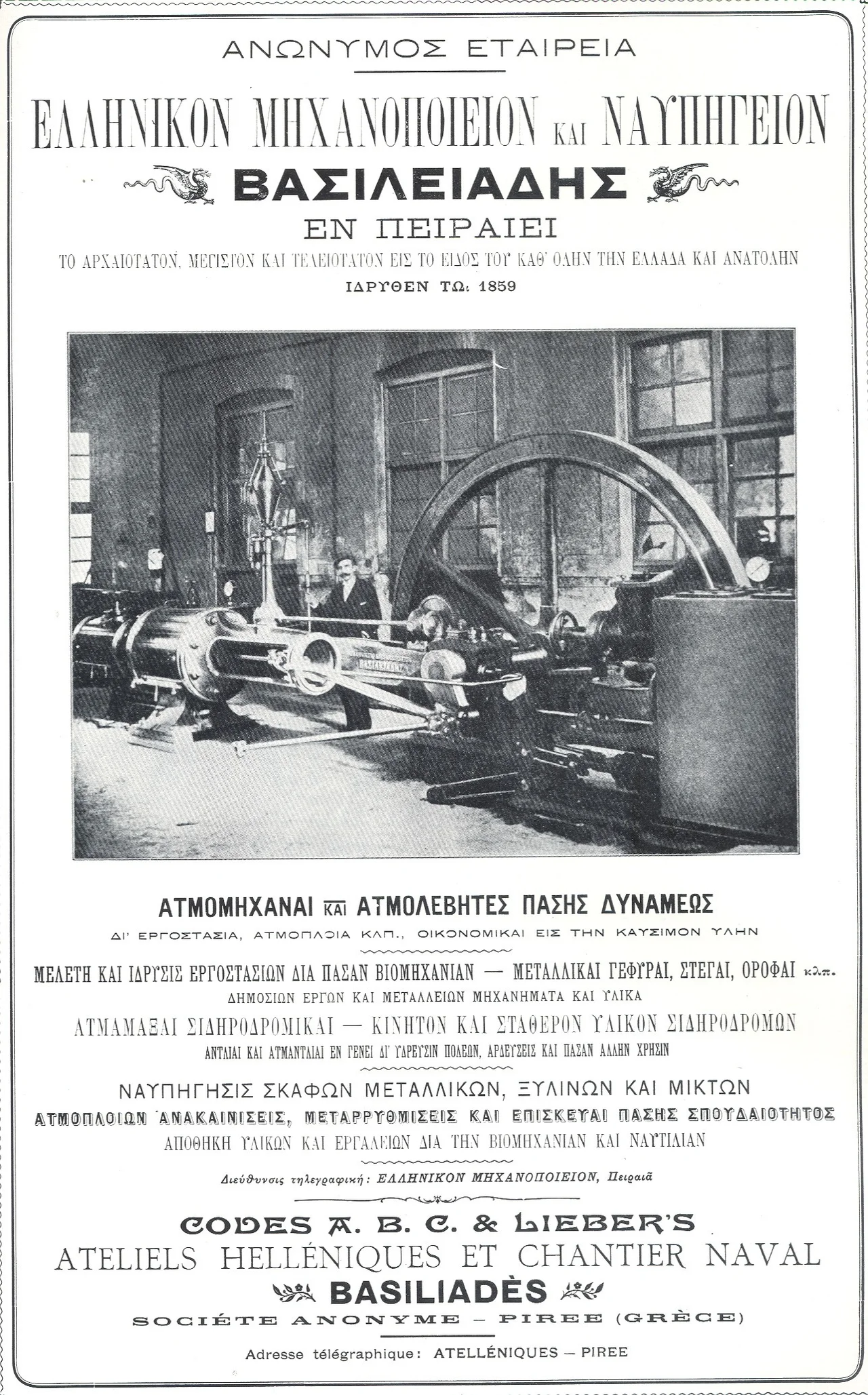

Basileiades
In 1900, a locomotive rolled out of a Piraeus shipyard that had never built one before. The Basileiades company had taken the order in 1899, worked from a French design, and delivered a functioning steam engine named *Hellenis* — Greek Lady — that would serve the Attica Railways for nearly fifty years. The company promptly announced its new status as a locomotive manufacturer in the trade press. Then it looked at the numbers and decided never to build another one. That combination of ambition, competence, and hard commercial pragmatism captures something essential about Basileiades: a company that shaped the Greek industrial revolution without ever losing sight of the waterline.
The Machine That Built a Port City
Basileiades was founded in Piraeus in 1859, at the moment when the city was beginning its transformation from a small harbor into Greece's industrial and commercial center, supplanting Ermoupolis in Syros as the country's economic heart. The company rode that transformation and helped drive it. Its product range was extraordinary by the standards of the time: steam engines, boilers, pumps, cranes, farm equipment, hydraulic devices, metal bridges, railroad materials. Basileiades didn't just manufacture components — it installed entire factories, building industrial capacity from scratch for clients across Greece and beyond. Its own advertisements made the scale of its ambition clear, calling itself 'the most significant machine builder in Greece and the East.' That was not empty boasting. In the second half of the nineteenth century, it was probably true.
Steel Hulls and One Extraordinary Locomotive
The company's first all-metal steamship rolled out of its yards in 1892, a milestone in Greek industrial history. Shipbuilding became an increasingly central part of the Basileiades identity, alongside the machine works. In 1896, new facilities opened in the Drapetsona area of Piraeus, expanding the company's capacity for ship construction and repair. Then came the locomotive. In 1899, Basileiades accepted an order from Attica Railways for a steam locomotive, built to an original French design. The finished engine — the *Hellenis* — was delivered in 1900 and worked reliably for nearly half a century before being scrapped. Only its badge survived; it is now held at the Railway Museum in Athens. The venture was not repeated. The company calculated that further locomotive production would be unprofitable and returned its attention to the waterfront. The *Hellenis* remained a singular achievement: the only steam locomotive Basileiades ever built.
The Largest Shipyard in Greece
By the time the Second World War began, the Basileiades yards at Drapetsona had grown into the largest shipyard in Greece. The company had progressively shifted its emphasis from manufacturing to shipbuilding and then increasingly to ship repair, a business that rewards location and reliability over novelty. Piraeus was the right place for it. Then German bombing during the war damaged the facilities, and that damage proved to be the first step in a long decline. The physical plant could be repaired, but the momentum was harder to restore. In 1953, Basileiades was acquired by the Hellenic Chemical Products and Fertilizers Company, AEEHPL, a member of the vast Bodosakis industrial group, which was then expanding its activities. The historic machine works became a subsidiary of a chemical conglomerate.
What the Waterfront Remembers
The subsequent decades brought further change. In 1963, AEEHPL sold the buildings and docks to the Piraeus Port Authority. AEEHPL itself survived until 1999, when it was wound up in the broader collapse of the Bodosakis industrial empire. The physical infrastructure of the old Basileiades yards proved more durable than its corporate owners. The two dry docks that Basileiades built at Drapetsona are still in use, owned by Piraeus Port Authority and leased to ship maintenance contractors. The stretch of Piraeus waterfront where the company once operated is still called the Basileiades coast — in Greek, Ακτή Βασιλειάδη — and the docks are still sometimes referred to as the Vassiliadis Docks. A company founded in 1859 that built locomotives, steamships, bridges, and factories for nearly a century left behind, in the end, its name on the water's edge.
From the Air
The former Basileiades works occupy the Drapetsona waterfront of Piraeus at approximately 37.944°N, 23.632°E, on the western edge of the main Piraeus harbor complex. From the air, the industrial character of this stretch of the port is immediately apparent — dry docks, quays, and the dense infrastructure of a working harbor. The Saronic Gulf opens to the south, with the island of Salamis visible just across the water to the west. Piraeus and its peninsular harbor sit about 10 kilometers southwest of central Athens. The nearest major airport is Athens International Eleftherios Venizelos (LGAV), approximately 25 kilometers to the east. A low-altitude pass at 1,500 to 2,000 feet on a clear day reveals the full geometry of the port: the main commercial basin, the Zea Marina to the east, and the industrial waterfront at Drapetsona where the Basileiades company reshaped Greek industry for nearly a century.
Nearby Stories
- Parnitha 3.4 km away
- Kea (island) 7.3 km away
- Sanctuary of Apollo Maleatas 11 km away
- Sousaki Volcano 12 km away
- Battle of Leuctra 14 km away
- Great Sand Beach 18 km away
- Agios Georgios (island) 23 km away
- Skyros 84 km away