
Battle of Arnhem
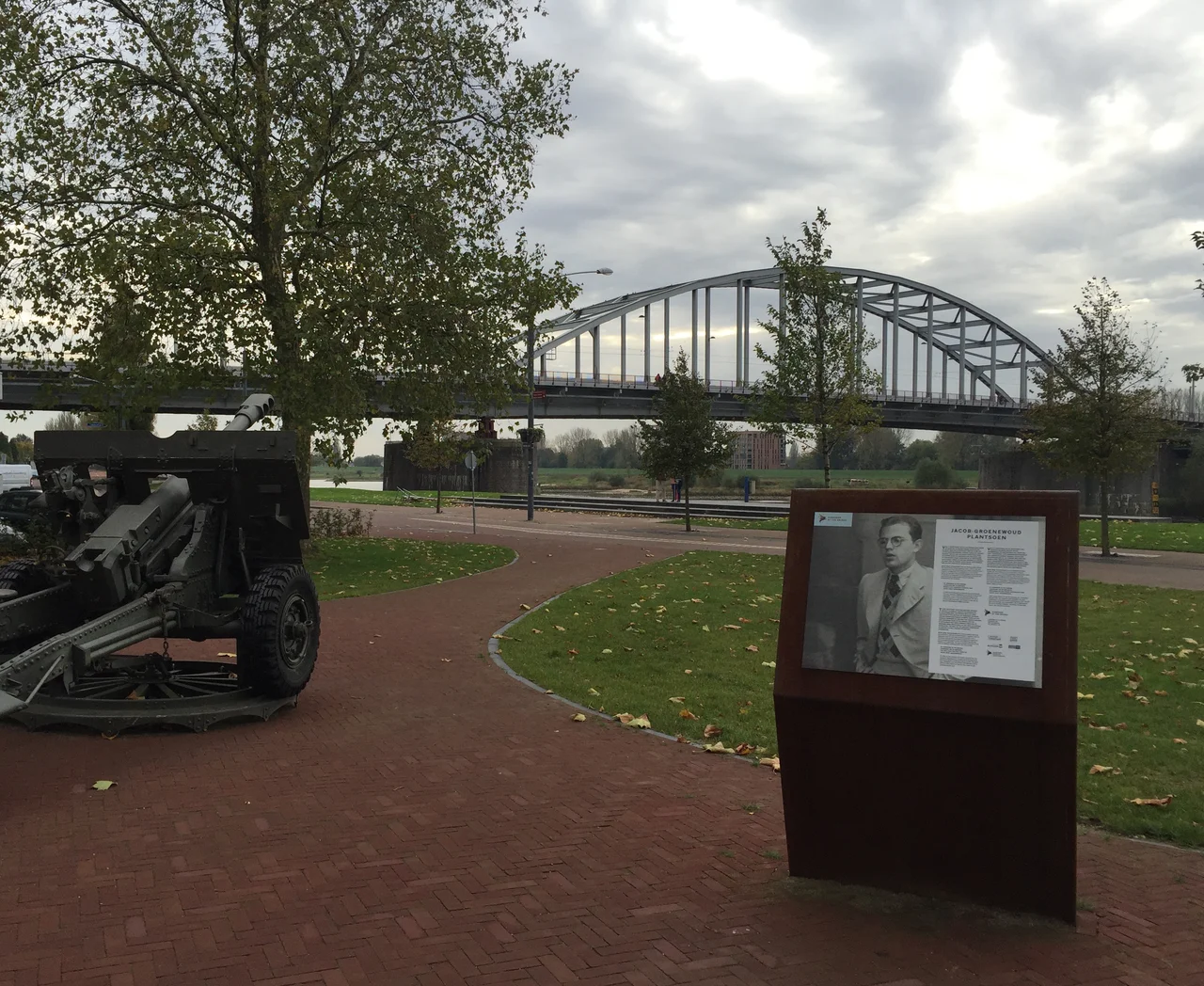
By the time the final radio message came out of the houses around the Arnhem bridge in the dark hours of Thursday 21 September 1944, the men inside had been fighting for four days on what they had been able to carry in on their backs. Walter Harzer, the commander of the 9th SS Panzer Division surrounding them, later said his radio operators caught the last sentence in the dark: Out of ammunition. God Save the King. About 740 lightly armed British paratroopers, dropped 8 miles from the bridge and ordered to hold it for two days, had instead held it for four against German armor. The relief column was still 11 miles to the south.
Montgomery's Single Punch
Field Marshal Bernard Montgomery argued through August 1944 for a concentrated thrust across the Rhine rather than a broad advance on Germany. The plan that emerged, Operation Market Garden, would drop three Allied airborne divisions along a single highway through the Netherlands. The US 101st Airborne would take the bridges around Eindhoven, the US 82nd Airborne the crossings at Nijmegen, and the British 1st Airborne the farthest objective: three bridges over the Nederrijn at Arnhem. The British XXX Corps, racing up the corridor from Belgium, would relieve each in turn and be across the Rhine within two days. If it worked, the war in Europe might be over by Christmas. The 1st Airborne Division was commanded by Major-General Roy Urquhart and reinforced by the Polish 1st Independent Parachute Brigade under Stanislaw Sosabowski. Brian Urquhart, an intelligence officer on Lieutenant-General Frederick Browning's staff, brought aerial reconnaissance photographs showing German armor near Arnhem. Browning had him sent on sick leave.
The Drop That Went Wrong
The first lift came in unopposed at 12:40 on Sunday 17 September. The American IX Troop Carrier Command had refused to attempt a closer drop zone, so the paratroopers landed up to 8 miles from the bridge and had to march in. Two of the three battalions in the lead brigade were stopped almost immediately by a thin blocking screen of SS training battalions under Sepp Krafft. The 9th SS Panzer Division Hohenstaufen, which the Allies had been told was not there, organized a kampfgruppe within hours and pushed a defensive line into Oosterbeek, sealing the western edge of Arnhem. Only the 2nd Parachute Battalion under Lieutenant Colonel John Frost slipped along the river road to the centre of the city. At dusk they reached the northern ramp of the road bridge with about 740 men. They could not take the southern end. A German attempt to rush across at 09:00 the next morning cost the SS Reconnaissance Battalion 12 of 22 armored vehicles and over 70 men killed including the battalion commander Viktor Graebner.
Holding Without a Wire
The British radio sets failed almost immediately, defeated by the wooded terrain north of the river. For nine days, Urquhart's headquarters could not reliably reach his battalions, Browning's headquarters at Nijmegen, XXX Corps, or England. Carrier pigeons were flown back to Britain to report. Urquhart himself, trying to find his subordinates on day one, was cut off in a Dutch family's attic for two days. The 1st and 3rd Parachute Battalions, joined later by the 11th and the 2nd South Staffordshires, tried four times to break through the German blocking line and reach Frost. By midday on Tuesday 19 September the four battalions had disintegrated, leaving about 500 men to retreat west toward what would become the Oosterbeek perimeter. At the bridge, the Germans began systematically destroying the houses Frost's men were holding. He was wounded by a mortar bomb on Wednesday afternoon. A two-hour truce was arranged so the British wounded, Frost among them, could be taken into German captivity. By 05:00 Thursday morning the bridge had fallen.
The Perimeter at Oosterbeek
What remained of the 1st Airborne Division, about 3,600 men, dug into a thumb-shaped perimeter around the Hotel Hartenstein in Oosterbeek with the Rhine as its southern edge. Urquhart's plan was to hold until XXX Corps could break through from Nijmegen, push across the river, and establish a new bridgehead. The Polish parachute brigade, delayed by weather, finally dropped on the south bank near Driel on Thursday afternoon. They found the Heveadorp ferry gone, sunk by the Dutch ferryman to keep it from the Germans. Improvised river crossings on the next two nights got only a few hundred Poles and British infantry into the perimeter under fire. The 64th Medium Regiment of XXX Corps, firing from miles to the south, kept the German tanks off the perimeter for days, and Urquhart later lobbied unsuccessfully for those gunners to be allowed to wear the airborne Pegasus badge. The supply drops by 38 and 46 Group RAF flew through deepening flak. By Wednesday 20 September only 13 percent of the dropped supplies reached British hands; the Germans had captured British marker panels and were attracting the aircraft to their own positions.
Operation Berlin
On the night of 25 September, after a Valburg conference decided the division could not be reinforced, the survivors made their way down to the riverbank in muffled boots, in heavy rain. Sappers from the Canadian 23rd Field Company and the British Royal Engineers ferried them across in storm boats and assault craft under German fire that grew through the night. About 2,400 men got over before dawn. The 1st Airborne Division had landed 10,600 men and Poles in the Arnhem area. Some 1,984 Allied soldiers were killed in the nine days of fighting, including more than 1,174 of the British 1st Airborne, 219 of the Glider Pilot Regiment, 92 of the Polish brigade, 368 RAF aircrew, and dispatchers of the Royal Army Service Corps. About 6,400 were taken prisoner. German losses are estimated at at least 1,300 killed. Some 453 Dutch civilians died in the fighting. The 1st Airborne Division did not see combat again as a formation.
What Stayed in Arnhem
The phrase a bridge too far comes from a comment Browning is said to have made to Montgomery before the operation. It became the title of Cornelius Ryan's 1974 book and Richard Attenborough's 1977 film. The road bridge Frost's battalion held was destroyed by US bombers two weeks after the battle and rebuilt almost identically after the war as the John Frost Bridge. The 17th of September is still the official date of commemoration in Arnhem. Veterans, paratroopers, and a thousand Dutch schoolchildren gather at the Airborne Cemetery in Oosterbeek every first weekend of September to lay flowers at the headstones, a ceremony that has not missed a year since 1945. When the Parachute Regiment suggested in 1969 that perhaps the ceremony had run its course, the Dutch refused. They have been keeping the flowers fresh ever since.
From the Air
Located around the Dutch city of Arnhem, approximately 51.983 degrees north, 5.917 degrees east. The battle area stretches from the original 1944 drop and landing zones in the woods north of Wolfheze and around Heelsum (8 km west of Arnhem) east to the John Frost Bridge over the Nederrijn in central Arnhem, with the Oosterbeek perimeter centered on the Hotel Hartenstein. Nearest airports: Teuge (EHTE) 35 km north, Schiphol (EHAM) 95 km west, Eindhoven (EHEH) 70 km south, Düsseldorf (EDDL) 90 km southeast. Recommended viewing altitude 3,000-5,000 feet AGL to take in the full geography of the operation: Wolfheze, Oosterbeek and the perimeter, the road bridge in central Arnhem, the polder of Driel where the Poles landed, and Nijmegen 18 km south where XXX Corps was held up. Deelen airfield (EHDL), the former German base used to oppose the airdrops, lies 8 km north of Arnhem.
Nearby Stories
- Herzogenbusch Concentration Camp 1.8 km away
- Gooi 4.8 km away
- Volkel Air Base 6.9 km away
- Achterhoek 8.3 km away
- Sportpark Berg & Bos 8.8 km away
- Vetera 9 km away
- Beverweerd Castle 10 km away
- Sallandse Heuvelrug National Park 15 km away