
Battle of Boldon Hill
Both sides claimed victory, which is usually how you know nobody actually won. On Sunday 24 March 1644, Royalist musketeers advanced on Scottish Covenanter positions near Boldon Hill at what one chronicler called 'sermon time' - the hour when most parishes in the country were listening to a preacher. The two armies then spent the rest of the day shooting at each other across ground so cut up with ditches and hedges that nobody could actually cross to make contact. The cannonade went on until midnight. The Royalists admitted losing 240 men. The Scots admitted nothing. By morning, both armies had retreated to where they started.
Why the Scots Came South
The First English Civil War was a year old when, in November 1643, the Parliamentarians signed a military treaty with the Scottish Covenanters. Scotland would invade northern England and attack Royalist positions; in return, Parliament would back the Presbyterian religious settlement the Covenanters had imposed on the Scottish kirk. In January 1644, Alexander Leslie, 1st Earl of Leven, led an army of 18,000 foot and 3,000 horse across the border into Northumberland. The obvious target was Newcastle upon Tyne, a medieval walled fortress with a High Castle and direct access to North Sea trade in guns, ammunition and grain. The town's Royalist garrison numbered just 500 men. The Marquess of Newcastle, commanding the king's forces in the north, took shelter inside and ordered Colonel Sir Thomas Glemham to bring 5,000 reinforcements.
The Siege That Wasn't
The Covenanters arrived outside Newcastle on 2 February. Lord Leven attacked an outlying fort the next day and called for surrender. Glemham requested five days to think it over - a stall both sides understood. Leven used the time to bring up siege guns. When the deadline passed and no attack came, the Royalists grew restless and on 19 February sent thirty-five troops of horse west to Corbridge in a surprise raid that killed or captured over a hundred Scots. That stung. On 22 February, Leven lifted the siege and marched south across the Tyne toward Sunderland, leaving six regiments under Sir James Lumsden to keep Newcastle pinned. Twelve troops of Yorkshire horse under Sir Charles Lucas reinforced the Royalists, bringing their strength to 14,000. The Marquess decided to chase Leven south.
Hedges and Ditches
On 7 March, the two armies drew up in battle order two miles apart near Boldon Hill, in what is now Tyne and Wear. They stood there for several hours staring at each other across fields too laced with drainage ditches and thorn hedges to charge across. At sunset, the Royalists left the field. Skirmishing continued for days, then both armies repositioned. The Royalists fell back to Durham; the Covenanters moved north of the River Wear, took on supplies at Sunderland, and seized the Royalist fort at South Shields near the mouth of the Tyne. On 22 March, both sides realised they were facing each other again. The Royalists climbed back onto Boldon Hill. The Scots took Whitburn Lizard - now known as Cleadon Hills - three miles away.
A Cannonade and a Stalemate
The battle that finally came on Sunday 24 March was strange. Royalist musketeers advanced toward the Scottish lines, took positions in the hedges, and stopped. The Scots did the same on their side. The ground between them was still impassable. Cannon fire from both armies started and didn't stop. Scottish dragoons made one foray in the afternoon, harassing Royalist musketeers in East Boldon, but the artillery duel was the day's main event. Around 300 cannon shots crossed the field. Most fell into ditches, hit nothing, or scattered livestock. By midnight, both sides withdrew. The Royalists admitted to 240 dead. The Scots gave no number. Both claimed victory because both could.
What Came After
The strategic consequences mattered more than the tactical ones. The Royalist army marched south to Durham, then to York. The Covenanters followed five days later. The two forces would meet again at the Siege of York in April, and then catastrophically at Marston Moor on 2 July 1644, when the Parliamentarian-Covenanter alliance shattered the Royalist northern army. After Marston Moor, Leven returned to Newcastle and resumed the siege in earnest. On 27 October 1644, the fortress formally surrendered. The cannonade across the hedges at Boldon had been, in its strange and indecisive way, a prelude.
From the Air
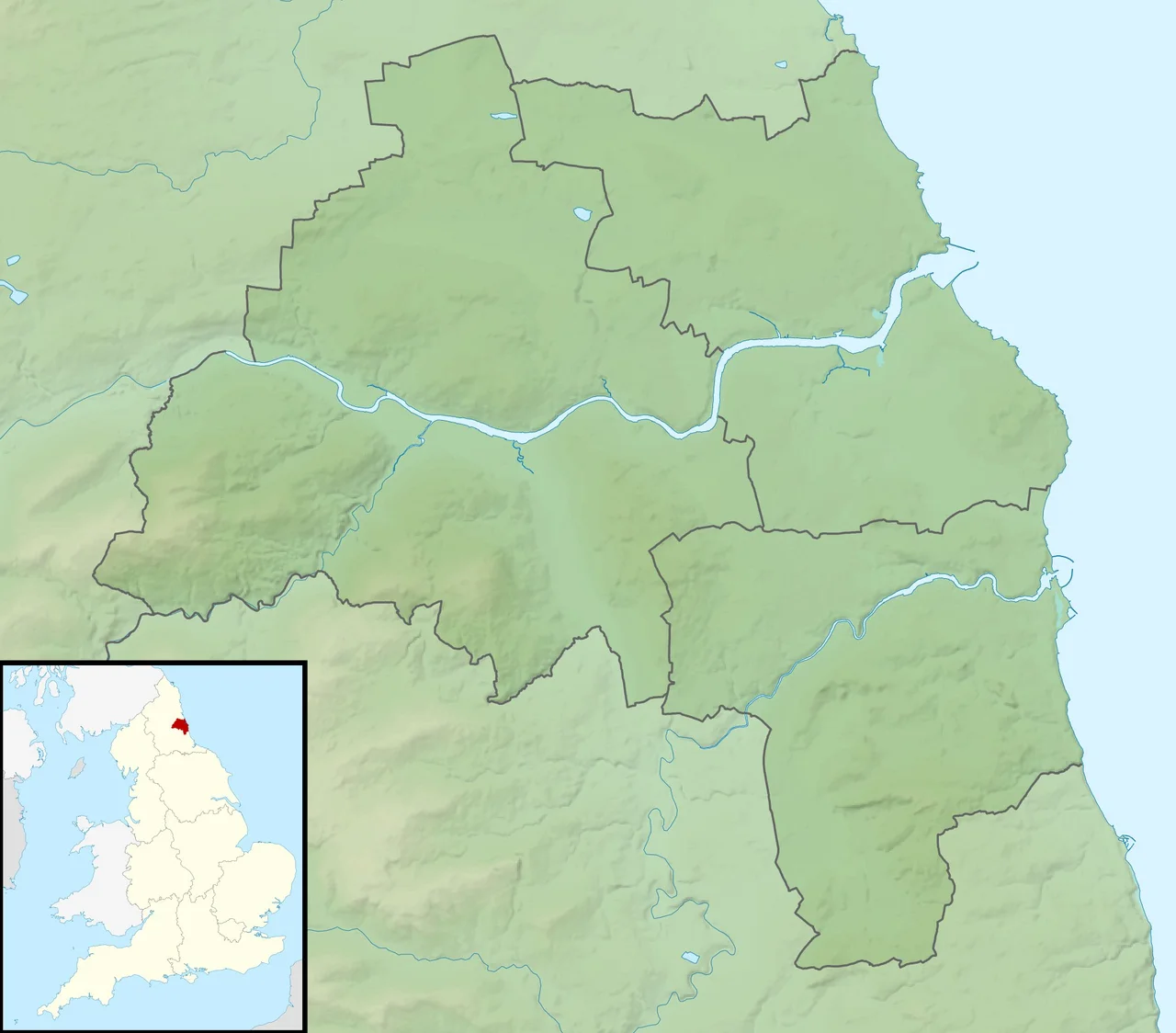
54.946N, 1.436W. The Boldon Hill battlefield lies in modern Tyne and Wear between the villages of East Boldon and Cleadon, roughly halfway between South Shields and Sunderland. Best viewed at 2,000-4,000 ft AGL on clear days; the hedgerow field pattern that frustrated the 1644 cannonade is still legible from the air. Nearest airport: Newcastle International (EGNT), 12 nm to the northwest. The North Sea coast lies 2 nm east.
Nearby Stories
- Cresswell Lifeboat Station 5.2 km away
- Auckland Castle 5.7 km away
- Battle of Otterburn 7.1 km away
- Saltburn Pier 11 km away
- Hadrian's Wall Path 11 km away
- Battle of Stainmore 18 km away
- Saltburn-by-the-Sea 39 km away
- Alexander L. Kielland (Platform) 296 km away