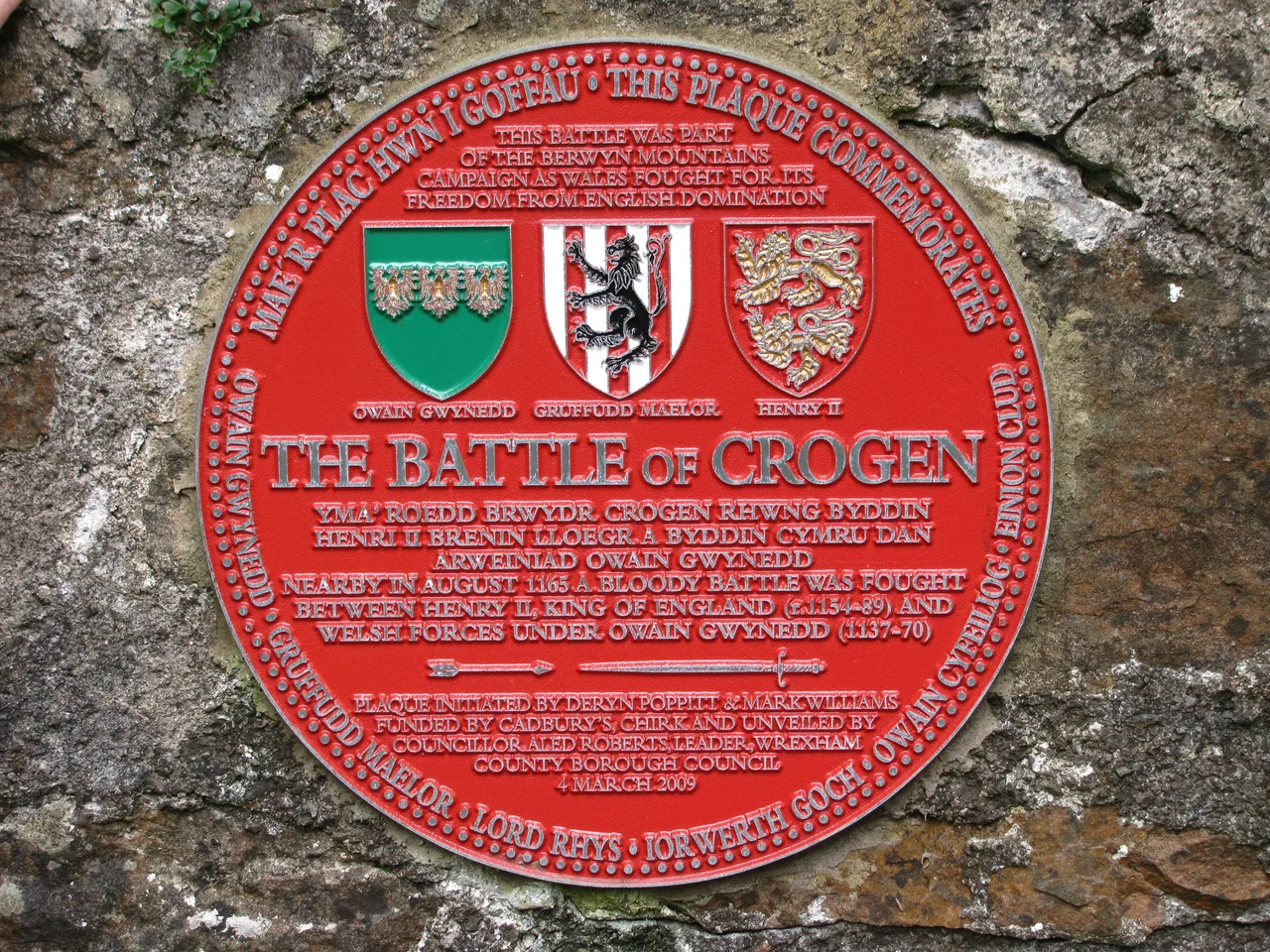

Battle of Crogen
It may not have been a battle. Some historians think nothing happened at all in the Ceiriog Valley in the summer of 1165 - that the whole story is a 16th-century invention, dressed up by Welsh chroniclers and repeated until it sounded like history. Others think it was a series of small skirmishes among the trees, what one modern commentator called 'a series of minor harassments' rather than anything you could call a battle. Either way, what is certain is that Henry II of England had assembled a serious army to crush Owain Gwynedd's alliance of Welsh princes, marched it as far as the Berwyn Mountains, and gave up. He went home in August. He returned to his court at Anjou. And on the way back through Shrewsbury, he ordered the blinding of twenty-two Welsh hostages, two of them Owain's sons.
The March on Wales
Henry II had spent 1164 planning a punitive expedition into Wales. The stated grievance was Rhys ap Gruffudd of Deheubarth, who had been raiding along the border in breach of the homage Welsh princes had given Henry at Woodstock in July 1163. The Welsh saw it differently - their chronicles record that Henry's Marcher Lords, particularly Roger de Clare, 2nd Earl of Hertford, had broken the terms first. What followed was unusual: the Welsh princedoms, which spent most of their time fighting each other, set their feuds aside and formed an alliance. The Welsh annals described it as a collective effort 'to throw off the rule of the French' - meaning Henry's Angevin court. Owain Gwynedd led it; Rhys ap Gruffudd joined from the south; even reluctant Powysian lords were drawn in. Henry's force was large enough to terrify all of them.
Oswestry and Corwen
By July 1165 Henry was at Oswestry, gathering his army. Owain had come south to Corwen, taking up position to block the obvious invasion route up the Ceiriog Valley and over the Berwyns. The Berwyn range - over 800 metres at its highest - separates the headwaters of the Dee from the rest of Wales, and any English army moving westwards from Oswestry would have to cross it. Henry sent woodsmen ahead to fell trees along the pass. The reasons are debated. He may have been trying to widen the route for his cavalry and supply train. He may have been trying to deny cover to Welsh skirmishers. He may have hoped to provoke Owain into a pitched battle in open ground. What he got instead, according to the Welsh chronicle Brut y Tywysogion, was an ambush.
The Gap of the Graves
The woodsmen and their guard were attacked in the valley. The losses, most modern historians agree, were probably light - this was not Bannockburn or Hastings, just a flash of violence among the trees - but the local memory was specific. The place where the skirmish happened became Adwy'r Beddau, 'the Gap of the Graves.' The dead were said to have been buried in the fosse of Offa's Dyke, which runs through the area, and a 1697 account claimed the graves were still visible then. A red plaque commemorating the engagement was unveiled in 2009, with appropriate caveats. The 16th-century historian David Powel's 1584 Historie of Cambria embellished the story considerably - Powel may have had access to oral traditions or lost manuscripts, but his account is the source of most later versions, and he is not a reliable witness. Henry's own contemporary, Gerald of Wales, in the Itinerarium Cambriae, agreed the campaign collapsed but added that Henry had failed to listen to his local advisors.
Rain on the Berwyns
What really stopped Henry II was the weather. After the harassment in the Ceiriog Valley, the army tried to cross the Berwyn Mountains and ran into severe storms. The mountains in north Wales catch every front coming off the Irish Sea, and an August storm in the high country could leave even a 12th-century army immobilised: tents flooded, baggage carts mired, horses lamed, soldiers cold and miserable. Henry pulled back. He returned to Shrewsbury and, in a fury that would not have surprised anyone who knew him, ordered the blinding of twenty-two hostages he had been holding since the 1163 settlement. Two of them were Owain Gwynedd's sons. The blinding was deliberate, cruel, and politically futile. It did not bring Owain to terms. It did not punish Rhys. It did not reopen the Berwyn passes. Henry abandoned the campaign altogether and crossed the Channel to Anjou.
The Long Consequences
Crogen, real or imagined, mattered out of proportion to its size. Henry II never tried to conquer Wales again. The Marcher Lords - who had expected royal support and got none after 1165 - drew their own conclusions. Many of them looked elsewhere for opportunity, and within a few years the most ambitious were crossing the Irish Sea: the Norman invasion of Ireland in 1169-71, which led to over seven centuries of English involvement there, was partly driven by Marcher families who had given up on royal backing in Wales. Owain Gwynedd kept his throne until his death in 1170. Rhys ap Gruffudd kept his. The independent Welsh principalities lasted another 117 years, until Edward I finally completed the conquest in 1283. Whether anyone really died in the Ceiriog Valley in August 1165 may always remain uncertain. What changed because of it is clear enough.
From the Air
The traditional site of the engagement is in the Ceiriog Valley at roughly 52.94 degrees north, 3.10 degrees west, in the hills west of Chirk. From the air the valley is a narrow, twisting cut climbing west from the Dee plain towards the Berwyn Mountains. Offa's Dyke runs through the area. The Berwyns themselves dominate the landscape to the south-west, rising sharply over 800 metres. Cruise at least 5,000 feet for safe terrain clearance over the Berwyn ridges. Mountain wave is possible in westerly winds. Hawarden (EGNR) lies about 22 nautical miles north; Shawbury (EGOS) about 25 nautical miles south-east.
Nearby Stories
- Lilleshall Abbey 5 km away
- RAF Hooton Park 5.5 km away
- Gwrych Castle 6.7 km away
- Knutsford 7.5 km away
- Battle of Blore Heath 9.7 km away
- Ysbyty Ifan 14 km away
- Powis Castle 15 km away
- Machynlleth 28 km away