
Battle of Driniumor River
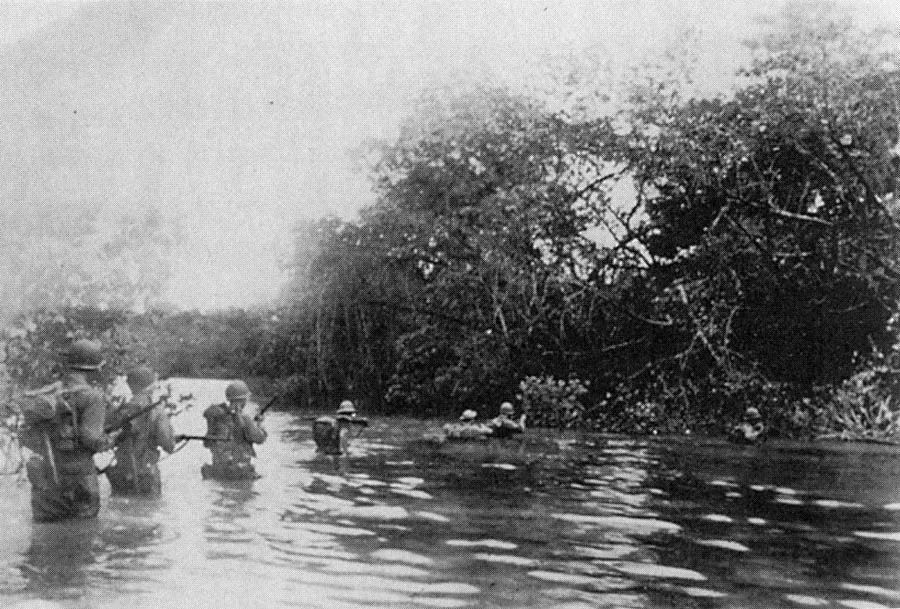
At 22:55 on the night of 10 July 1944, after a five-minute artillery bombardment, roughly ten thousand Japanese soldiers waded across the Driniumor River and threw themselves at the American line. They had been starving for weeks. Their commander, Lieutenant-General Hatazo Adachi, knew his 18th Army had only half the ammunition Japanese logistics manuals considered adequate for a major battle, and his troops were receiving half the usual rations. He attacked anyway. The breach his men tore through the center of the American line was real - but so was what came next, and for six more weeks of jungle combat, the fate of Aitape would be decided a mile of riverbank at a time.
An Army Left Behind
When Allied forces seized Hollandia and Aitape on 22 April 1944 as part of Operations Reckless and Persecution, they cut off the Japanese 18th Army entirely. Roughly 20,000 men, already bled white in the Lae, Huon Peninsula, and Finisterre Range campaigns, were now stranded on the wrong side of a rapidly advancing American front. They could not be reinforced. General Douglas MacArthur's campaign was now hopping west toward the Philippines, and the 18th Army had become a problem to be contained rather than destroyed. Adachi, however, did not see containment as his orders. Intelligence - from codebreaking, from captured documents, from Allied Intelligence Bureau patrols - indicated he was moving his army west through the jungle toward the Driniumor, intent on breaking back through and retaking Aitape.
The Surprise That Should Not Have Been
The Americans had plenty of warning. General Walter Krueger ordered reinforcements in as early as late May. The 43rd Infantry Division was moved from New Zealand. The 112th Cavalry and the 124th Infantry arrived from eastern New Guinea. Yet the intelligence picture was contradictory. Decoded Japanese radio traffic suggested attack was imminent, but the same traffic also laid bare the 18th Army's desperate logistics. MacArthur's chief of intelligence, Brigadier General Charles Willoughby, and Lieutenant General Robert Eichelberger's staff concluded that an army so short of food and ammunition simply could not attack. American troops had been placed on alert several times in late June and early July - and stood down each time when no attack came. The Japanese were merely delayed. When the assault finally struck, the Americans were taken by surprise.
The Night the Line Broke
Companies E and G of the U.S. 128th Infantry Regiment bore the first rush. Company G, supported from the right by a battalion of the 127th, held its ground. Company E, in the center, did not. At least thirty of its men were killed or wounded in minutes; the line collapsed under the weight of three Japanese regiments attacking at once. Some survivors fought back toward Company F's lines near the coast. Others were cut off behind Japanese lines for at least three days. The 120th, 129th, and 149th Field Artillery Battalions hammered the river crossings with 105mm howitzers; a battalion of 155mm guns (the 181st) added its weight to the defense. The Japanese suffered catastrophic casualties but kept coming, pushing the Americans about three miles west to Koronal Creek and the X-ray River before supply and communications problems halted the advance.
Hand-to-Hand at Afua
Around 15-16 July, elements of the Japanese 20th Division renewed the attack northwest of the village of Afua, on the southern flank of the Allied line. The U.S. 112th Cavalry and 127th Infantry fought them across broken ground, and Afua changed hands repeatedly before the Japanese captured it outright on 22 July. By then the fighting had devolved into hand-to-hand combat - small groups of Americans clinging to positions at the river, encircled, while Japanese troops worked to eliminate them. The next day, reinforcements from the 127th began relieving isolated cavalrymen. Adachi, undeterred, committed his reserve regiment, the 66th, and the bulk of the 41st Division to one more all-out assault starting 29 July. It captured ground. It did not keep it. Japanese casualties mounted into the thousands.
The Long Walk Back
Meanwhile the Americans had quietly prepared a counteroffensive. Between 29 and 31 July, elements of the 124th and 169th Infantry Regiments swung east of the Driniumor from near the coast, pushed south to Niumen Creek, and then turned west to envelop the Japanese forces still attacking Afua. By early August, the Japanese advance against Afua had petered out and their troops were retreating eastward back across the Driniumor. Australian Beaufighters and Beauforts from No. 71 Wing RAAF, U.S. reconnaissance aircraft from Tadji and Saidor, and Task Force 74 - two Australian cruisers, two Australian destroyers, and two U.S. destroyers - supplied air cover and naval gunfire. PT boats intercepted Japanese barges running between Aitape and Wewak. Four U.S. soldiers received the Medal of Honor for the battle, all posthumously: Private Donald R. Lobaugh, Staff Sergeant Gerald L. Endl, and Second Lieutenants George W. G. Boyce Jr. and Dale Eldon Christensen. The 112th Cavalry, 124th Infantry, and 169th Infantry suffered the heaviest American losses. The starved Japanese 18th Army withdrew back into the jungle it had come from, and the Aitape-Wewak campaign would chase its survivors for the rest of the war.
From the Air
The Driniumor River flows into the Bismarck Sea about 20 miles east of Aitape, at roughly 3.13 degrees south, 142.35 degrees east. From altitude the battlefield is a stretch of dense coastal jungle running inland from a narrow beach - now almost entirely reclaimed by forest, with the Driniumor and X-ray (Tiver) rivers visible as dark lines snaking through the canopy. Tadji airstrip (AYTA / TAJ), from which Allied aircraft flew in support of the battle, remains the regional air gateway. Wewak (AYWK / WWK) lies roughly 90 miles to the southeast. Expect year-round tropical humidity and heavy afternoon cloud buildups over the coastal ranges. The terrain that tormented both armies - triple-canopy jungle broken by muddy river valleys - is visible in every direction from the coast inland.
Nearby Stories
- 2002 Sandaun Earthquake 34 km away
- Operation Copper 95 km away
- Trikora 109 km away
- Battle of Hollandia 123 km away
- 2024 East Sepik Earthquake 138 km away
- Dutch New Guinea 168 km away
- Merpati Nusantara Airlines Flight 9760D 192 km away
- Manus Island 470 km away