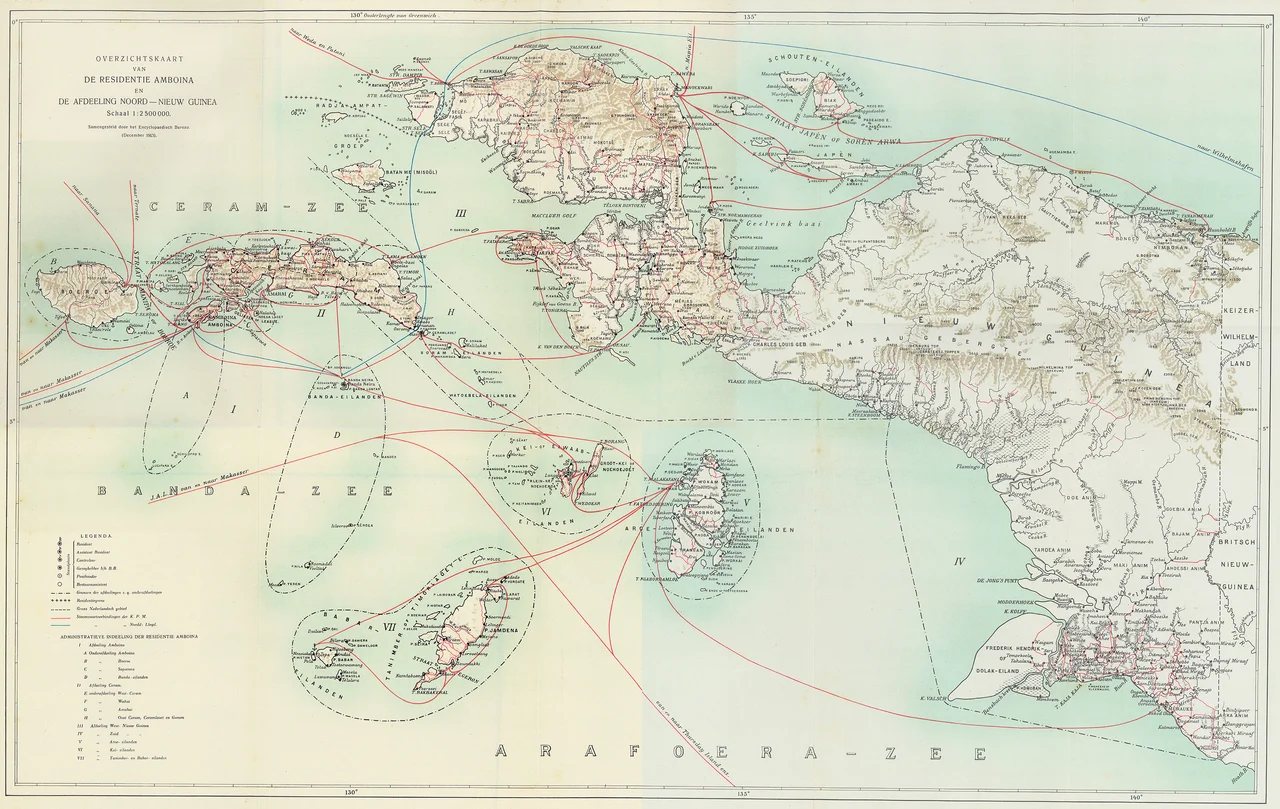

Dutch New Guinea
On 1 December 1961, at a ceremony in Hollandia, Dutch officials raised a new flag beside the Dutch tricolor. It showed a white Morning Star on a red vertical band, with horizontal blue and white stripes beside it. A new anthem was sung. A New Guinea Council, elected earlier that year, prepared to lead a territory toward independence. Eighteen days later, in Jakarta, President Sukarno issued the Tri Komando Rakjat, the People's Triple Command: defeat the formation of an independent West Papua, raise the Indonesian flag there, be ready to mobilize. Within eighteen months the Morning Star was down and Dutch New Guinea was gone, transferred first to the UN and then to Indonesia.
A Colony Nobody Wanted
The Dutch claim to western New Guinea rested on a centuries-long chain of indirect rule. In a 1660 treaty, the Dutch East India Company recognized the Sultanate of Tidore's supremacy over "the Papuan people," even though Tidore never actually controlled the interior. In 1872, Tidore formally recognized Dutch sovereignty, which gave the Netherlands legal cover to draw the 141st meridian as the eastern boundary of their East Indies possessions. Colonial posts opened at Fakfak and Manokwari in 1898, and at Merauke in 1902, largely to keep the British and Germans from pushing the border west. Most of the island remained outside any colonial influence whatsoever. Large areas on the map were simply blank. Economic activity was negligible. Until the Second World War, Dutch New Guinea was a disregarded corner of an otherwise profitable empire.
A Homeland That Did Not Work
In the 1920s and 30s, a strange idea took hold among Dutch colonial planners: New Guinea could become a tropical homeland for the Indo-European population of the Dutch East Indies. Between 150,000 and 200,000 Eurasians, of mixed Dutch and Indonesian ancestry, held an uncomfortable middle position in colonial society. As educated indigenous Indonesians began taking jobs Eurasians had traditionally held, the economic squeeze intensified. Forbidden by colonial law from buying land on Java, some Eurasian associations lobbied to settle New Guinea as a kind of Protestant-Catholic frontier. Small groups of settlers arrived. Most efforts failed. The climate was brutal, the settlers were office workers with no farming experience, and the numbers stayed small. The scheme's supporters in the Netherlands itself were mostly fringe figures linked to the NSB fascist party.
The Linggadjati Amendment
When the rest of the Dutch East Indies became the independent Republic of Indonesia in 1949, Dutch New Guinea was peeled off at the last minute. The Dutch government argued at the United Nations that Papuans were ethnically distinct from Indonesians, and it began, quite seriously, to prepare the territory for separate independence. Five thousand teachers were flown in. Schools expanded. On 8 February 1950, Stephan Lucien Joseph van Waardenburg became the first Governor of Dutch New Guinea. The first local naval cadets graduated in 1955. The first Papuan army brigade stood up in 1956. Meanwhile, from Jakarta, the Republic of Indonesia insisted that the territory belonged within its natural borders. Bilateral relations with the Netherlands decayed. In 1957, after losing a UN General Assembly vote, Sukarno authorized the seizure of Dutch enterprises operating in Indonesia and began expelling Dutch residents.
The Vlakke Hoek Incident
The crisis became military in January 1962. Indonesia launched a seaborne infiltration against the disputed territory, and on 15 January Dutch destroyers Evertsen and Kortenaer intercepted the force off Vlakke Hoek. Among the Indonesian casualties was Commodore Yos Sudarso, Deputy Chief of the Naval Staff. What the Indonesians did not know was that Dutch signals intelligence was reading their coded traffic, enabling the Dutch to anticipate subsequent infiltration attempts through 1962 and, with the assistance of the indigenous population, to defeat the more than 500 Indonesian paratroops and special forces infiltrated during the coming months. But the diplomatic ground was shifting under the Dutch. The United States pressed for a settlement. Domestic support for holding the territory was fading. On 15 August 1962, the Netherlands signed the Bunker Proposal at the United Nations.
The Act of Free Choice
UN administration began in October 1962. On 1 May 1963, the territory was transferred to Indonesia. The agreement stipulated that a plebiscite would be held to determine the final status of the population. In 1969, after Sukarno had fallen and Suharto's New Order government had consolidated power in Jakarta, the Act of Free Choice was conducted. Rather than a one-person-one-vote referendum, the procedure consisted of 1,025 selected elders voting under the watch of the Indonesian military, who reportedly warned of consequences for dissent. The vote was unanimous for integration with Indonesia. The UN General Assembly noted the result through Resolution 2504. The territory became the Indonesian province of Irian Jaya, later reorganized into what are now six provinces, today called the Papua region. The Morning Star flag still surfaces, quietly, at funerals and protests. Raising it remains a criminal offense.
From the Air
Dutch New Guinea covered the western half of the island of New Guinea, bounded on the east by the 141st meridian, which remains the international border between Indonesia and Papua New Guinea. The former capital Hollandia, now Jayapura, sits at approximately 2.53°S, 140.72°E, just west of the border. Sentani International Airport (WAJJ) serves Jayapura. Other significant locations from the colonial period include Manokwari (WASR) on the Bird's Head Peninsula in the northwest, Merauke (WAKK) in the far southeast, and Sorong (WASS). Overflying the 141st meridian takes you from the modern Indonesian Papua region into Papua New Guinea; the border follows a straight line visible mostly through sparse road networks and occasional clear-cuts.
Nearby Stories
- Battle of Driniumor River 119 km away
- Aitape 131 km away
- Foja Mountains 132 km away
- Battle of Wakde 145 km away
- Baliem Valley Campaign 193 km away
- Merpati Nusantara Airlines Flight 9760D 212 km away
- Battle of Lone Tree Hill 250 km away
- HMS Nabaron 619 km away