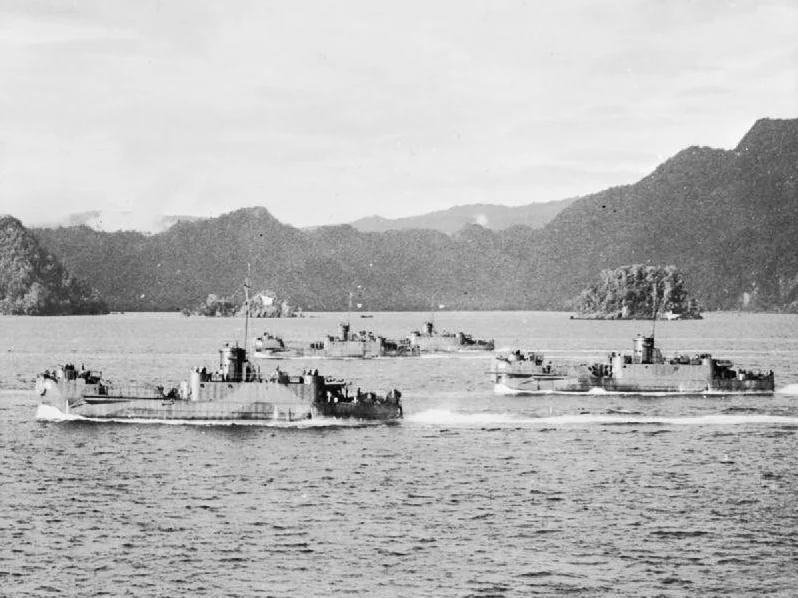

Battle of Hollandia
General Hatazo Adachi was ordered to move west. He chose not to. In March 1944, Japan's Second Area Army instructed Adachi, commander of the 18th Army, to shift his forces from Madang and Hansa Bay to Hollandia, sending one division immediately. He ignored the order. He believed the next Allied landing would fall at Hansa Bay, and he was massing his troops there. When two American divisions landed at Hollandia on the morning of 22 April 1944, five hundred miles behind him, Adachi's entire army was trapped in the wrong place. Operation Reckless had earned its name.
A Port Between Nothing and Nothing
Hollandia, now called Jayapura, was the only good anchorage on a vast stretch of New Guinea's north coast, the one sheltered port between Wewak far to the east and Geelvink Bay to the west. The Japanese had taken it in 1942 as part of their general push into the Dutch East Indies. Behind the town rose the Cyclops Mountains, a ridge climbing steeply to 7,000 feet, backing Lake Sentani. On the narrow plain between the mountains and the lake, the Japanese built airfields. By April 1944, three were complete and a fourth was under construction, though only one was judged fully operational. Humboldt Bay to the east and Tanahmerah Bay to the west framed the headland. Both were usable for amphibious landings.
Ultra, and Adachi's Mistake
Allied code-breakers had been reading Imperial Japanese Army radio traffic. The decrypts revealed that Hollandia was lightly held while Adachi's divisions were concentrated hundreds of miles east in the Madang-Wewak region. MacArthur saw an opportunity to leapfrog. On 8 March he asked the Joint Chiefs to bring forward the landings at Hollandia from some vague later date to 15 April. Approval came four days later. He met Admiral Nimitz at Brisbane in late March to negotiate fleet carrier support. Nimitz would commit Task Force 58's big carriers for only two days after the landings, which forced a second simultaneous landing at Aitape to seize an airfield that could quickly cover Hollandia once the carriers departed. The timing slipped to 22 April for logistical reasons. Meanwhile the Allies ran a deception campaign against Wewak and Hansa Bay, with feigned reconnaissance and real naval bombardment, to keep Adachi looking the wrong way.
The Airfields Burn
The air campaign preceding the landings was devastating. Between 30 March and 3 April 1944, the U.S. Fifth Air Force and Royal Australian Air Force struck Hollandia and the Sentani airfields with complete surprise. They destroyed 340 Japanese aircraft on the ground and another 60 in the air. The 6th Air Division, charged with defending Hollandia, effectively ceased to exist. It was the last moment of the New Guinea campaign when Japanese air power had any chance of threatening the Allies. American air and naval forces, guided by code-breaking intelligence, sank many of the Japanese ships trying to reinforce Hollandia and Wewak. On 19 April, the British Eastern Fleet struck Sabang in the Indian Ocean as Operation Cockpit to pin Japanese air units near Singapore. Four days later the main assault force turned toward the New Guinea coast.
Reckless Becomes Routine
At dawn on 22 April, after preparatory naval bombardment, the U.S. 24th Infantry Division came ashore at Tanahmerah Bay while the 41st Infantry Division landed at Humboldt Bay near Hollandia itself. Simultaneously, Operation Persecution put 22,500 troops ashore at Aitape, 125 miles east, to seize the airfield needed to cover Hollandia after the fleet carriers departed. Total Allied strength committed to the combined operations was 84,000 personnel and 200 ships. The Japanese defenders numbered around 11,000 on paper, but only about 500 were actual ground combat troops, drawn from antiaircraft batteries. Resistance collapsed almost immediately. The base complex designated Base G became a major staging area for subsequent operations in New Guinea and the Philippines, hosting the headquarters of the Sixth Army, the Eighth Army, the Fifth Air Force, and the Seventh Fleet. Adachi's 18th Army, stranded hundreds of miles east with no functional air cover and its sea lanes severed, would spend the rest of the war cut off.
From the Air
The Hollandia battle area is centered on present-day Jayapura at approximately 2.53°S, 140.72°E on the north coast of Indonesian Papua (formerly Dutch New Guinea). The Cyclops Mountains rise sharply just inland, peaking above 2,100 meters (7,000+ ft). Lake Sentani sits in the plain behind the ridge and is now the site of Sentani International Airport (WAJJ), the main field for Jayapura. Humboldt Bay (now Yos Sudarso Bay) and Tanahmerah Bay flank the headland. Flying east from Biak (WABB) toward Jayapura traces the axis of the Allied advance in reverse. Afternoon convection over the Cyclops range is intense; morning departures are preferred.
Nearby Stories
- Battle of Driniumor River 119 km away
- Aitape 131 km away
- Foja Mountains 132 km away
- Battle of Wakde 145 km away
- Baliem Valley Campaign 193 km away
- Merpati Nusantara Airlines Flight 9760D 212 km away
- Battle of Lone Tree Hill 250 km away
- HMS Nabaron 619 km away