
Battle of Fishguard
On the cliffs above Goodwick Sands on the morning of 24 February 1797, hundreds of Welsh women in red flannel shawls and tall black hats gathered to watch the French surrender. From the beach below, the invading column saw scarlet on the heights and assumed the worst: British redcoats, ranks of them, in numbers they could not match. The French had only been on British soil for two days. Already most of their convict recruits were drunk, deserting, or dead. Their officers told Colonel Tate to take the deal. He did. And that was the end of the last invasion of mainland Britain.
The Plan and the Ships
It was supposed to be three landings. The French general Lazare Hoche dreamed up a synchronized assault in support of the Society of United Irishmen: fifteen thousand troops to Bantry Bay in Ireland, with two smaller diversionary forces hitting Britain itself, one near Newcastle and one in Wales. Atrocious weather wrecked the Irish expedition before a single soldier could disembark. Mutiny and the North Sea killed the Newcastle force. Only the Welsh prong went ahead. On 16 February four French warships left Brest under Commodore Castagnier, flying false Russian colours, carrying 1,400 men of the Seconde Legion des Francs, a partly penal battalion better known as the Legion Noire after the captured British uniforms they had dyed black. Their commander was William Tate, an Irish American who had fought the British in the American Revolution and was forty-four years old, not the seventy he was later painted as.
Landing at Carreg Gwastad
On 22 February the four ships nosed up to a rocky shelf at Carreg Gwastad Point, three miles west of Fishguard. Six hundred French regulars came ashore disciplined and intact. The other eight hundred, scraped from prisons and royalist holding cells, came ashore and immediately disintegrated. They were under orders to live off the land, and the Welsh land happened to contain a Portuguese wine wreck recently washed up on the coast. Within hours the irregulars were looting farmhouses and getting magnificently drunk. One group broke into Llanwnda Church to escape the cold and tore out the pews for firewood, lighting the kindling with pages of a Bible. Colonel Tate set up his headquarters at Trehowel farm and waited for things to improve. They did not.
The Welsh Response
Fishguard's defenders were sparse: a few cannon in the old fort and Lieutenant-Colonel Knox's Volunteer Infantry, undermanned and outnumbered ten to one. Knox decided to retreat south and meet reinforcements coming up from Haverfordwest under Lord Cawdor. But the locals had not been told to wait. People streamed into Fishguard from the surrounding farms armed with whatever they could carry, ready to fight for their homes. By the time Cawdor took command of the combined force, six hundred British troops with three cannon were marching back toward the French. A grenadier ambush prepared in Trefwrgi Lane never sprang; Cawdor called off the dusk attack because the light was failing. Somewhere in the dark, six Welsh and French had already been killed in scattered clashes.
Jemima Nicholas
And somewhere, depending on which version you believe, a Fishguard cobbler named Jemima Nicholas was making history with a pitchfork. The folk tradition says she rounded up twelve French stragglers single-handed and locked them inside St Mary's Church. Other versions credit her with marshalling the women of the town in their red whittle shawls and tall hats, marching them along the clifftops to make the French believe British regulars were everywhere. No contemporary written source mentions her by name. But a genealogical search in 2006 found that a Jemima Nicholas was baptised at nearby Mathry on 2 March 1755, which would have made her forty-two at the time of the invasion. She lived to ninety-two and is buried in St Mary's churchyard, the same church where her twelve prisoners supposedly spent their night. Whether or not she captured anyone, the story belongs to her now.
Surrender on the Sands
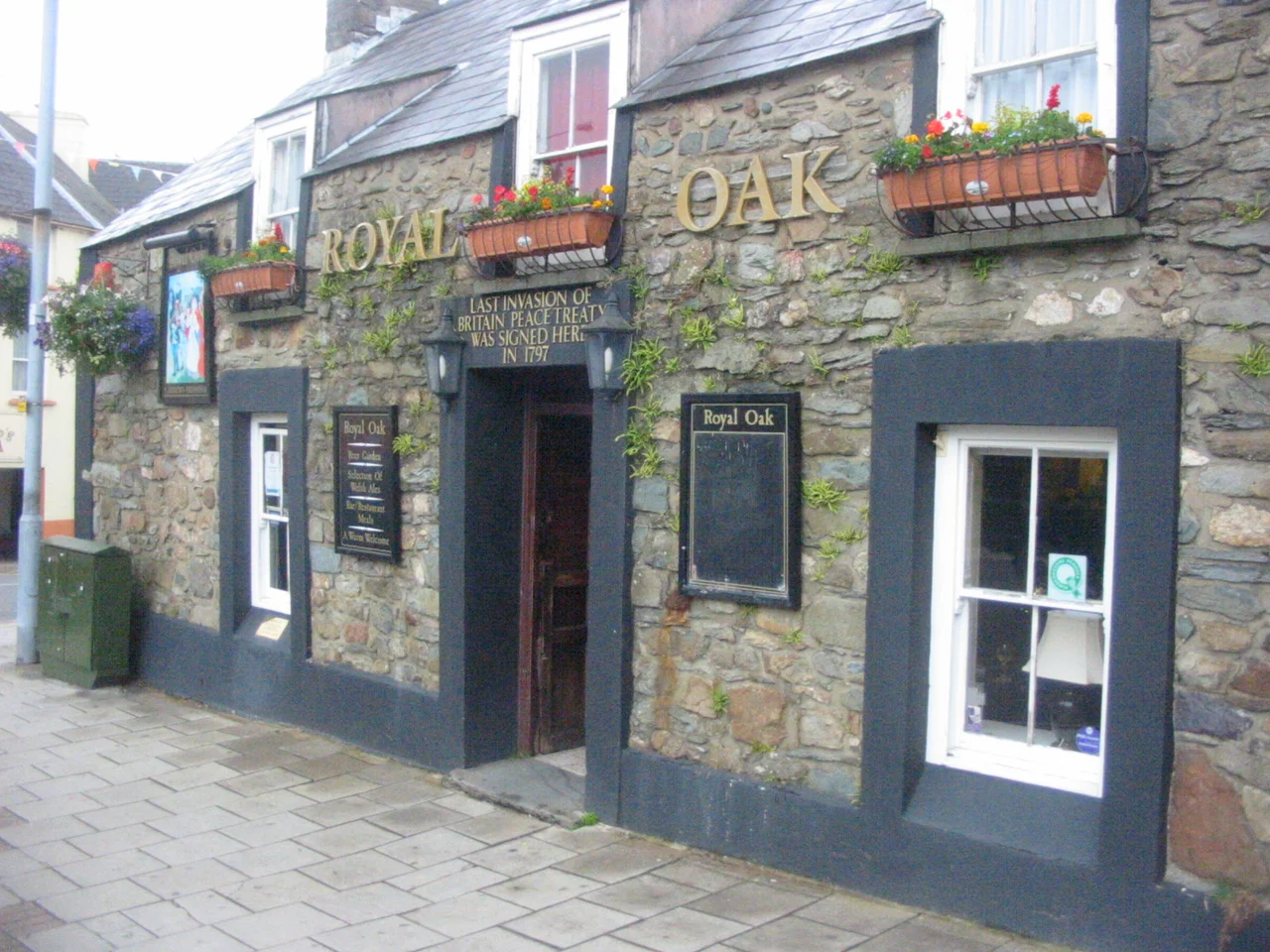
By the evening of 23 February, Tate's situation was hopeless. The drunks were useless. The ships had sailed. Two French officers crossed the lines to the Royal Oak inn on Fishguard Square, where Cawdor had set up headquarters, and asked for terms. Cawdor bluffed magnificently: unconditional surrender by ten the next morning, or attack. The following afternoon, French drums beat the column down to Goodwick Sands, where the prisoners stacked their weapons in the surf and were marched off to temporary imprisonment at Haverfordwest. Tate was returned to France in a prisoner exchange in 1798. The Pembroke Yeomanry got the battle honour Fishguard from Queen Victoria in 1853, the only unit in the British Army ever to bear a battle honour for an action on mainland soil.
The Tapestry
Two hundred years later, in 1997, seventy-eight local people began stitching the story back into history. Designed by Elizabeth Cramp and inspired by the Bayeux Tapestry, the Last Invasion Tapestry runs to 100 feet and was sewn in 178 shades of crewel wool: the ships at Carreg Gwastad, the looted farmhouses, the drunk grenadiers, the cliff-top women in their red shawls, and the surrender on the sands. It hangs in Fishguard's Town Hall today. The work took four years. Most of the embroiderers are gone now, and as of late 2024 only one remained to tell the story of how it was made. The tapestry is still there, the stitches still tight, the colours barely faded. Above it, somewhere in the rafters, you can almost hear the Welsh women laughing.
From the Air
The invasion site sits at 52.00 degrees north, 4.98 degrees west, on the north coast of Pembrokeshire. Carreg Gwastad Point juts out at the northwest end of Fishguard Bay; Goodwick Sands, where the surrender took place, lies just east of the modern ferry terminal. From cruising altitude the bay is a clear scoop in the cliff line, with the breakwaters of Fishguard Harbour visible inside it. Nearest airfield is Haverfordwest (EGFE) eight miles south; Swansea (EGFH) fifty miles east. Atlantic weather; the cliffs above Carreg Gwastad are 80 to 100 feet high and notoriously gusty.
Nearby Stories
- RAF Angle 0.9 km away
- Cardigan Bay Special Area of Conservation 5.4 km away
- Abercych 11 km away
- Cantre'r Gwaelod 12 km away
- Burry Port Lifeboat Station 22 km away
- Johnstown Castle 61 km away
- Hook Lighthouse 92 km away
- 1979 Fastnet Race 157 km away