
Battle of Hieton
They thought they could negotiate with Oliver Cromwell. The Remonstrants - the most zealous wing of a Scottish army already shattered three months earlier at Dunbar - believed they could persuade the Lord General to take his New Model Army home and leave Scotland to those godly enough to govern it. Cromwell's reply, on 1 December 1650, was a thousand cavalry under Major-General John Lambert. They met the Scots at Hieton - Scots for 'high town,' the rise above the Cadzow Burn that is now central Hamilton.
A Kingdom Divided Against Itself
The execution of Charles I in January 1649 had pulled Scotland in two directions at once. The Scottish Parliament, never consulted about the killing of its king, had promptly declared his son Charles II to be King of Britain and set about raising an army to put him on the throne. Cromwell's response, in July 1650, was invasion. By September the Scottish army under David Leslie lay broken at Dunbar - 6,000 prisoners, 1,500 dead or wounded, Leslie's reputation in tatters. In the aftermath, the more dogmatic Covenanters drew an unforgiving lesson. God had abandoned the army, they argued, because the army had not been sufficiently purged of impure men. The remedy was more purging. They issued the Western Remonstrance, took control of the Western Association army, and prepared to fight both the English and their own government.
The High Town Above the Burn
Colonel Gilbert Ker led the Remonstrants south through a country wet with early winter. At Hieton, on rising ground above the Cadzow Burn where it joins the Clyde, he caught Lambert's English troopers off-guard and attacked at dawn. The surprise worked - briefly. The Scots broke into the English position before Lambert's veterans steadied, regrouped, and counter-charged. Cavalry against half-formed cavalry, on ground neither side had chosen, in the cold light of a December morning. The Remonstrant army did not so much retreat as dissolve. Ker himself went down wounded and was taken prisoner. The Western Association ceased to exist as a fighting force before the sun was high. There would be no godly remnant to wrest Scotland back.
What Came After
Hieton was a small fight in a much larger war, but its consequences were immediate. With the Western Remonstrants destroyed, the Scottish government's hand was forced. The radicals were finished, and the army would be rebuilt by whoever was willing. The following summer Cromwell forced his way across the Firth of Forth, won at Inverkeithing, took Perth, and cut the Scottish army off from supply. In desperation, Charles II and Leslie marched south into England, hoping for an English rising that never came. At Worcester on 3 September 1651, exactly a year after Dunbar, Cromwell crushed them. Charles escaped, famously hiding in an oak tree, and fled abroad. He would not see Britain again until the Restoration of 1660.
A Plaque on a Bridge
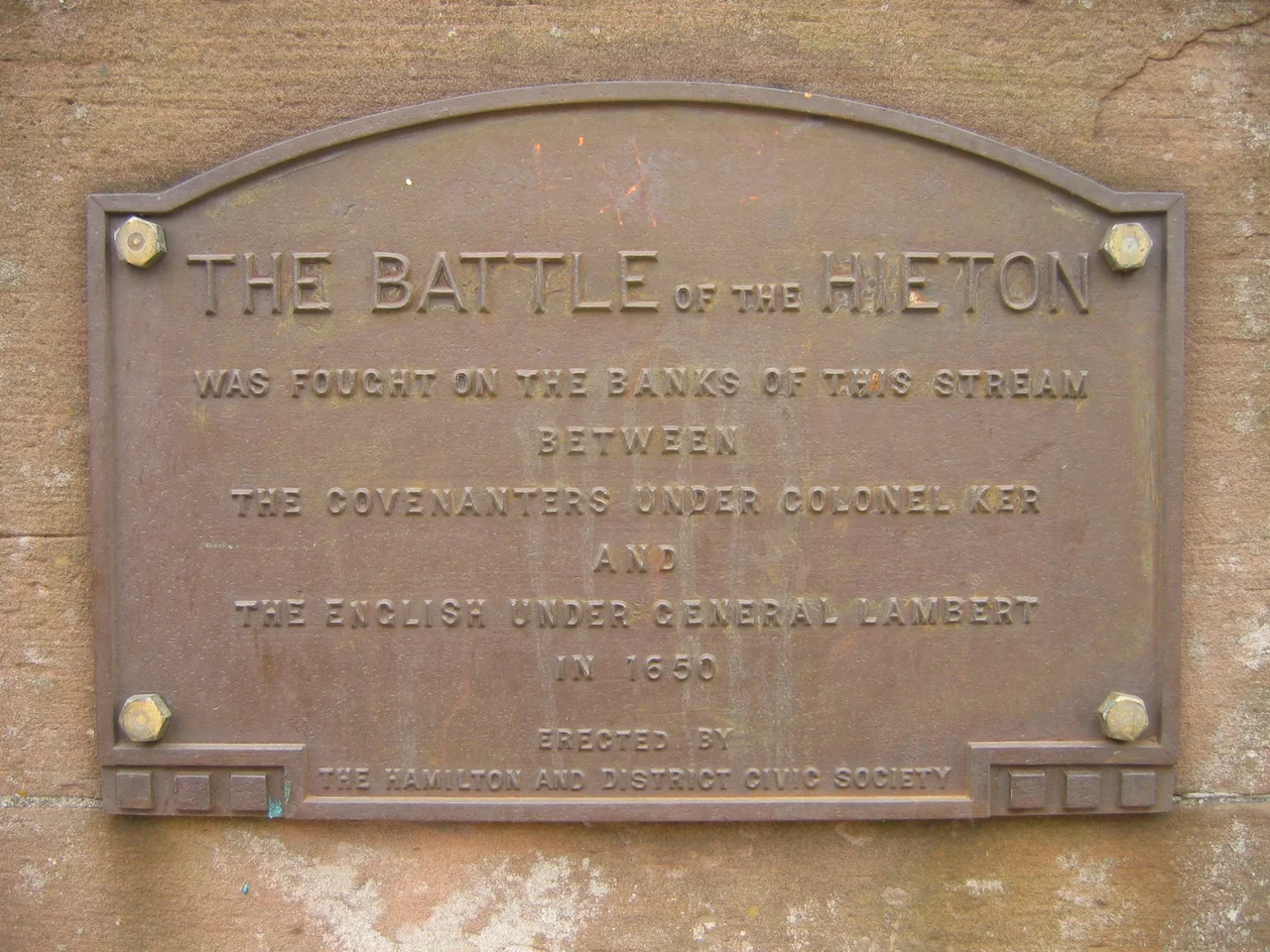
Today the field of the Battle of Hieton lies under Hamilton's Common Green, a sliver of public grass tucked beside the town centre. The 19th-century Cadzow Bridge crosses overhead, and a modest plaque mounted on the bridge by Hamilton Civic Society tells passers-by that men once died here for a quarrel about how purely a king's army ought to be raised. Most people walking past do not stop. The burn still runs the same line it did in 1650, and the rise above it still earns its old Scots name of Hieton - the high town - even if no one calls it that anymore.
From the Air
Hamilton lies at 55.78N, 4.04W, on the south bank of the Clyde just before the river turns west toward Glasgow. The battle site is in central Hamilton, near the Cadzow Burn confluence. From cruise altitude in clear weather, look for the M74 motorway running northwest from Hamilton toward Glasgow, with the meandering Clyde to the north. Nearest major airport is Glasgow International (EGPF), about 13 nm northwest; Edinburgh (EGPH) sits 33 nm east. Glasgow Prestwick (EGPK) lies 23 nm southwest. Best viewed from 4,000 to 8,000 feet to make out Hamilton's urban grid and the green sweep of the Avon and Clyde valleys.
Nearby Stories
- HMS Gannet 3.6 km away
- Luss 5.3 km away
- Oliver Castle 6.8 km away
- Battle of Bannockburn 6.9 km away
- Beith 7.9 km away
- Pentland Hills 7.9 km away
- Lochleven Castle 16 km away
- Cumnock 17 km away